Restoration of a Floral Needlepoint Seat ca 1900

The needlepoint seat we restored was part of a larger restoration/conservation project of a historic Mason and Hamlin Melodeon, ca 1866, shown above during assessment, and the small brass and glass claw foot spool turned Piano Stool which accompanied it, shown with the original needlepoint seat intact above.

(The Melodeon conservation, and the Stool Conservation, will be posted in separate blog posts at a later date.)

Note: We apologize in advance for the colors of the yarns, which were difficult to image properly.  They were photographed with both flash, no flash, and in natural light and incandescent light, but some of the colors were simply “off” or garish.

The needlepoint was made by our client’s grandmother in the early 1900’s.  It was terribly faded, as shown in the first image above, and there were broken fibers in the original yarn.

What we believe was a secondary moss fringe trim was removed, shown image #2 above.  The overly large upholstery tacks (image #3 above) were carefully removed, and the needlepoint was free to be lifted from the split seat top, shown left.

When we discuss the restoration of the stool, more will be said about the fact that the stool as it was built was not intended for an upholstered seat.

After the needlepoint was removed from the seat top, it was ready for cleaning and restoration.  We began by gently removed drips of wax on the needlepoint, then thoroughly vacuumed the needlepoint from the back through a hepafilter to preserve the stitches, and finally spot-cleaned the seat cover.   Assessment and restoration commenced.

Before infill and reparation, left, and after, right.

To give you a sneak peek of the transformation, see the above detail of the before and after images of the floral image.

Not sure how well you can see the bits of broken and
lifting yarns in assessment images, above
.

The most obvious areas in need of restoration where areas of missing yarn, but the original yarn which created the central image showed that many of the edges on the stitches were fraying.  We made a decision to repair areas which were going to break completely once our clients began to play the melodeon again, rather than have them disappointed that the seat had to be again brought in for restoration

CHOOSING YARN COLORS

Unfortunately, we lost a days worth of images, and among them was the needlepoint turned over before Kate started the restoration.   The video on choosing yarn colors, below, was made after the leaves and much of the small coral blossoms were completed.  Still, the video speaks to the dilemmas of choosing yarns when colors have faded.

A video discussing the choosing of the yarn colors, above.

Above: the back of the floral image, left, and right, choosing yarns based on the
vibrant back colors.  Note the picks which appear to have rubbed off on parts of the
calla lilies, above?  We do not know from where the pink dyes came.

FADING

Reds tend to fade first.  Greens can quickly turn brown because the red drops out.  Our floral image before restoration appeared to be a study in browns, but the truth was the various corals and greens had faded first.

Originally the field was black, but it too had faded slightly and turned a deep blue-black, almost imperceptible.

This brings us to our first issue when choosing yarn colors: it is nearly impossible to match a faded color.  The dyes used in yarns are not formulated to match faded colors.  If this was a museum project with small areas of infill one might custom dye the yarns in advance of restoration, but this is costly and not practical for most private clients.

FINAL CHOICES

Our choice was to strike a balance in choosing our yarn colors.  We began choosing yarns based on the backside of the needlepoint, then turned it over and considered how the deep vibrant colors might look against the various faded yarns which we did not plan on restoring.

Left, the beginning of consideration based on the back side of the needlepoint;
right, the yarns we considered as they were finally determined.

We used Appleton Bros LTD, 100% wool in a 2-ply twist, made in London.  This is not a true needlepoint yarn, but we were using it OVER existing yarn in many areas, and found the 2-ply better in this situation, though we had to sometimes stitch three times through when there was no existing stitch.

Because Appletons is SO hard to find, skip the searches and purchase from:
HM Nabavian & Sons out of NYC
info@hmnabavian.com / 800-352-7510
If you purchase from their site the prices are better and they are wonderfully helpful.  Know that you can also purchase a smaller put-up and only 1-2 skeins from their Etsy site for a few cents more to sample before you commit.

Though we used us a few colors up completely, we gifted our clients a 24-30″ length of most of the colors for future use if necessary.  Colors #s used: 241, 242, 342, 293, 292, 342, 691, 696, 304, 695, 541, 303, 204, 205, 542, 851, 981, 701, and 993 (black).

LEAFY FOLIAGE

We wanted to distinguish the leaves from the shadows in the calla lilies, and so moved from warm greens (leaning yellow-red, think autumn greens) to cool greens (leaning blue, think mint) for the shadows in the coral buds and the calla lilies.

TINY CORAL BUDS AND FLOWERS

Our interpretation of the floral motif was tiny coral flowers and their buds.

Three coral shades and one brick-red-brown yarn color was used in the small flowers, shown right, surrounded by sage green foliage in two shades.


CALLA LILIES

A sample of the stitching of the calla lilies from beginning to end, above and
below right.  In the first image, we are also showing detail of repairing the
black background between the flowers.
Detail of the shadow adds depth to the calla lilies, left.

The calla lilies were meant to show depth, but had faded so much that they had a flat cartoon appearance in shades of cream, beige and brown, shown in detail above left.

The stamen gold is a bit paler than the original, and the dark sage green is meant to show shadow around it, as it was intended.

We moved from a creamy white, to a very pale yellow, then into the green shadow colors, and that is Kate’s interpretation of the colors from the back side.

THE BACKGROUND, or FIELD

As stated, the field was originally black, however, had faded to a very dark blue-black.

We edged the field around the floral motif, shown right and in the left-hand image of the calla lily, above.

The field had a few outright holes, such as the one from a large upholstery tack, shown in the video and in the images below, before and after restoration.

A short video regarding the hole, above,
which Kate now knows is from a large upholstery tack.
Below, the hole before and after restoration.

The field was riddled with bits of the needlepoint grid showing through the black yarn, shown left in an image before restoration.

Kate realized that the most obvious bits of grid showing through happened where our client’s grandmother tied off her knots.  Kate does not yet know why this would be more likely to expose the needlepoint grid.  The video below discusses this oddity.

The mystery of the large bare areas in the field, explained, above.

Repairing the entire field was going to be a costly endeavor, so Kate limited her infill to areas that were riddled with exposed grid.

As the black yarn covers the exposed grid, the piece looks much better, shown right.


COMPLETION

Completion of this phase is the restoration of the floral motif and repair of the black field covering exposed grid.

We were able to leave the large historic leaves as they were originally, with infill only around exposed grid at the edges, and leave some of the buds intact as they were originally.

Above, detail of the floral pattern; below, the entire seat completed.

The Stool is repaired, and the finish restoration has begun.  When completed, Mitchell plans to create a proper upholstered buildup and give it a showcover of cotton velvet.  The needlepoint will then be hand-stitched to the new top of the upholstered seat with an appropriate trim.


 dkatiepowell  @  aol.com / mitchellrpowell  @  aol.com
(So sorry, but we got too much spam — please copy and remove the spaces!)
503.970.2509 / 541.531.2383
©MPF Conservation.  May be printed for your own use.
Notify us if you repost, and use our url + copyright in reference.

Posted in antiques, conservation techniques, decorative motifs, French Furniture, Interim Report, painted furniture, painted objects, preservation, process, reparation, restoration techniques, upholstery, wooden objects | Tagged , , , , , , , , , , , , , , , , , , | Leave a comment

Crater Lake National Park CCC Table

W15 10 14 CCC TABLE BACK TO CRLA 003 MPFCW08 INSTALLATION IN LOBBY (4) MPFCThe beautiful table (shown above after treatment by MPFC) was made for the Crater Lake National Park by members of the Civilian Conservation Corps, or CCC.  Several pieces of furniture were made for the parks, such as the bench we also conserved, shown right; unfortunately not all of them have survived.

CCC HISTORY

The CCC was created by President Franklin Roosevelt to offer manual labor jobs to young men between the ages of 17-28 during the Great Depression.  The CCC both trained the men and benefited from the work program, which ran from 1933 to 1942 and employed over three million men.

“I propose to create [the CCC] to be used in complex work, not interfering with normal employment and confining itself to forestry, the prevention of soil erosion, flood control, and similar projects. I call your attention to the fact that this type of work is of definite, practical value, not only through the prevention of great present financial loss but also as a means of creating future national wealth,” President Roosevelt, 21 March 1933.

Left, this image is a work of a Works Progress Administration employee (Albert M. Bender),
taken or made as part of that person’s official duties. As a work of the U.S. federal government,
the image is in the public domain (17 U.S.C. §§ 101 and 105).

For more information (and our sources for info):

Note 1:  Excuse some of the poor images, examples above in our “BEFORE”  and “AFTER” images.
Our first digital cameras were in use in these images in 2008-2014.  Between getting to know
how the cameras worked, and their own poor imagery on occasion, the early images were
hard to edit in Photoshop as opposed to modern images, especially when there were
high contrast light and dark areas in the same image.
Note 2:  It was during this time we moved to Portland and found our studio rooms.  Unfortunately, we
had to wait until two people moved out to inhabit all that we needed, but they were scheduled to move.  Understand this is why so many moving boxes are stacked all around and under our worktables!

ASSESSMENT

When we first met the large Myrtle wood CCC table it was buried in the historian’s office at Crater Lake where he used it for his desk, above.  Our assessment was taken around stacks of folders piled on top of and under the table, and we could not photograph much more than we are showing you in the images above.

Messy, yes, but thankfully it had been secreted away in his office where it received gentle use, because it was protected from what would eventually have been a nearly irreparable break in the hands of park visitors!

STRUCTURE

The thick myrtle wood boards that made up the table were warped and cracking in several places, shown right in the image of Mitchell sitting on the edge of the table to demonstrate.  As an example, had this one area been left to be used by visitors, it would have likely cracked clear through.  The boards are not all the same width: the two edge boards are 6.25″ wide, while the three center planks are 8.5″ wide.

At the time, the management at the NPS had not made up their minds on what would happen with the table when it returned.  It might live in the curatorial offices as a conference and work table for visitors, or might be used again with supervision.  This is one of the protocols of the National Parks, that history is sometimes used daily rather being set aside in a museum.

OUR PROPOSAL

MPFC proposed to create two additions to the CCC table.

  • The first would hold up the boards on the tables long edges, where the likelihood of further damage was high if the tables were to go back into use.
  • We also wanted to secure the warping boards so they did not continue to twist.
  • We wanted the additions to look like they part of the original design, and yet they would be removable if necessary.

TABLE SURFACE


The table surface had cracks, splitting boards, and areas where it appeared that someone had carved out a square and driven a peg into the table, such as shown right, and for that we have no good reason to offer.

Over the years when it was used for crafts or as a work table, blue and white oil-based paint was splattered all over it.

The surface had interesting “natural” anomalies:

  • Bark was left on one of the corner boards, shown left,
  • Knots were left in the boards, shown bottom right.

This only added to the rustic appearance and tells us a bit about the makers of the table.

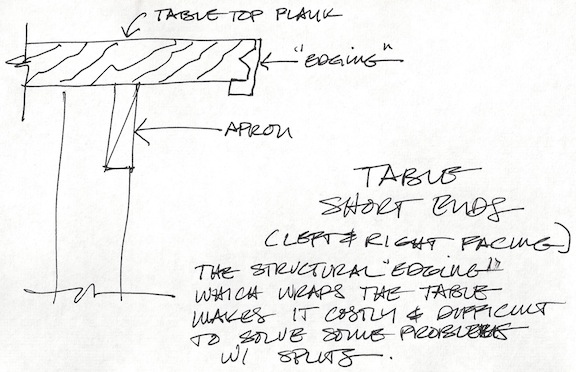
The edging helped hold the table together when it wanted to split, as shown below in image two. In order to repair some of the largest splits in the tabletop, we would have to remove the rabbeted edging, and we thought this was a very invasive procedure which might damage the edging, therefore, on the largest tabletop splits we proposed to insert butterfly keylocks in order to stop the splits from growing..

Some of the splits measured in at over a quarter-inch, shown below in the first image.

As you will see, there were other small repairs to be done to the structure of the table in order to stabilize the top and legs.

FINISH

Finally, the legs and top needed to be cleaned and finished as part of its preservation protocol, to bring it back to a proper representation of a historic antique which had been kept in good working condition.

REPARATION

Above, the table before treatment in what became our new finish room!

CARVED BLOCKS + STRETCHERS

Besides keeping the long edge tabletop boards from splitting, we also wanted to give the center boards some additional stability.

To that end, we created a system of carved blocks and stretchers (the latter shown on either side of the historic stretcher), as shown after reparation and finish treatment, right (because a picture is worth a thousand words).

The table was turned upside down during treatment, above, and that is the position it lived for all but the final cleaning and finish to the tabletop and legs.

2×6 clear vertical grain fir with a tangential grain face were used for the stretchers.

2×6 iroko boards were used for the carving blocks, shown above right.  Iroko wood, left,  looks very similar to the rusty-colored aged Myrtlewood, and yet it is hard and durable.

Both sets of 2×6 boards were glued together using hide glue, and clamped to cure, shown above.

STRETCHERS

Once cured, the fir was cut into the stretcher lengths needed: four long and four short, shown left.

Two long stretchers would supplement each end, which was left unsupported, shown below.  Two short stretchers wrapped each side of the center leg post, shown below.

Above, the long and short stretchers shown after both reparation and finish treatment.

CARVING BLOCKS

Carving blocks were created from iroko boards, laid together and glued using hide glues, then allowed to cure, not shown.

Proper sized blocks were cut, above left and right.

The placement of the blocks was laid out in chalk, and we realized that on some blocks an additional bit of iroko needed to be added; on historic items there are often anomalies in size, and as the CCC table was hand-made, this is not surprising.

The rough shape of the carving block was readied and fit to the final place in each spot on the historic table.

We decided to carve a motif similar to the trees used on the legs.

Kate drew a carving pattern on each block, shown above.

Mitchell began hand-carving the images on the hard iroku.

Once they were basically carved, we added our own design touches to the stabilizing blocks, by taking the edges off at an angle.  This also meant they did not hurt anyone who might bump into them while using the table.

Finally, the blocks were hand-sanded to further soften the edges, and remaining pencil marks were removed.

LARGE CRACKS

Large cracks were treated in two ways depending upon their depth and location.

MINOR LEG CRACK

While unsightly, this crack is not a danger to the structure.  However, it can be infested with pests if not filled, and to that end needed reparation.

It was filled with a repair paste we created  from carnuaba, tree resins (damar, sandarac, copal, and mastic) infused in larch balsam,  finely ground earth pigments, and tung oil.  It is a wonderful paste and lasts for years.  Though it is a very hard paste, it can be burnished.  Its melting point is 180-degrees, so it can also withstand sunlight.


STRUCTURAL SPLIT

The small missing chunk may have been the instigator for the split that developed on the end of the table shown right (after treatment).

The split was glued using warm hide glue (Old Brown Glue) injected deeply into the split with a sharp needle, shown above.

It was then clamped to cure overnight.

CORNER BLOCKS

One of the corner blocks was loose, causing the leg to be loose as well.

To that end, we repaired all the corner blocks in the same manner for more stability through the next many decades, by re-establishing a solid connection for the corner blocks.

FINISH

Below we show the steps of finishing the bare wood blocks:

Each step is shown in the images below, in the order of application.

Materials used:

We strive to use the least toxic chemicals in our studios, and Gamblin Artist Colors has a similar commitment to that ideal.  From their site, “(it) is made for products and processes that come into more intimate contact with the body…(it) is a petroleum distillate but all the aromatic solvents have been refined out of it, less than .005% remains. Aromatic solvents are the most harmful types of petroleum solvents.”

Final coats of wax were applied, shown upside down, left.

Damaged areas such as the one on the inside leg below, and the table top, were wiped down after skip sanding with Tried and True polymerized linseed oil with a bit of mahogany pigment added.

Everything was allowed to cure over a weekend.

ASSEMBLY

The stretcher supports and blocks were assembled onto the CCC table.

Holes were pre-drilled for the stretcher supports on either side of the table supports, shown above.

Blocks were secured from behind with screws, shown at the corners and with stretchers supports on either side, below.


AFTER

The table was ready for delivery to Crater Lake National Park.
Unfortunately, the offices the table was to occupy were under construction.
Above and below, before treatment, left, and after treatment, right.

Thankfully we took good images here in the studio, as the room it inhabited was
fairly cramped and we could not have gotten great images of the table after.
Above, you will notice that many blemishes and deep marks were left on the table top.  These deeper scars were part of the history of the table, and the NP was in agreement
not to completely erase the table’s history.
After Treatment, below.


DELIVERY

Loaded up and ready!

Delivering from Portland to Crater Lake is a long but beautiful drive.

Once we arrived, many people came out to see the table, and the men shown left helped us lift it.  This is something we find is true in all the national parks; the employees take pride in the objects and want to see it when it is back from treatment.

Mitchell polished one more time in the warehouse, above, where it was to live until it could be taken to the curator’s office, where it was to be used as a conference table.

©MPF Conservation.  May be printed for your own use.  You may republish; please notify MPFC and link back to this post with our url + copyright is used as reference.

Posted in American Furniture, antiques, conservation techniques, decorative motifs, history, preservation, process, reparation, restoration techniques, table, wooden objects | Tagged , , , , , , , , , , , , , , , , , , , , , , , , , | Leave a comment

Oregon State Capitol Textiles

MPF Conservation conserved several textiles for the State of Oregon, intended to be displayed in the Capitol building; Megan Atiyeh was our contact.

For more information on art shown in the Oregon State Capitol Collection,
see the short booklet by Megan Atiyeh.  Our projects are listed in the collection.

ASSESSMENT + DELIVERY

The initial assessment of the textiles to be considered was performed in a facility storing many State Capitol items, with Megan Atiyeh present.  Several artist’s textiles were considered, and three were chosen after estimates were proffered:

  • Judith Fawkes “Fawkes Eight”,
  • Marie Lyman’s “Desert Grasses”,
  • Heidi Fuhrmeister’s “Untitled”
Right, two of Judith Fawkes “Fawkes Eight” during assessment.
All of the items had identification labels on them, example below left. 

Most of the better assessment images shown were taken in the MPFC studio as we prepared for treatment, and after this we will not differentiate where the assessment image was taken.  For all textiles below, descriptions will be as follows:

  • LF-: Left-facing
  • RF-: Right-facing
  • Top and bottom are described as the directions when hanging
  • Front is the side that the artist chose to view
  • Backside is the side facing the wall

Our assessments covered necessary reparation and cleaning in all cases, though there was not enough money in the budget to cover all the repairs in all cases.

Identification labels were originally attached with a metal ring, which actually damaged some of the textiles.  They were removed during treatment and replaced before delivery using thick thread or yarns instead of a metal ring, left.

DELIVERY

After cleaning, each piece was rolled and wrapped in the best manner for its design, to be stored until installation.  All had support under the textile, such as is shown below for Heidi Fuhrmeister’s “Untitled”.

FAWKES EIGHT

The eight panels before treatment, above. 
The panels were identified with a thicker thread, example shown below left.

Eight woven tapestry blocks hung from square dowels, each block a slight variation of a plaid, in colors of blues, greens, pinks, orange, maroon, red, cream, grey, and yellow, shown before treatment above.

Panels were identified by a thick smooth cording with the eight initials, example shown left.  Because of what we presume was Judith’s choice in thread to identify the panels, we used a similar smooth thick thread from DMC or Gütermann whenever we had to sew a repair.

Some minor fading exists, probably due to the fluorescent lighting in the Capitol rooms, as it is more apparent at the top of each panel; no treatment will be done toward the fading issues.  Fluorescent lighting can cause fading over time, but are not the danger that sunlight poses.

Our intention was to repair torn, unraveling, or broken areas using appropriate techniques, then clean and block tapestries before returning for re-installation.

We also found several areas where the hem was failing, and in these instances we removed sagging threads and stitched those areas, not shown.

MPFC cleaned and repaired all eight panels during treatment, plus two of the wooden square dowels which were cracked.

PANEL B

We are focusing on repairs to panel “B” because it displayed the most damage.  The back of panel B is shown below, before treatment; note the unraveling edge on the lower hem, detail shown below right.

In all the sewn repairs, Kate used a slightly thicker thread to ensure that it did not cut into the woven materials, and also made sewn repairs (such as securing a long woven piece) on the backside.

Above, the stages of the largest repair, the unraveling RF-edge on the bottom of panel “B”; the woven bottom hem and front selvage edge had unraveled.

Note that three previous repairs were attempted, which we surmise is why loose warp yarns were braided and secured with cotton thread, shown in the second and third images above.  Green weft yarns are loose, shown above.

MPFC cut the hem thread 7-inches back to release tapestry for reweaving, not shown; threads used to secure previous repairs, such as the braid ends, were also cut.  It appears the artist wove the back layer into the front at the edges, which doubled the number of warp threads.

The treatment was performed with the piece pinned; without the benefit of a tapestry loom to secure the field, the repair became lopsided and tight from pulling warp threads through weft.  Black and cream weft yarn ends were braided loosely, then wrapped in order to tuck into the hem.

Prior to hemming, two pale pink and one coral pink repairs were completed, as shown above.  Stitching was performed on the backside so it did not show.

Final step before tying was to release the tension caused by the repair, and to space the warp and weft yarns into the proper spacing.  The long repair was complete, above, shown on the front and back side at the edges.

We were fortunate with pulls like the one above that no one had cut the long strands of wool, but instead tucked them behind the panel, shown image one. MPFC organized the warp yarns, image two, and wove the weft yarns back where they belonged with two crochet hooks.  Stitching to secure the repair was performed on the backside.

Before any repair was attempted, we studied the how the artist made her wraps and connections to try to duplicate it in our repairs, above.

Below, edges are balanced and appear much as they did when Judith first completed panel “B”.

CLEAN

MPFC  vacuumed the panels through a filter under low strength, above, to lift loose dust and debris with minimal damage to the fibers.

MPFC performed a wet test with with both deionized water and isopropyl alcohol to see if the dyes would run, above, on edges, and yes, there was enough dye run that we decided not to wet clean Fawkes Eight.

Because bug residue is laid into the textile wet, it is harder to removed with a vacuum.  Removing bug feces, embedded bugs, and the resulting stains (shown right) from all the textiles was a large part of our treatment; for small stains like the one shown right we would carefully use a wet cotton swab to lift residue that could mimic stains.  Residue could be removed using a dry mushroom brush then vacuuming immediately.

Above, residue from a bug long gone was gently removed using a mushroom brush.

Selective wet cleaning with a damp cloth wrapped around a finger is effective and does not move dyes, image two.  Finally, a slightly damp cloth is wiped across both front and back of each panel to lift residue surface dirt.

SQUARE DOWEL REPAIRED

Two of the square dowels were broken and were repaired, below.

COMPLETION

The Fawkes Eight’s treatment was complete, and sent back to the State of Oregon for assembly and installation.  Our project made the cover of the Statesman Journal, shown right.

BIOGRAPHY

Judith Fawkes, shown right, died in 2019 in Portland, Oregon.  The short bio below is “lifted” from her Obituary and Wikipedia:

“Judy exhibited her linen inlay, double weave and pattern weave tapestries since the 1960s, and beginning in 1989 she showed at Laura Russo Gallery, now Russo Lee Gallery… and taught weaving for many years at four colleges in Portland, including Lewis & Clark College.  (Her work) is included in numerous public and private collections.  She published Weaving a Chronicle, Schiffer, in 2012; in (it) she described the circumstances and techniques behind the tapestries she produced over five decades. Her work was inspired by the grid of the loom, Bauhaus, Renaissance tapestry, light through water, Italian gardens, Portland weather and the medium of flax itself.”

Along with the entry for “Fawkes Eight”, you can also see a sample of her husband, Tom Fawkes’ artwork in the Oregon State Capitol Collection (page 36), next to his wife.

Note: The protocol used in Fawkes Eight was repeated
in the next two textile treatments; we are not repeating the details,
but will say when protocol changes.

DESERT GRASSES

Marie Lyman’s “Desert Grasses” was created in 1977.  We consider it a quilt, though many sites catalogue it as “mixed media”.

It was 80″x84″, eight rows of varying sized fabric pieces in shades of golds, rusts, and browns, hemmed and backed with the soft brown shown in the hem on the backside right.  Fiber content was cotton, cotton blends, wool and synthetics.

During assessment there was a marked difference from the condition of the front of Desert Grasses to the backside.  Seams and the hem needed to be restitched in several places on the back.  The back was also abraded, and we found many moth holes on the textile, example shown top right, next to the seam.

Only one large hole (Repair “A”) appeared on the front, shown left.

The moth holes were difficult repairs because the weave was fine or had a ribbed texture, and we could not find proper matching yarn threads.

We developed a different protocol for the single hole on the front, versus the many holes on the backside.

To reweave Repair “A” on the front, MPFC devised protocol to pull enough threads from the seams under the hem, shown above.

MPFC opened the quilt hem to obtain threads from the edge.  Hem stitches were carefully picked from the backside of quilt with a sharp new stitch picker, image one above.  Five small pieces of weft were removed from the end of the hem area of the panel!

Shown above, the short weft yarns were woven as shown between warp.  Knots were not possible due to the short length of the thread, so were cut close to the panel.

The hem was restitched using a blind stitch and matching thread, shown right.

Two holes on the backside, referred to as Repair “C” and “D”, were located on the RF-back on the third row, two panels in, and were approximately ¼-inch and ⅛-inch, in the rust-colored wool twill.

Repair “C”, before treatment, left..

A second machine hem stitch ran through the top and back. Both were released for the repair, approximately 2-inches in either direction, so the damaged quilted piece could be accessed.

Rust colored cotton thread DMC was used as both warp and weft in the repair, woven on the diagonal.

The second hole Repair  “D” was treated in much the same manner, shown right and below.

Again, rust colored cotton thread DMC was used as both warp and weft in the repair, anchored in the hem area.

If a bit darker weft had been found possibly a better variation would be seen, but the changes in the degree of color were too great to show the woven shadows.  A simple darn was woven on the diagonal, to produce a shiny diagonal that would blend into the twill.

Repair “C” and “D” shown after treatment, left.

The repair was visible.  Another option was to replace the rust-colored panel, but was not advised.

Several moth eaten areas are documented which were not to be repaired during this treatment due to time and budgetary consideration; they were extremely difficult losses where the recommendation would be to replace the material or disassemble the quilt for reparation.

CLEANING

A general cleaning included the following:

  • A gentle brushing with the soft “mushroom” brush lifted loose surface debris, shown right;
  • Vacuuming the debris followed at low suction, not shown;
  • Spot wet cleaning, where possible.

Tests were done in safe areas for wet cleaning for dye movement, with both deionized water and isopropyl alcohol; no failures were seen during wet treatment tests.  Wet cleaning was performed with both, as was appropriate.

Spot wet cleaning was performed along edges and in specific areas, where frass, dead bugs and oils from handling (on edges) existed, shown above.

After treatment, above and below; below shows Marie’s’ labels.

BIOGRAPHY

Marie Lyman was born in Toldeo, Oregon in 1950, and died in 2000 in Astoria, Oregon at 50 years of age.

Over her lifetime she had many name changes, and we couldn’t find out their genesis:

  • Nyx Philomela Lymann
  • Nyz P Lymann
  • Delores Marie Lyman

She died as Nyx Lyman in 1992.

We were curious, and found Nyx in Wikipedia: “Nyx is the goddess and personification of the night. In Hesiod’s Theogony, she is the offspring of Chaos, and the mother of Aether and Hemera by Erebus.”

Her art does not appear chaotic, but orderly in a non-traditional manner.  She was a quilt artist, fascinated by textile history and particularly interested in Japanese textile traditions, from folk art to garments to embroidery.  She passed that interest on to her students, teaching at the Oregon College of Art and Craft in the 1970s and 1980s.  The blue quilt, “Morning Light”, 1975,  shown left is in the Smithsonian.

Marie Lyman’s “Desert Grasses” can be found on page 50 in the Oregon State Capitol Collection.

FUHRMEISTER’S “UNTITLED”

As Heidi Fuhrmeister’s “Untitled” was unnamed, we will refer to it as “Fuhrmeister” in this post.

It is a large woolen woven piece, 51″ x 74″, in shades of purple, maroon and dark blues; after weaving it was then quilted, which accounts for the puckering of some squares in a pattern across the surface.  It hung top and bottom on wooden rods.  Because of the height we were never able to hang it in our new textile room in our studio and therefore never photographed it in its entirety; it is shown below during reparation, taking up our longest tables.

.

Unlike Desert Grasses, above, we could not scavenge yarns from Fuhrmeister.

Instead MPFC  bought many variegated and heathered wool yarns from several brands, including a locally made multicolor wool, left, and found bits that matched the wools in Fuhrmeister. Reweaving was performed using the new yarns mixed with existing yarns around the damaged areas and the treatment was successful.  The yarn was split into fibers the appropriate weight for weaving and repair.

Several “mistakes” in the weave were located during the thorough examination, mostly in the form of a weft yarn that skipped two warp threads, examples above.

REPAIR A

We were to repair several moth holes.  We are documenting two holes in this post.

One was located on the RF-side on the bottom, approximately ¼-inch, shown above and right.

The other was slightly smaller, shown below.  MPFC believes both holes were caused by moths.

We filled in the holes by extending the weaving yarns out 2-3 strands and in-weaving warp and weft in matching yarn threads, as shown above and below.

The hole shown above was located on the LF-side approximately ⅓ of the way from the bottom and 14-inches into the panel, shown during reparation above.

One repair that was not made were the few long strands of warp that are left unwoven and are held by the bottom support, shown left.  Because they were not long enough to be placed back into the clamped support, we did not take it apart and attempt it.

WOOD REPARATION

The wood support at top and bottom needed reparation: scratches and color loss existed in several places, a sample shown right, before.

MPFC did not want to remove the piece from its support, and so carefully applied pigmented wax in the scratched areas, shown above.  The wax was allowed to set then the excess was carefully buffed.

CLEANING

Each panel was vacuumed; the gauze was replaced frequently.

Tests were done on the fringe for wet cleaning for dye movement, with both deionized water and isopropyl alcohol, shown below.  Only very slight dye failures were seen during wet treatment tests.

Wet cleaning would be performed with both, as was appropriate.  Isopropyl alcohol was used as a treatment over moth holes and where webbing existed, in order to kill potential eggs.

BIOGRAPHY

Unfortunately, little information could be found on the Oregon artist, Heidi Fuhrmeister, then or now.

Heidi Fuhrmeister’s “Untitled” can be found on page 38 in the Oregon State Capitol Collection.   Note: The Fuhrmeister tapestry is not green as described on the Oregon Libraries site!


 dkatiepowell  @  aol.com / mitchellrpowell  @  aol.com
(So sorry, but we got too much spam — please copy and remove the spaces!)
503.970.2509 / 541.531.2383
©MPF Conservation.  May be printed for your own use.
Notify us if you repost, and use our url + copyright in reference.

Posted in antiques, conservation techniques, decorative motifs, French Furniture, Interim Report, painted furniture, painted objects, preservation, process, reparation, restoration techniques, upholstery, wooden objects | Tagged , , , , , , , , , , , , , , , , , , , , , , | Leave a comment

MCM Wormley Circular Desk circa 1950

Dunbar created the Circular Desk, shown above, before treatment.  It was designed in the fifties by Edward Wormley, AIA, 1907-1995.  The teak desk had its original leather intact, a real find!  The desk is teak wood with built-in bookshelves, and hinged drawers which swing open (photos throughout).

“Modernism means freedom—freedom to mix, to choose, to change, to embrace the new but to hold fast to what is good.” Edward Dunbar, from collectdunbar.com.

Wormley was an architect and furniture designer, along with others such as Eero Saarinen and Charles Eames.  Wormley worked solely for Dunbar.  From collectdunbar.com,  “Rarely does a prominent designer collaborate with only one manufacturer. The DUNBAR and Wormley relationship lasted over 30 years. As such, Wormley’s primary body of work is related to and owned by DUNBAR.”

This is a great post for Throwback Thursday!

For the desk below, descriptions will be as follows:

  • LF-: Left-facing
  • RF-: Right-facing
  • Top and bottom are fairly evident
  • Front is the side that a guest would approach
  • Backside is the side where the person sits to write

ASSESSMENT

One item brought the desk to us; a puppy scratch on the lowest book shelf, shown below in images at our client’s home.

The desk was in otherwise good condition, however,

  • there were veneer issues on the bottom rosewood plinth on both sides, and
  • hinging issues which threatened to fail if not treated, shown below in REPARATION.
In studio before treatment, above and below.


REPARATION

VENEER

Above, the veneer which was hanging by a thread was removed.

New veneer was created from rosewood, matched both in grain and in thickness.

It was then cut to fit the missing veneer, left.

The area it was to fill was prepared, that is, cleaned and trimmed to accept the veneer.

Once ready, the veneer was cut to the exact size of the loss.  Hide glue was applied to both the bare plinth and the veneer.  It was then set into the loss, clamped and left to cure for two days, shown above.

Once the clamps were removed, the rosewood was colored with dyes to match the surrounding historical veneer, right.

In the two areas where the veneer lifted but was still viable, shown above and below, Mitchell inserted hide glue under the lifted veneer, shown left.  This softened the veneer enough that it did not crack.

The glued veneer was then clamped to cure and left for 24 hours under clamps.

The veneer replaced, right, but before finish work.

We finished the new veneer plinth with pigmented shellac, not shown.

FYI, the name Dunbar is stamped under the center drawer, shown left.  The downside to stamping a drawer, is that if the drawer is lost, the piece goes unidentified.

We thought that it would be interesting to share the underside of the desk for those interested in Dunbar’s furniture; it is a side you never see!

HINGED DRAWERS

The hinged drawer had been brought to us before the drawer ripped out, which would have caused serious damage to the veneer and drawer structure.

The hinged drawer which is on its way to becoming unhinged, above.

Mitchell removed the hinged drawer, above left, and repaired the hinge (not shown).  It was a matter of thoughtfully considering what parts of the hinge needed to be gently moved back into place.

In fact, a good deal of our work is patiently considering the object, and really looking at what might not be aligned or missing a part.

The desk bore holes were conserved in anticipation of reattachment, image two.

After both hinge and drawer were repaired, the drawer was reunited with the desk.

SCRATCH

The worst issue with a puppy scratch, shown left, is that unlike a surface abrasion it had the weight of a paw crushing the grains.  this was also a cross-grain scratch, which cut across grain lines, making them hard to reestablish.

The first thing we did was use warm water only on the scratch to raise the grains if possible, not shown.

That helped some, but not enough.

Kate mixed a shellac to infill the scratch, shown right, and used a tiny brush to fill the scratch, shown above.

We recommended the desk be cleaned after treatment and polished to bring up the lovely original finish; other finish issues were declined to be treated.

Below, a detail of the area before and after treatment.

AFTER

Hinging mechanism once again working, above;
below, the beautiful desk after treatment.


INSTALLATION

Our clients were delighted with the results; the desk back home again, below.


 dkatiepowell  @  aol.com / mitchellrpowell  @  aol.com
(So sorry, but we got too much spam — please copy and remove the spaces!)
503.970.2509 / 541.531.2383
©MPF Conservation.  May be printed for your own use.
Notify us if you repost, and use our url + copyright in reference.

Posted in American Furniture, antiques, conservation techniques, decorative motifs, preservation, process, reparation, restoration techniques, wooden objects | Tagged , , , , , , , , , , , , , , , , , , , | Leave a comment

Washington State Flag

HAPPY INDEPENDENCE DAY!

Just in time for the 4th of July, we have posted the painting
of the reproduction flag MPFC painted for the DAR
of George Washington which will hang in the State Capitol,
allowing the historic flag to be retired permanently for conservation
and safekeeping; go to Washington State Flag or click on the image below.

Aren’t you just a little curious about Green George, above?

©MPF Conservation.  May be printed for your own use.
May be reposted if our url + copyright is used as reference.

Posted in antiques, decorative motifs, Interim Report, painted objects, process, reproduction, textiles | Tagged , , , , , , , , , , , , , , , , , , | Leave a comment

Antique Quilts: Care and Repair

This article is an update of our old article!

Kate at the Hillsboro Museum, above; members brought their quilts
and asked questions and/or had a quilt assessed.

The advice in this post is referring to antique quilts, though it might apply to modern quilts.  If you are given a quilt, this information can guide you in asking the person gifting you questions which will assist you in taking good care of your quilt.

Right, Kate darning a hole in the the back of the antique Star of Bethlehem quilt.

We offer guidance to caring for your quilts, and these of course apply to many other textiles.  The following will be covered:

  • Handling
  • Strike a Balance: Display or Use?
    • Provenance
    • Fading
    • Best Choices: Ideas
  • Environment
  • Foxing
  • Mold
  • Pests
  • Repair, Restoration, Conservation
  • Storage
    • Displays
    • Boxes and Tissues
    • Folding
  • Cleaning
    • Hand-Washing in Cold Water
    • Vacuuming
    • NO Dry Cleaning
  • Other Resources

Remember, we specialize in the repair of antique quilts, in keeping with the antique quilt’s year of birth and using traditional techniques, and all are hand-stitched.  Our estimates for repairs are usually free.  Contact Kate at 503-970-2509; her email is dkatiepowell  @  aol.com (So sorry, but we got too much spam — please copy and remove the spaces!)

HANDLING

Above, Mitchell assessing a Bengali Quilt from the Campbell House
(a house museum in Spokane, Washington); everyone used the protocol below.
  • When handling a very old antique quilt, use clean cotton gloves or latex gloves.  If you do not have these, wash your hands, do not use hand cream, and do not touch your face or hair (body oils).
  • Always assume the quilt is fragile, and to that end:
  • Especially if it is a large fragile quilt, have help in carrying and opening the quilt.  Have the area you are going to unfold the quilt prepared ahead of time: topped with a clean sheet (no softeners or bleach) if possible, and free of objects.
  • Never grasp at a fragile textile with your fingers; use your broad hand splayed open to lift, fold or cradle.
  • Make sure you do not have anything on your body that is sharp and can catch the quilt and rip it as you handle it — rings, watches, etc.  I have been known to take off belts as well if I am working on a textile so that I do not lean over it and catch a sharp part on the textile.

STRIKE A BALANCE: DISPLAY OR USE

Caring for a quilt is a balance between protection and use. Often I caution antique quilt owners not to use their quilts, not even to use them in a spare bedroom.  You might think that extreme, but we suggest you look at the age and condition of your quilt, and ask yourself the following question about your antique quilt:

  • Is it an heirloom quilt?
  • Is it a fragile quilt?
  • Are the seams intact?
  • Is the environment in which it is going to be displayed safe, that is, free of children and pets or adults who are rough on furnishings in general?

If the answer to any of these questions for an antique quilt is yes, then it is not advisable to use the quilt!

Susan’s Crazy Quilt is a mixed materials
quilt with crewel work, shown left.

First, assess the quilt.

If the quilt is in reasonably good condition and not threadbare, ripped, or having issues with seams coming apart, then it may be a candidate for gentle use or display.

But, if your home is full of pets and small or unruly children (or adults), then it is advisable to keep a family quilt tucked away until the children are old enough to learn to be careful with an older quilt, or the adults have moved on!

Next, is it a cotton quilt (shown below), or is it made of mixed materials (cotton, silk, velvet, crewel work, embroidery), such as a Susan’s Crazy Quilt, shown left?

Mary’s Antique Log Cabin Quilt,
shown right, was an exception.

Mary’s was a double bed sized quilt, and while there was normal wear and tear from daily use, the family took good care of the quilt.  MPFC restored the degraded pieces because Mary wanted to be able to gently use it.  Mary’s environment was a good candidate for gentle use, and she wanted to follow our advice on the environmental requirements.  The quilt now graces the top of her guest bed.

An antique quilt with a lot of embroidery or crewel work might be a better candidate to display behind glass, or remove (store) when inappropriate people are visiting.

PROVENANCE

This brings up the unfortunate issue of hiding it away.

Over the years I have gotten many calls where someone found a quilt tucked safely away in a closet after a relative died, and they know nothing about it!

They want to know if I can tell them about their family quilt, and of course, I can tell them some things relative to design and age, but not the provenance (who made it, their relationship, their location).  This is sad, because if the quilt had been maintained in good antique condition, it might have been gently used or brought out and displayed when a family gathering occurred, and the story of the quilt would have been told to people in the family.

An aside, for fun, on the topic of provenance or for quilt lovers, the film How to Make an American Quilt is excellent!

FADING

The largest amount of fading comes from direct sunlight, even if the light does not hit the quilt directly, if it fills the room then it can fade a quilt.  Northern exposure is best to combat fading, but even northern sunlight can eventually cause fading, but very very slowly!

By the way, so can fluorescent lighting, and some other kinds of lighting — but again, to a lesser degree that direct sunlight.

BEST CHOICES: IDEAS

If you have a guest room, preferably with northern exposure, where you can keep the door safely locked from small children and pets, then displaying it on a bed will not harm it.  Cover the top of the guest bed with a clean sheet or clean light-colored bedspread devoid of perfumes, bleach or softeners, and gently open the quilt on the bed, remembering not to pull or tug on the quilt to center it.  Ask a second person for help if necessary.

Specialty display boxes can be made to show off your quilt and protect it; a conservator can tell you if it is strong enough to hang gently over a painted pole.

Displaying it on a wall behind glass is another option, where pets and children cannot reach it, and again, the room should have northern exposure.  The simplest way is to create a hanging mount from a 4-inch or larger rod mounted to sit 6-inches or more from the wall, sealed with acrylic paint.  The glass can be a framed piece that hangs over the quilt.  You can place the folded quilt over the rod, but be sure to unfold and change the display of the quilt seasonally to ensure that the quilt does not fade in one quarter!

Any other display should be created with the advice of a conservator, curator or other professional.  The best way to find out who in your community might have experience creating displays is to contact your local museums or art galleries and ask who they use for display boxes, or a seasoned quilting society.  Some historical societies have lists of members who have experience with antiquities.

W12 ES Cigar Quilt 1When in doubt, always ask a conservator before proceeding.  Most conservators will offer assessments at a low rate, many will answer a question if when they are not busy.  An hour of their time might save your heirloom.

We are available for consultations, or you can find a conservator in your area here: https://www.culturalheritage.org/about-conservation/find-a-conservator

An antique silk cigar quilt, right.

I like to tell clients a good rule of thumb is to treat your antique quilt like you would your grandmother:

  • She doesn’t like to be too warm to too cold (don’t leave her in the attic or basement)
  • She doesn’t like to be left out in direct sunlight or rain
  • She doesn’t want to be stuck in the basement, attic or the garage (the latter is full of carbon fumes and dirty items, even if you keep yours clean)
  • She wants to be handled with care
  • She doesn’t want to breathe smoke, steam, or airborne grease.

Taking care of an antique quilt is not as hard as it sounds, if you follow sound advice.

Notes on cleaning are at the bottom!

ENVIRONMENT

Remember, sunlight and fluorescent lighting causes irreversible damage to fabrics, and silk is especially susceptible.  Fading, brittleness and splits are all evidence of light damage.  If your quilt is eligible for light use or year-round display, make sure the room’s windows are north-facing, and draw the drapes when the room is uninhabited as even ambient light is hard on older fabrics.

Our family’s 200-year old Crazy Quilt, left, is in good condition mostly from being stored
properly, even though it lived for a half century in a California beach community.

Ocean salts can be detrimental to quilts, and so, fragile quilts should not be displayed unprotected year around in a seaside environment.

Smoke and accumulated tars, whether from cigarettes, pipes, cigars or wood stoves, are extremely damaging to textiles.  If your home is one in which this is a frequent occurrence, it is not advised to display your quilt unless you can do so behind glass or completely away from the smoke.

Keep antique quilts away from a kitchen and wood stoves, as steam, heat, and grease can accumulate and/or add to the dust and debris that is normal to a home causing stubborn stains which may not be able to be removed.

All of the advice above for antique quilts can be applied to other textiles!

FOXING

Foxing exhibits as a small dot-like stain that many people think is rust.  Zerophilic fungi create the rust-colored spots, which are not rust, but the result of a melanin type exudate.

Unlike mold, foxing cannot harm living beings, as in family members or pets, but foxing can be spread from one item to another.  If you notice foxing on a quilt place it in a separate container such as a textile box or blanket bag, and wash your hands before handling other textiles or paper.

Foxing and molds on a suitcase liner, left.

W MOLD AND FOXINGIf you must place a foxed item in a storage container or cedar chest with many other items, consider using a plastic bag, but wrap the item in a clean sheet before placing in the plastic bag.  Plastic is not usually recommended, but as a last resort can be used wisely if you are protecting your items from a spreading fungi.

NOTE: Clients often ask about bleaching these foxing spots.  Do not try this!  Hydrogen peroxide or bleach may reduce the color a bit, but will weaken the fibers in the cloth and potentially ruin your quilt.  Contact a conservator!

MOLD

If your quilt is ever drenched (broken pipes, roofing problem or flood) contact a conservator immediately.  Do not lift it from a bed or a storage box unless you see dyes running or there is no one to contact.  In that case handle as discussed above, and carefully lay out on a clean pale sheet to dry in normal temperatures out of direct sunlight, without a heater.

Mold is potentially dangerous, and also can spread.  If you find mold on an antique quilt contact a conservator.

Notes on cleaning are at the bottom!

PESTS

Insects (including moths) can be found in adult or larvae stages.

They can be kept at bay with a drop or two of cedar oil or pure essential oil of lavender, refreshed monthly.  Lavender or cedar oils interrupts the insects ability to find one another and mate.   KEEP THE OIL FROM TOUCHING THE QUILT!   I keep mine away from the objects in storage by placing the lavender essential oil on a tissue, then placing the tissue in a sturdy small clean paper box (think of a jewelry sales box), so that the oils cannot come into contact with the objects but the scent disperses.  The trick is not to use to much oil, so that it does not seep through the box.

If you find textiles harboring insects, they should be immediately wrapped in a clean sheet and placed in a plastic bag, isolated from all other textiles, and treated by a conservator.

Regarding cedar chests, see below in STORAGE.

REPARATION, RESTORATION, CONSERVATION

From time to time repairs are necessary in order to save a quilt.  Rips, tears, loose seams, missing quilting are all items to possibly repair, such as the tear below right.

If you decide to undertake any small sewing repair yourself, use a brand new, very small sharp quilting needle.  Most people do not retire their needles often enough, and needles become dull quickly.

Use cotton or silk thread, whichever is appropriate for the textile, and never polyester thread.  Cotton and silk will expand and contract with the quilt fibers, but polyester does not, eventually abrading the fibers.

Make your stitches even and do not pull them too tight.

Below, Mary’s Log Cabin Quilt during repairs. 

STORAGE

Do not store your quilts (or any textile) in an attic!  Heat and possible carbons can penetrate storage containers and make the fabric brittle.

DISPLAYS: see ideas above in “BEST CHOICES: IDEAS”.

BOXES + TISSUE

To properly store a textile, you need acid-free tissue and acid-free boxes.  Do not store quilts long term in plastic bags (though if you find pests in the quilt you can set it into a plastic bag for a short time — a few weeks — while you get advice on ridding the quilt of pests).

A common problem we encounter is clients who tucked a quilt into a Cedar Chest for safekeeping, hoping to keep away the moths and other insects.  Wooden boxes, and especially cedar, contain acids, oils and resins which continue to fume for years, even when you cannot smell the cedar scent.  This is wonderful for pest control; unfortunately, woods continue to leach out color in their resins onto the quilts.  We have seen clients who placed quilts and other keepsakes into their hope chests and come back to them years later and find large swaths of brown-orange stain on the quilts.

For this reason, you want to keep your quilt protected from touching the wooden sides of any chest in which you store it.  We recommend acid-free boxes (see below).

FOLDING

A quilt (or other textile, if you adapt the method) may be folded and placed in undyed unbleached/unstarched muslin, but we prefer acid free paper, because it can be refreshed seasonally or at last once a year.

The folds should be padded from the inside with acid free paper to avoid permanent creasing and splitting, especially if the fabric has been painted or has a very crisp details, such as is shown left, in Kate’s Great-grandmother’s Crazy Quilt.

We use a two-part method.  For each fold made::

  • Lining the flat side to be folded with acid-free tissue;
  • Creating an acid-free tissue roll that is about 3-inches, which is tucked into the fold.

NOTE: Storage alternatives in the USA have disappeared, or are s
o outrageously expensive that they are not an effective alternative.
Until we find an alternative, these are our best suggestions:

Don’t fold the quilt too tightly.  Buy a box that is large enough to take your quilt, at last 24″ x 36″ or 30″ x 30″, and tall enough.  If you fold your quilt ahead of buying the boxes and measure the folded dimensions, you will know what size will fit your quilt.

Maintenance: Seasonally, or at least once per year, the quilt should be removed from storage, refolded (in a different pattern) and fresh new acid free tissue paper used to minimize damage from creasing.

Textiles expand and contract with humidity shifts and temperature shifts.  At risk, fragile or brittle fibers should never hang or be folded tightly as the folds can cause abrasion of the strands and damage quilts that are sitting in boxes without human interaction.

Do not store quilts long term in plastic bags (a short time to contain pests is fine, see above on PESTS) due to moisture from condensation or fumes from plastic.

An Acid-free box is best, but there are problems getting them now, in 2025.  Most companies are not carrying large enough boxes for a quilt.  We used to suggest acid free boxes from Talas, but they have become too expensive for most people, especially with shipping.  Until we find a good acid free alternative, wrap your quilt in a clean unbleached sheet inside an open box in the bottom of the cedar chest, or set it wrapped on a high shelf in your bedroom closet.  I suggest placing a few drops of pure lavender oil next to it on a tissue, and replenishing the lavender frequently.

If you can find a large enough container such as this Sterilite Storage container, which seals completely from pests, then wrapping your quilt in a clean non-bleached sheet and placing it into the container with lavender is a good interim solution.

Never use the vacuum-seal bags on any antique textile!

The following items should never contact the quilt in storage:  brass pins, iron, wood, newsprint or newsprint paper, post-its, unwashed cloths, plastic films, acidic tissue papers (including anti-tarnish tissue papers with a pinkish cast), labels, tapes, or brightly colored textiles that might leech color.  All will cause irreversible damage.

Provenance is the history of the item:  age, who made it, what family members it was gifted to or who purchased it and the maker, materials, and any other or notes about the quilt can be written in pencil on white or natural colored  paper and placed on top of the tissue or taped inside the box.  If you have a hand-written item that was written in pen from another family member and want to keep it as provenance with the quilt, slip the note into plastic before storing it in the box.  Never use Sharpies or other ink pens near textiles.

Above, Kate trying to remove dyes which ran when a person tried to clean a
lovely modern quilt,  and the green dyes ran.  Unfortunately, the experienced quilter had
not tested the fabrics before using them to see if their dyes were prone to running.

CLEANING

First, remember we are discussing antique quilts.  Not a quilt made in the last fifty years, though precautions are still a good idea, as shown in the modern quilt above, where a very experienced quilter washed her quilt and the dyes ran..

HAND-WASHING IN COLD WATER

If a family quilt made from cotton is given to you, ask questions about whether they have ever washed the quilt.  If they have washed it and had no issues with migrating dyes, then it is a good chance you will not have these issues if you hand wash the quilt.  If they haven’t, assume that you should ask a conservator if the quilt can be washed.

Do not ever wet or dry clean a crazy quilt or other quilt made from silk or many materials, or one that contains crewel or embroidery.  Ask a conservator.

If you decide to hand-wash a quilt after verifying it is cotton and that it has been washed previously, wash it is a clean bathtub, making sure that after the tub is cleaned you thoroughly rinse the tub from scrubbing cleansers.  Place the STURDY quilt into the tub, and use a gentle detergent such as Orvis WA Paste (it comes in HUGE containers, lasts forever, and is excellent on other delicates as well)!  The quilt can be loosely folded, because unless you have to GENTLY work a stain, you will be agitating the quilt gently with an up and down motion.

If you have to work a stain, use a mushroom brush — used only for gently washing stains from delicate materials — because the scrubbing motion is gentle enough that it does not remove the skins from mushrooms!

When rinsing, make sure you completely drain and refill the tub several times., gently agitate to move clean water through the quilt, all to ensure that no residue of detergent lingers.

For items like crazy quilts (many types of fabrics) or a silk quilt, assume that you should not wash it.  EVER!  Instead, try vacuuming!

VACUUMING

Dust and dirt can do a great deal of harm when it becomes embedded in a textile.

Once or twice each year, thoroughly but gently vacuum your antique quilt, which also gives you a chance to inspect it if it is in storage.

Image from the Victoria and Albert Museum

Image from the Victoria and Albert Museum

To do this, lay the quilt flat on a large table or a large bed covered with a clean sheet (with no starch or softener added during washing cleaning.)

Purchase a small nylon screen (fully edged); make doubly sure that there are no edges with which to snag textiles.  Wash it with soap and water, then make sure it is completely dry for 48 hours.

Using a canister (hose-style) vacuum cleaner to vacuum the quilt through the screen, attach an upholstery attachment tool. Turn on the vacuum on the lowest possible suction.

We bought this model: the Green Label Brand Micro Vacuum Accessory Kit Compatible with Dyson Vacuum Cleaners, but it is no longer available from this site. 

Suction can be controlled by an adjustment slider on the wand — set the holes to the open setting and test it, then move it to the lowest suction for an antique quilt.  Do not rub back and forth.  Lift the screen to reposition it instead of dragging it across your textile.  Gently turn it over to vacuum both sides.

NO DRY CLEANING!!

Dry cleaning tumbles all items in a chemical bath as part of the process, and neither chemicals nor tumbling are advised for any antique quilts.  Common dry cleaning solutions can dry fibers and very little research has been done on the long-range effects of dry cleaning, which is one reason why it might be best for a conservator to clean the quilt or recommend a cleaner that uses a gentle solution meant for antique fibers.

There are specialty cleaners in larger cities; ask them if they hand wash and air dry their quilts flat (which you want), or tumble the quilts.  If it is the latter do not have them clean your quilt.

The dyes used in older fibers and quilts are not necessarily water-fast and may run on adjoining areas.  Wet cleaning quilts is not advised.

Other resources for your perusal can be found here.  Two caveats:

  • MPFC may disagree with even good publications, especially older ones.
  • Stay far, far away from DIY sites, such as reddit, quora, eHow, and even Martha Stewart.  Do not trust AI, because they glean information from the internet and you don’t know where the information is sourced.  Any one of them may have good ideas, but I cannot endorse them at this time.

Resources to trust:

Our pick for an all-around book to have in your home as a guide to caring for many antique items is Don Williams’ book, Saving Stuff: How to Care for and Preserve Your Collectibles, Heirlooms, and Other Prized Possessions, New York, NY: Fireside. 2005   If you choose to follow any of his recommendation on DIY, follow them exactly, especially any advice on taking care of yourself when using a chemical.

Victoria and Albert Museum: Cleaning Textiles

Smithsonian Institution:

I do not recommend their Stain Removal page, as it encourages someone with no training to venture forth.  I believe a layman might cause damage with the information attached.

American Institute of Conservation has pages of free downloadable information about many items, including Textiles, however you can get lost in technical language.  The following are user-friendly:


   dkatiepowell  @  aol.com / mitchellrpowell  @  aol.com
(So sorry, but we got too much spam — please copy and remove the spaces!)
503.970.2509 / 541.531.2383
©MPF Conservation.  May be printed for your own use.
Notify us if you repost, and use our url + copyright in reference.

Posted in antique quilt, conservation techniques, decorative motifs, preservation, process, quilt repair, reparation, restoration techniques, textiles | Tagged , , , , , , , , , , , , , , , , , , , , , , , , , , | Leave a comment

CRATER LAKE CENTENNIAL QUILT REPAIR

The center of the Crater Lake Centennial Quilt after treatment, above.

Not all quits brought to us are antique quilts.  Sometimes they are special project from one of our institutions.  Our repairs still are in keeping with the quilt’s year of birth and techniques, and in this case, the repairs were all hand-stitched.

The Crater Lake Centennial Quilt was such a project.  It was made for the anniversary of the park by park employees and friends of Crater Lake National Park.

Each square depicted as aspect of the park, from critters and flowers in the park, to the fabulous views, to the schools for the park employees children.

It was traditionally quilted using fabric, and also made with photo-images on fabric and quite a lot of embroidery. Designs were both traditional and modern.

The Centennial Quilt visited many National Parks on a year-long tour.  After touring, the quilt had several stains and a few tears.

MPF Conservation repaired the rips and separations in the squares, then cleaned the quilt before it went on permanent display at Crater Lake National Park.  In this instance, the NPS did not pay for documentation, so minimal images were kept, other than before and after images; these are all images after treatment.

Below these are the individual images after cleaning and repair:

To return to Crater Lake National Park home page on MPFC’s website, click here.

If you do not know historian Douglas Brinkley, left, this is an excellent time to learn about him. We rarely plug authors, but Brinkley has entertained and informed us with so many excellent narratives on America!

Brinkley has written an excellent book on Theodore Roosevelt’s creation of the National Parks. We are lucky that Roosevelt set aside 230 million acres of wilderness between 1901 and 1909, and Crater Lake was part of that effort!

The Wilderness Warrior: Theodore Roosevelt and the Crusade for America” (link for book is to Amazon), or listen to it on Audible with an excellent narrator.

Links to interviews on CSPAN below:

Image top left of Douglas Brinkley, February 13, 2020.
Photo by Shawn Miller/Library of Congress, from Wikimedia

COMING SOON: Other antique quilt blog posts!


   dkatiepowell  @  aol.com / mitchellrpowell  @  aol.com
(So sorry, but we got too much spam — please copy and remove the spaces!)
503.970.2509 / 541.531.2383
©MPF Conservation.  May be printed for your own use.
Notify us if you repost, and use our url + copyright in reference.

Posted in antique quilt, conservation techniques, decorative motifs, Interim Report, preservation, process, quilt repair, reparation, restoration techniques, textiles | Tagged , , , , , , , , , , , , , , , , , , , , , , , , , , , , , , | Leave a comment

STAR of BETHLEHEM QUILT RESTORATION

The antique Star of Bethlehem Quilt was brought to us for repair, a family heiroom.

Above, before treatment, left, and after, right.
Note that I rotated the before image so it aligns with the cleaned
quadrants of the after image.  I found it impossible to keep track of the four
quadrants after the post-it marker was lost moving the quilt one day!

The quilt is a beautiful example of a traditional pattern that goes back to the 1800s.  Made of hundreds of small diamonds called a rhombus, culled in pulsating patterns, it is a challenging pattern.

The added bonus are the four corners, where our client’s seamstress showed her hand-stitching skills a beautiful floral pattern, shown right, which Kate began calling the Sun (in juxtaposition to the star).

The entire quilt is hand-stitched, not machine quilted, no small feat.


ASSESSMENT

To assess and with intention to repair the quilt in an orderly fashion (best laid plans), Kate divided the quilt into four quarters, but as she worked on it the quarters were change, and the right-facing side of the before images below became the bottom two quadrants.

Shown below, the four quarters:

The quilt is in good condition when you consider it was used on a bed daily and is over a century old!  Several issues stand out, however:

1) An occasional rip or threadbare area, which Kate tried to stitch in all cases.  As careful as she was during the assessment, she still found a few threadbare areas while stitching seam repairs, usually in very pale pieces, or on the white areas around the star itself.

2) The biggest issue is loosened stitches on the seams between the rhombus fabric pieces, example shown right.  In the assessment images these are indicated by the small bits of green paper with no writing on them.  Kate advised a not-to-exceed budget be allocated for the restitching of some of those indicated, and she would make the determination as she was stitching which areas actually need to be restitched.

The loosened stitches were overwhelmingly in the bottom half of the quilt, probably because at one time it may have been held while hanging in a manner that pulled the weight, or this was typically at the top or side of the bed, and so pulled or sat on more frequently.

Kate would not remove existing stitches, but over-stitch between viable but loose stitches.

We noticed that there were several areas which had been previously repaired, such as the one shown left.

3) The quilt is extremely dirty, and we are advising hand-washing.  There are several stains, and it is unlikely, given they have been in the quilt for decades, that they can be completely removed, but the general accumulated dirt should release and they will be lessened.

The stains appear to be spills, mostly, tea or coffee, and blood spots, shown image 4 above, and unknown stains, image five above.

In Quadrant Three, there is new puppy urine, shown in the first three images above.  Kate assumed this was new because it still had a strong urine smell to it, so it had never been washed out.  Examples below:

ASSESSED ISSUES:

Not all issues are shown below.  Quadrants have changed.

Quarter 1 (now Quarter 2)

12 sides loosened; 2 small rips or tears or threadbare areas to repair:

Quarter 2 (now Quarter 3)

10 sides loosened; 1 sizable rips /hole in body and into the edging to repair:

Quarter 3 (now Quarter 4)

15 sides loosened; 3 small rips or tears; 1 sizable rip in the edging to repair; and lastly, one area (sixth image) which has some quilting stitches missing, and I would like to restitch them to complete the “sun”:

Quarter 4 (now Quarter 1)

18 sides loosened:

FOXING

We do see some foxing, shown left.  Foxing exhibits as a small dot-like stain that many people think is an odd rust stain.  Zerophilic fungi create the rust-colored spots, which are not rust, but the result of a melanin type exudate.  Foxing cannot harm living beings, as in family members or pets, but foxing can be spread from one item to another, though not easily nor quickly.

Note: It cannot be removed.  BTW, do not use bleach, ever, on foxing.

This means that if you display a quilt with foxing on a wall, for instance, it should be placed in a room separate from other old quilts, not near a library area, and not near other hanging textiles.  Wash your hands before handling other textiles or paper.

TREATMENT

REPARATION

In this post we are showing a smattering of examples of treatment, not all the areas treated, as they would be boring, many many images of stitching seams!

Stitching loose seams come in small areas, above, to areas of 4-5 rows of loose stitches, below.

Above, process images of one of the lower areas in Quadrant Three where the center branches out into the star points; the point where the two meet is where the most stitches were loose.  In this case five rows of rhombus pieces of fabric had to be stitched.

Kate made sure that all areas were stitched by placing silk pins in the seam areas that needed to be tightened, so she could see the area from left to right, top to bottom:  red polka dot, apricot floral, orange floral, pink floral and black polka dot are the rows that were stitched in this quadrant.

A small quilt needle was used to stitch the 1/32″ stitches.

Right, a small threadbare area exposed during stitching and repaired.

Note: For some reason in many images both with and without flash the red-with-white-polka-dot pieces look purple; below, the color is much closer to accurate.  


Above, process images of a large hole and rip both front and backside being stitched;
Below, the area after treatment and before cleaning.

One of many small threadbare holes in the white body of the quilt, above.  When I saw them, I stitched them!

WASHING

The Star Quilt had been washed by our client’s parent long ago, and we were not concerned about dye movement.  Had we not had this information, we would have tested a small portion of the quilt, especially the reds and greens, which are most likely to move in wet solutions.

Washing a delicate quilt should be undertaken by someone with patience, and hand washed only.  Do not dry clean, because dry cleaning is a submersion and agitation in a chemical, and is not advised for antique fabrics in general.

Because of the relatively new puppy urine (new enough that it still retained a strong smell). Kate gently hung the quilt on a stand and rinsed it thoroughly with cold water on a gentle spray, shown above right.  There was no sense in adding that to the first wash.

It was placed in a clean bin and the detergent added, shown left; the agitation was by hand and gently, up and down in about 10-inches of cold water, making sure the quilt was thoroughly cleaned.

That water was discarded, and it was brown.  A second filling of lesser detergent and cold water was added, and a second agitation.  The water still came out slightly brown, but we were ready to rinse.

The water was completely emptied and refilled six times.  Each time Kate checked the water as it was dumped until the water ran clear with no tinge; otherwise she placed the quilt back in for more rinsing.

The quilt was rinsed thoroughly a dozen times, until the water was clean.  It is important for the water to be clean so there is no residue of dirt left in the cleaned quilt.

It was then pulled out on top of a clean towel, and allowed to sit on top of and allowed to drain for two hours, which removed a good portion of the remaining water as it dripped  down the sides.

It was then laid out on a clean sheet and allowed to dry flat for several days, shown right, until it was completely dry.

Above, the stain in the third quadrant, left,
and the same area shown after cleaning, center and detail right.  

The most dramatic area that came clean was the urine stain, shown above, before and after.  Kate was uncertain how much of the stain was gone when it was wet during the cleaning, and was thrilled with the stain removal when it was finally dry!

One note about what the urine did which was not reversible, shown left.  The pale apricot print was bleached by the urine.  It did not effect any of the others dyes in the quilt, thankfully, but that one print faded.  Showing it using a flash, right, so the print can be better seen.

AFTER

Note: Below, if there are areas that show a longish light brown “stain”,
it is actually a shadow from Kate’s arm taking images.  No matter how Kate
lit the quilt, a shadow continued to show up!

After treatment, above.

The quilt is not a true square, which is why is looks a bit wonky.  The lower right white square is a little smaller than the others.  The point is, sewing is rarely an exact science, a point of which Kate was reminded frequently in this project.

Center, above.

The center had almost no issues, and the couple of small sewing areas done in the “center” were documented in the quadrant it lay within.

First Quadrant, above.

Second Quadrant, above.

Third Quadrant, above.

The Third Quadrant had both large tears and/or fresh stains.

Right, the finished rip at the bottom was approximately 3/4″ square, in the white field.  A longer small rip lay within the red rhombus fabric.

Below, the areas after the stain was removed, and the apricot rhombus fabric which was bleached, we assume, by the urine.

Fourth Quadrant, above.


 dkatiepowell@aol.com / mitchellrpowell@aol.com
503.970.2509 / 541.531.2383
©MPF Conservation.  May be printed for your own use.
Notify us if you repost, and use our url + copyright in reference.

Posted in antiques, conservation techniques, preservation, process, reparation, restoration techniques | Tagged , , , , , , , , , , , , , , , , , , , , | 2 Comments

SPANISH RED MASON MONTEREY A-FRAME

Note: We are adding older projects and updating (recreating) some which
were previously posted because they were written at a time when tags
and other web-based items were not offered on WordPress.
This is one of them, and the older post was deleted to make room for this post.

MPF Conservation conserved and/or restored many pieces of Mason Monterey furniture which were bought for the Chateau at the Oregon Caves National Monument (NPS).

MPF Conservation had eleven A-frames to repair and restore.  Some were museum pieces to be displayed in the Museum; but some, like the A-Frames shown above, were destined to go back on the floor for visitors to enjoy.

We began our process as we often do, with an on-site meeting and assessment.  All the pieces were photographed for future reference.

We assisted the curator, Mary Merryman, in choosing the pieces to be treated with an eye for efficiency of treatment, and confirming her assessment of which should go into the museum versus back onto the floor, or which should be conserved versus restored in this instance.

Conserved pieces would be cleaned and minimally repaired to become part of the museum collection, never to be used again.

Pieces chosen for the floor would be fully restored, including paint (if necessary), upholstery, and occasionally structurally reinforced for stability during use.

SPANISH RED MASON MONTEREY A-FRAME #441

This page features the Mason Monterey Spanish Red A-Frame #441, shown above before and after restoration.

Right, the Mason Monterey burn-in on #441: both the name and the infamous horseshoe.

Mason Monterey furniture does not always carry both the Monterey and the horseshoe stamp, or even one stamp, and so we will begin with an overview of the history to explain.

HISTORY

The furniture and lighting in the Chateau was designed and built by Frank Mason, who founded the Mason Manufacturing Company of Los Angeles in 1919.  “Monterey” furniture was born in the 1920’s, evolving out of the Hollywood design studios depicting the film industry’s version of ranch furniture.  I have always thought it humorous that he painted the furniture colorfully, because the wild west movies from that era were all black and white!

The style was derived from Spanish Colonial, Dutch Colonial, Pennsylvania Dutch, California Mission architecture. It features cowboy accoutrements such as might be found in a barn (lariats and branding irons), and was meant to reflect simple ranch furnishings.

Most Mason Monterey furniture was stamped with a burned in horseshoe and the name, “Monterey”, shown above left, but not all, so it is conceivable someone might have authentic Mason Monterey with no stamp. From time to time the inversion layers in downtown Los Angeles would be overwhelming, holding a dense layer of smog close to the ground, and they would stop using the branding irons for the day.

In this case of the Spanish Red A-frame #441, both were present.

HOW THEY CAME TO BE DAMAGED

The A-Frames had been stripped in an unusual manner.  A heavy snowstorm with many inches of packed snow was present at the Chateau at the caves.  An unexpected turn came when the weather suddenly warmed, and snow quickly melted, causing a flood of sorts which swept through the dining room at the Chateau and sent most of the A-frames in the dining room crashing out the large glass window and into the ravine below.

Due to weather and the treacherous terrain in winter, no one was sent to retrieve the furniture.  They overwintered under many feet of snow, and when the snow melted they were brought up to the basement of the Chateau to gently warm under the knowledgeable eyes of the Curator.  However, due to the fall and the overwintering, most had suffered paint losses and many splits and breaks.


BEFORE

When MPF Conservation first encountered A-Frame #441, it had not yet fractured completely through, but in handling the hairline crack separated.

The chair looked like the images above and right, stripped of color, broken, fractured, and rickety.

TREATMENT

EXCAVATION

We disassembled the frame by injecting warmed white vinegar into the joints, shown above left in our studio.

In the process we discovered traces of red on the tops of legs and the splat, confirming our suspicion that chair #441 was Spanish Red.

Note the splat was historically shimmed using linen muslin, shown left.

An employee used a screw to hold the front left-facing leg in place, shown above center; this led to or exacerbated the split seat.

One of the stiles-to-crest tenons was fractured, above, and both parts were left glued in both the stile and the crest.  Further, someone nailed through the crest into the stile, causing additional damage.

The rear right-facing leg would not release; we left it intact throughout the treatment.

The A-frame was disassembled and ready to begin reparation, right.


WOODWORKING REPAIRS

MPFC designed and built gluing frames for the A-Frame seats, shown above.  Felt pads were added to keep the frames from bruising when clamps tightened on the seat face and along the sides during glue-up.

A test run of chair #441 was performed, shown left, making sure that at the critical time the gluing would happen without incident; this was done on all the A-frames before glue-up.

Before reassembling, the various damaged parts of #441 were repaired.

BACK CREST AND STILES

Mitchell repaired the back crest and stiles, above.  He drilled out the broken dowels, and cleaned the mortise to accept new hide glue.  He then inserted a fresh hardwood dowel after coating it with warm hide glue, with additional glue dropped into the mortise.

There were several splits in the crest, above.  When the breaks were old and appeared to hold debris, they were properly cleaned before gluing.  Clean splits were glued using warm hide glue and clamped to cure.

THE SEAT

The seat was fractured around two leg mortise on the right-facing side.  Mitchell planned where they keylocks were to be placed, above.

Note: Meanwhile, keylocks were created and waiting for
use on all the A-Frame seats; see below “KEYLOCKS & KERFS”.

The seat was prepared for gluing.  The fractured edges of the seat were prepped: they were smoothed, then test-matched in anticipation of gluing, above.

Parts were matched and glued as part of the prep of the entire glue-up.

A new part was created for the seat by Brian Petrowski, not shown.  It is the small area to the side of the seat that holds the the back stiles in place through the use of hide glue, and eventually they are screwed into the seat with the large historic screws.

Finally, the parts were repaired and the seat could be assembled.  Ample warm hide glue was used, shown above and below; excess was wiped down after clamping with a warm wet rag.

The chair seat was set into the padded glue-up jig and squeezed snugly with clamps, pushing excess glue out.

Clear plastic cauls ensured the seat surface stay flat during the clamp and curing process, above and right.

MPFC was ready to move to the legs / mortise connections while the clamped seats stayed in stasis for several days.  Note the leg mortise repairs, below; once they were completed the seats were finished.

KEYLOCKS & KERFS

Keylocks were cut for the splits in many of the seat frames by Brian Petrowski (see below).

MPFC had him create them in two sizes to fit two areas of repair, shown left.  The small ones were made for the times when a seat was fashioned of two small boards such as is shown below in image five.

Brian fashioned many other parts for us, such as an extra stile, shown bottom in the image above left (not used on chair #441).

The NPS contract would not allow items to leave the studio without one of us, and we wanted examples for Brian, Mitchell joined Brian his woodworking studio creating templates, keylocks and kerfs for all the chairs, shown right.

Above, in our studio, the keylock mortise were crudely carved out of the underside of the chair seats using a router.  Using a chisel the keylock mortise were then worked by hand to the exact measurements.

Note: Above images are of a Smokey Maple A-Frame seat having its keylocks installed, and after installation, left.

The keylocks needed further finesse for the area they were to hold.

Left, the fine tuning work began on the keylocks for chair #441, with Mitchell sanding the edges of a keylock.

These were inserted underneath the seat along the split, insuring it did not split again.

The underside had four keylock mortise routed, then hand-chiseled.  Four keylocks were sanded to fit the mortise, and glued into the holes using hide glue.

After the glue cured, four keylocks were planed to the historic under-seat surround.  The seat was now stable.

LEG MORTISE REPAIRS

All leg mortise were cleaned of old glues, detail shown right after sanding.

Many mortise were compromised and repaired as needed to ensure a snug fit around the legs.  Thin veneer was glued into loose mortise using hide glue to act as a shim, not shown.

LEG TENON REPAIRS

Historic leg kerfs were excised in all three legs, excluding the leg which we did not remove.

A pile of historic kerfs after removal, left.

Kerfs are inserted between tenon walls and used to secure the leg tenon by pushing against the tenon walls.

Two legs showed additional damaged: One was splitting, and one had a screw, which we discusse earlier.  These needed reparation along with a new kerf.

The leg tenon above was splitting; a crack had developed and was moving down into the body of the leg.

The historic kerf was removed, and the sides were planed, removing old hide glue in the process.  A thick chisel was used as a wedge to open the split just enough to allow hide glue to saturate into the split.  A 1/4-inch dowel (a previous attempt at a repair) was also removed, a clean hole was drilled, and the new hole was filled with a hard dowel.  The dowel was trimmed, and the leg was ready for its new life.

Above, the nail driven through the tenon by a well-meaning NPS staff person was also removed and properly repaired in a manner similar to the split above.  We wrapped the top of the leg for stability during this repair.

Left, the pieces of the chair (stiles not shown) which were repaired, curing.  They will be ready for re-assembly using new kerfs, below.

Step one, all the legs were inserted into the underside of the seat mortise.  Warm hide glue, was applied in the mortise and on the tenon outside and inside.

The seat was righted, and new kerfs covered with hide glue were driven into the leg tenons until they were snug and could take no more kerfs, above right.

The repaired leg-to-seat connections were allowed to cure overnight.

The next day the kerfs were cut using a Japanese saw, then leveled, above.

THE BACK: STILES AND SPLAT

Stiles were repaired during assembly in a similar manner to the leg tenons with a hardwood dowel, not shown.  When cured, they were attached to the outside of each side of the seat, shown right.  New holes were bored, and the historic screws & bolts were applied.

Splat was attached to the seat mortise using warm hide glue, above.  MPFC chose to follow Mason’s original decision to use muslin as a shim, rather than a modern traditional lamination of wood veneer to take up any gap between wood surfaces. Because of the softer more bruisible nature of alder and the inherent flexible nature of the construction design MPFC decided the addition of hard lamination surfaces might damage the historic wood.

A long clamp gently pushed the splat into place, and was a gentler method than tamping it hard with a mallet.  A mallet gently worked the splat into the mortise by tapping on one side, then the other, above.

The crest was attached to splat and stiles using the same technique: shimmed and glued using warm hide glue, and a long clamp to gently push the splat and stile dowels into their proper mortise using gentle tapping to seat it.

Strategic clamps held the crest in stasis while the glues sat for several hours, shown left.

The back of the chair was attached.


The chair was leveled on a plywood platform while the glue was still warm, and clamped in a leveled position on a flat surface. We tied the chair using heavy strapping cord and allowed the chair to remain in stasis for several days while the hide glue cured.

In some cases we set large bags of sand on the seats of the chairs.

Once the chair cured, we were ready for the finish restoration, shown left and below.

FINISH

The clamps were removed, and the chair was sent to the finish room, where it was sanded to an acceptable grit to accept paint. The chair was primed with gesso, above.

Base coats were applied, ivory for the splat, and red for the body of the chair, shown above. We used Gamblin Artist Colors: 1980 Oil Colors.  The 1980 line is less expensive (I think of them as a student grad oil paint), which are great for furniture as they still have good pigment load.

We used a bass wood test board, which mimicked the original wood grain and color; we made two, one for our records and one for the NPS.  This eventually served as a record and sample of the actual 1980 Oil Colors we used on each chair.

Some base coat colors required more than one coat of paint for coverage, and each coat had to dry thoroughly between coats.  In the image top right the red has only one coat on and you can see it is streaked, but after two coats it had a proper glossy appearance.

Kate used artists brushes between 1/2-inch and 1-inch wide.  These are smaller brushes than most people use on furniture, but her control was excellent, and because of this she avoided drips and so forth.  For the small longer time it takes painting, there was no sanding, scraping, dripping, etc.  When each coat was dry, Kate was able to move straight to the next coat.

The inside back splat has the lovely decorative image.  Kate took a tracing from the best historic A-Frame, a Chateau Green chair which was headed to the Museum Collection, above left.

She carefully traced the back splat, taking notes, shown middle image above.

She saved the first tracing, and made working templates to transfer the image, without the notes, to the inside back splat, far right above and right.

The tracing was transferred to the splat using white “carbon” paper which would be easily removed if it was not painted over.

For each chair notes were made for the paint colors which had to be mixed and applied, and the order of their application, shown left.  The process had to planned in advance, because Kate was painting a dozen chairs, not just one, and this way she could keep track of what colors she was using on a given day.

Layers of decorative 1980 Oil Colors paint was mixed to match the various colors of the splat, and bass wood sample boards were made for all finish colors mixed and use.  In the end a large book was presented to the NPS of all our notes, original samples sheets, and templates so someone in the future would be able to repair another Mason piece.

First coats: chair #441 was laid onto its back, and the splat was painted using both brushes and fingertips in the order shown above, then allowed to cure over many days.

Second coat, above.  Between colors several days had to pass so the paint was dry enough that it would not move if a brush touched it by accident.

Third coat, above.  The layers were applied as shown, drying completely between coats as necessary. Brush work and finger painting created the designs, as Kate interpreted the historic splat strokes.

Above image number four, three steps of the splat completed before we began the overall Smokey Maple top coat, below.

The undercoat of Smokey Maple was applied by hand on the splat, both outside and inside back, above.  Kate used Gamblin’s Galkyd and the Smokey Maple formula, and worked the dense to clear coat which was mixed on the chair.

Above, the undercoat of dark Smokey Maple was hand-applied to the body of the chair, then allowed to cure.

A final Smokey Maple glaze top coat was painted on the entire chair, and allowed to cure for a week.

A glossy coat of Galkyd was placed over the entire chair for strength, and allowed to cure for several days. This idea was based upon a test done by one of Gamblin’s partners, Pete Cole, using Galkyd on his Bicycle and riding it through Portland weather for many weeks.  Galkyd stood up to weather abuse!

The final coat was a dark carnauba-rich wax, applied then hard burnished, and allowed to cure.

After curing the wax was scuffed to make it look aged.

The Spanish Red Mason Monterey A-Frame chair completed!


Kate and Mitchell Powell of MPF Conservation greeting people at the opening!

AFTER

After treatment was completed on chair #441 and all the other Mason Monterey we had the opportunity to restore or conserve, we had an opening at the studio.  Many people from several National Parks drove up, and we also invited our own clients.

The Spanish Red A-frame turned out beautifully, and it was hard to imagine the stripped damaged chair transformed into this sturdy colorful piece.

I don’t think most people realize how beloved the National Parks are by the people who work there — and by many visitors who come to visit or camp during the seasons.

Employees are proud of their park!  When we delivered the Mason Monterey furniture, everyone who was able came to see it.  (I plan on a post about the delivery eventually.)

I hope everyone realizes this in these tumultuous times.

Below a last look at Spanish Red A-Frame #441 during the opening, right, and installed at the Chateau, left.

Right, Brian Petrowski, shown left with Mitchell at the beginning of our project.  Brian created the keylocks for us and turned legs as we needed replacements, among other things.

If you love Monterey, follow the blog, as I will be posting other pieces.

SEVERAL OTHER MONTEREY POSTINGS:

And Mason Monterey’s kissing cousin, Del Rey (see parts 1 and 2):


Written by Kate Powell  ©MPF Conservation.
May be printed for your own use ONLY, not for use on blogs without permission.
and may be reposted if our url + copyright is used as reference.

Posted in antiques, conservation techniques, decorative motifs, history, Interim Report, painted furniture, painted objects, preservation, reparation, restoration techniques, upholstery, wooden objects | Tagged , , , , , , , , , , , , , , , , , , , | 2 Comments

CRAZY QUILT WEDDING QUILT “TOPPER” RESTORATION

Our client has a Kentucky-born crazy quilt top dated 1900, shown above left, and brought it to us for repairs.  It was made to be a wedding quilt for her grandmother, Lula Shirrell, and her grandfather, Pleasant Melvin Cook, but it was never finished.  One of the bright center quilt squares has “Ples Lula” in crewel work on the burgundy silk, detail above right.  PLES stands for Pleasant.  They were hill country people from Green County Kentucky and spoke English, and while they had some informal schooling, most in their part of the country had little to no formal education.  There are many spelling mistakes on the quilt, which is part of it’s history and charm.

Our clients wish they knew about the other people whose names are on the quilt: Mabel, Bette, Curt & Ana, and her parents (or were they for Ples and Lula’s parents?), but at this time our client doesn’t know the people attached to the names.

MY BRIEF HISTORY OF CRAZY QUILTS

Crazy Quilts are favorites of mine!  I have two of my families quilts (see Quilts as a Microcosm of History), and possibly because they do not have a set pattern, I see a different form of creative freedom in them.  My family was well off, and so my crazy quilt fabrics are rich in silks and velvets, but this quilt has few silks and velvet, and many more fabrics suitable for working shirts, skirts or pants.

Above, the before image of the best of the squares, in a 6×6 pattern;
Below left, the entire quilt with the 13 squares we propose to remove.

When I see Crazy Quilts, I am reminded that fabrics were often hard to acquire, especially for working or poorer families.  Crazy Quilts were an excellent way to use every bit of scrap fabric, and I imagine many poor women worked long days and then stitched on their quilts alone or with family members at the end of a day as a way to relax.  It may have been their only creative outlet in a hard life.

Crazy Quilts could start as a topper, which was not quilted, like our client’s, while some went on to become quilted with warm batting.  They were made even more beautiful by the application of embroidery, or in this case, crewel work!

Crewel is distinguished from embroidery by the use of  two threads of fine worsted wool
instead of cotton or silk threads, and the word may derive from the Welsh word ‘krua,’ meaning wool.   The needle used has a wide body, large eye, and sharp point.

When the quilt arrived in the studio looked like the image left, at 7×7 squares.   There were many torn pieces of original fabric.

The thirteen squares on entire right (in this image) and bottom may have been added later.  I proposed to remove those squares: I believed they were added later, and they also were torn and had NO embroidery.  This allowed me to scavenge scrap fabric to use as infill into the smaller 6×6 square topper shown above, with leftovers to be saved or used for a pillow.

When quilts were made from scratch, the embroidery was most often stitched before the squares were sewn together, and each square could be stretched on a hoop.  This makes it so much easier to have lovely straight lines and even stitches!  I was stitching free-form, without a hoop, which sometimes made my crewel work difficult and sometimes wonky, because I was also straddling a thin silk and heavier wool fabric seam.

It is likely this topper was intended to be made into a quilt, but was never completed, though as you will see below, each square was backed with a single piece of fabric.  I believe this was used to allow the various pieces to be stitched onto the fabric for stability.

Note 1: This was a difficult topper to photograph, and many images were taken
with and without flash, under different types of lighting to get a good photograph,
but even so, sometimes a color glares out at you!
Note 2: Many images have descriptions attached to them; run your mouse over the image to view the writing.

ASSESSMENT

OVERALL ISSUES IN THE SQUARES OF THE TOPPER

The following issues were found in many squares, so to avoid repetition these are common issues:

  • Damaged fabrics with huge holes, whether moth eaten or torn.
  • There were teeny-tiny pieces, which made me think that she was poor, and that ever little bit was valued by her.
  • The differences in the weights of the fabrics sometimes made restoration difficult, because of how unruly it was to embroider a seam when one piece was a wool, and the other a silk.
  • Looking at the back, detail right, allows us to see how she embroidered the pieces.  I was struck by how she individually knotted each individual tiny flower, for instance, which is meticulous and time consuming, while I tend to secure the woolen thread from time to time, but keep stitching without knotting, and knot only when finished or I run out of thread.  Throughout the project I wondered why she did this.
  • Also, note the backing fabrics (shown below) of the squares that would become the final topper; many were beautiful, but terribly stained.

This shows the historic backing fabrics of the
four quarters that became the final topper.

  • “Squares” were not all the same size, and….
  • “Squares” were sometimes not square at all, evident in the corner of the first image below with the large red flower!
  • The size and lack of being square made the quilt quite wonky, a highly technical term!  It is both charming and caused issues when I began to finish off the topper with an edge trim.

THE FOUR QUARTERS BEFORE TREATMENT

FIRST QUARTER SQUARES

The first quarter’s nine squares below photographed during assessment.

SECOND QUARTER SQUARES

The second quarter’s nine squares below photographed during assessment.

THIRD QUARTER SQUARES

The third quarter’s nine squares below photographed during assessment.

FOURTH QUARTER SQUARES

The fourth quarter’s nine squares below photographed during assessment.

TREATMENT

The pile as each square was dismantled.

I began by removing the thirteen squares sitting to the right and bottom, shown again above left.  I further dismantled the two long rows into a pile of squares, image #3 above.  She used the tiniest seam allotment I have ever worked with, shown in the second image above!

From there I further dismantled each square into the various quilt pieces, with an eye for the ones that were worth reusing, shown left.  Many were too stained, or were threadbare or torn.  Along with the historic fabrics, shown bottom in the image left, there were two different and lovely backing fabrics, black and white, shown piled above them in the same image.

We are getting ahead of ourselves, but I wanted to show the
backing fabrics in two squares of the restored topper, above.

The backing fabrics of her squares was so pretty, I decided at the time to find a few nice pieces to put onto the front of the Crazy Quilt, because all of the black and white backing fabrics were now removed.  While I planned on returning the various leftover pieces to my client, this was the only place the backing fabrics from those missing thirteen squares along the bottom and side would exist on front squares or be seen in the restored topper.

I finally could see the 6×6 square topper
I would restore on my work area tables, above.

MATERIALS

For all basting and final stitching of the new fabric pieces and the trim, I used Gütermann 100% cotton thread which I bought in many colors in 110 yard spools.

For the crewel threads I tried several types to find a good match.  I never found a perfect match for her yarn, which had a smooth feel to it, but came close in weight and material in Appletons Wool LTD Crewel Embroidery, 100% wool in a 2-ply twist.

Because Appletons is SO hard to find, I suggest skipping the searches and purchasing from:
HM Nabavian & Sons out of NYC
info@hmnabavian.com / 800-352-7510
If you purchase from their site the prices are better and Daniel, one of the owners, was wonderfully helpful.  But know that you can also purchase a smaller put-up and only 1-2 skeins from their Etsy site for a few cents more to sample before you commit.

Hand-stitching is hard on my hands, and longer needles make it easier.  I used several types of needles, but found the Embroidery and Tapestry needles from Bohin and John James the best for the embroidery, especially the longer Tapestry needle.  Smaller but longer quilters needles from Bohin and Dritz were used.

RESTORATION: ADDING NEW
FABRIC PIECES AND CREWEL WORK

This long blog post would be too long if I showed all the restoration on the squares, though our client was provided with all images.  What I offer below are general notes, followed by a sampling of a few squares and detailed notes about what was done during the restoration on those squares, plus the trim.

Before I could add new crewel stitches, and sometimes before I could replace a degraded bit of fabric, I had to pick (remove) historic stitches.

In terms of the crewel work, if I could I saved a well preserved line of her historic stitching,  repairing what I could.  I then added to or completed the line by shifting to a different stitch in a compatible color.

However, she knotted her stitches so frequently that when I had to remove her stitches it was time consuming, shown left: I cut the top and lifted using tweezers, then turned the topper over and removed more from the back!

Sometimes I stitched one of her patterns down, above left, or repaired/completed a piece that was missing, above right.  In the latter case I tried to match the yarn perfectly, but due to fading of historic yarns it was sometimes difficult.

I used many of her crewel patterns during restoration, but also added my own, especially in terms of several flowers (and their variations) that I often use in my own projects.  I used these throughout the Crazy Quilt.  Some were couched to cover holes in otherwise viable fabric pieces, some were part of the edging patterns along seams.

Sometimes it was a challenge to understand what she was stitching in the written areas, especially as her English was not always spelled correctly, as in “KIND Reseption”, above.  Once I realized what it was I felt foolish for not getting it, but until then it stumped me.

SQUARES: PROCESS

RED FLORAL CORNER

Above, before and after treatment, left and right.

Below, process images and their description.  The first image shows the back of the floral square and the deterioration.

I pinned a large piece of historic fabric taken from one of the thirteen squares to cover the tattered damage. It was stitched using Gütermann thread, then gently ironed on low setting.  Several holes still are exposed in the gold historic fabric, but there is no way to properly cover them with the large piece applied, shown in the second image below.  To cover the largest hole, I embroidered a large flower. The flower was outlined then infilled, image six below.

In the fifth image below, I show placement of the larger hole, and the smaller hole next to it, to give context for the other bits of crewel work placement along this line.

Final image shows the final line of crewel work: vine, large infilled flower, and small buds.

TATTERED GREY WOOL SQUARE

Above, before and after treatment (with trim), left and right.

Below, process images and the description.  The first shows a detail of the degradation in the fine grey wool.

A piece of brick-colored historic fabric was cut to the area and pinned over the tattered wool, then stitched into place, images two and three below.

The corner had the same wool, and it too was full of holes, image four below. Note too, that the square edge is not straight, but missing a piece that makes it bend. I pinned a historic dark blue wool piece, but was not satisfied with it.

My priority was to keep the embroidered name on the dark blue between the wool pieces, “BETTIE B HINDS” while straightening out the edge. I found a large finely milled historic taupe grey piece and layered it over the edge, and onto the brick-colored piece, then pinned and basted it into place, images five and six below, sacrificing 3/4-inch of the historic green vine and red flower.

Crewel work began, and you can see an unusual version, in image seven below, of my flower in blue with an infilled green center, which covers/repairs a small hole in the brick fabric.

In the last image, the final pattern has a line of whimsical white flower “pop-ups” running along a line of green. That morphs into a larger flower pop-up with a blue petal, referring back to the large blue flower. To the left of the final image along the squares seam line, you can see some infill stitching to complete her historic blue stitching above, just slightly different.

Looking at the after image top right, you can also see the white herringbone stitch that runs along the taupe grey fabric line, and the purple trim which I’ll talk about later.

A VERY LONG RIP AND SEVERAL HOLES

Above, before and after treatment, left and right; the tattered edge which is
covered by new fabric is in the upper left corner in the before image.

The grey wool again made a tattered appearance, and it was on a sweet square with a bouquet that had the writing, “FOR MY LOVE” along the top of the floral arrangement.  Next to this sweet bit of crewel work was a long rip in the gold fabric sewn to a heavy mauve velvet.

As a cautionary tale for anyone making a Crazy Quilt, balancing the weight of fabrics is important.  Placing a very heavy velvet next to this lightweight gold fabric allowed the velvet to pull continuously on the gold fabric, and as it wore, it finally tore a 1.5-inch rip next to the velvet, images #1 and #2 below.

My task was to cover the rip, and then mask the torn grey wool.

I basted the hole (not shown — photo was blurred) in gold Gütermann thread, and then reinforced the long rip using yarn.

In images #3-#4, I started with the pink yarn in a herringbone pattern to bind the velvet to the gold.  Then I used a variation of my floral pattern and a couched leaf to cover much of the rip, which also reinforced its repair.

I covered two degraded areas by basting two of the scavenged historic fabrics onto the top of the degraded areas, then worked the seams, shown in images #5-#7.  In a few areas of the scavenged fabric, I had to cover tiny holes.

A SIMPLER SQUARE GETS A TOUCH OF COLOR

Many of the squares in the second row in from the edge contain enough historic embroidery to be left as is, but not all.  Some were muted but pretty fabrics, and needed a little help after the degraded historic crewel work was removed.

Above, before and after treatment, left and right.

Because this square lost most of its embroidery, I wanted to add enough to balance it with the rest of the topper.  This was outside of the estimate, and I did this in two squares, gifting this crewel work as it was outside the scope of work.

Below, details of the (mostly) simple additions to brighten the piece.

THE BRILLIANT SILK CENTER FOUR SQUARES

The center of the Crazy Quilt topper is a departure from the entire quilt, and in my opinion, was meant to be a focal point.  The silk colors are bright pinks, brilliant burgundys and purples, and deep blues.  It appears she saved some of her most precious pieces for the center, as they are not the kinds of materials one would find in work clothes or even most going-to-church clothes during that period.  I wondered from what project she might have acquired these scraps!

Above, the center four squares together,
before and after treatment, left and right.
Below, each center square before and after treatment, left and right..

The above square was the only square in the topper which was intact!

Once the historic tattered crewel work was removed along with some of the heavier fabrics, new silk and replacement pieces were cut and pinned into place, shown below in images #1-#4.  Some of these were from the historic fabric I scavenged, and some were new silks I bought.

Once pinned, I hand-stitched the pieces, shown left and below in images #5-#8, and readied them for crewel.

One historic watery silk had several rips, shown right.  It was such a beautiful piece I had to save it.

I decided to cover all the tiny rips with coral flowers and a bit of green in a vine/leaf motif.  This is seen in in image #2, below.

I used several historic fabrics in small amounts, shown in images #3, #9, and #10 below.  Crewel stitches tied the fabrics together, and bordered the four squares of the central brilliant motif.  A sampling of the many stitches used in the three squares and in the square borders is shown below.

I like to think that she would be pleased with this rendition of what she intended.

EDGE TRIM

Applying a trim around the topper was essential to its future longevity, but it was not going to be easy because the squares did not often offer a straight line to which a trim could be applied.

The process was simple in planning: cut long strips, iron them and ready them to be placed on the four sides.  They were pinned into place, shown left.  I resisted pinning for years, always impatient to get to the sewing.  Now I am a firm believer!

BTW, note one of my favorite patterns that worked the seam between the two squares, a feather stitch for the vine, and chain stitches for the petals culminating in a flowered top, left.

The long sides of the purple trim were hand stitched, which took a bit longer, but we were concerned about running the fragile fabrics through a commercial sewing machine, and in the end, it allowed us to make the small adjustments necessary to ensure a nice edge.

The long trim pieces during attachment, sitting open, shown above left, with the Crazy Quilt topper square adjusted into the proper position, then stitched into place, above right.

Below, a few border details after hand stitching.

CLEANING

After treatment I vacuumed the Crazy Quilt thoroughly through a screen using a hepafilter.

I spot cleaned a few areas before adding new crewel work, but the truth is that I was unable to remove stains (see above), and after spot cleaning was disappointed in the outcome.

I could not advocate for overall wet or dry cleaning, however, as I was concerned any type of cleaning of this nature would result in running dyes or further damage to the incredibly fragile topper.   While many damaged and degraded fabrics were replaced, almost all of the remaining fabrics had issues that made them likely to come to ruination if cleaning was performed.  Remember, dry cleaning is not dry, but done with a chemical solution.

AFTER TREATMENT

Here are the 36 squares after treatment, from left to right, and top to bottom;
every time you encounter a purple trim piece along the side it is the beginning of a new row.  I chose not to display them as rows so you can scroll through all the squares.

Below, the finished topper.


dkatiepowell@aol.com / mitchellrpowell@aol.com
503.970.2509 / 541.531.2383
©MPF Conservation.  May be printed for your own use.
Notify us if you repost, and use our url + copyright in reference.

Posted in antiques, conservation techniques, decorative motifs, preservation, process, reparation, restoration techniques | Tagged , , , , , , , , , , , , , , , , , , , , , , , , , , , , , , , , | Leave a comment

Stickley Chairs

Above and right, the chairs before treatment.

Our client had six original Stickley chairs, some of which had their original upholstery.  They have been in her family for 6 generations, bought in Chicago in 1907.

We will offer thorough documentation images on two of the chairs, an armless
Chair 3, third image above, and the armchair, Chair 6, shown right.
We will document the treatment by
choosing the best chair images for
the part of the documentation at hand.
You can find which chair it is (if not stated) by clicking on the photo, as they are named.

We photographed the chairs with and without flash, and chose the best images.
Above, an examples of no flash (left) or flash (right) changes the colors
of the chairs (Chair 2 before treatment).
The color without flash is accurate; the chairs have no red tinge.

The sections below are BEFORE, REPAIR, FINISH, UPHOLSTERY and AFTER.  In AFTER, we show comparisons of before and after images on all of the chairs.

BEFORE

CHAIR 3

Chair 3 had structural issues.  The chair was rickety and
unbalanced on its feet.  One of the legs was too short, and this may have
caused the loosening of many rung connections.
Mitchell surmise the shortened leg was original to the chair,
because we cannot think of a scenario which would
not have been discovered in our inspection.
The general disintegration of the chair’s leather is evident.
The historic finish was in good condition, but needed to be cleaned.

ARMCHAIR, OR CHAIR 6

The Arm Chair was structurally intact.  The original finish was in good condition,
but in need of cleaning.  The leather needed to be replaced.
The Arm Chair was a better sample of what treatment
would be performed on all the other chairs.

SUMMARY: All of the leather was to be replaced on all the chairs.
All of the historic finish was in need of cleaning and would be waxed.
Other than Chair 3, only minor frame repairs on Chair 1 were necessary.

REPAIR

CHAIR 3

Chair 3 was to be completely disassembled.
We removed the seat and set it aside to be upholstered later.
Corner blocks were removed and set aside.  The chair back was gently tapped
off the seat frame, exposing the seat rung connections.

The shorted leg was made longer with a leg shim.

The rung tenon and frame dowels were in need of being cleaned of glue and debris; the rung mortise and seat frame dowel holes needed to be cleaned as well.

The corner blocks were also cleaned of finish and glues.

Holes were filled with hard picks.

The rung tenons needed to be repaired.  Thin shims were attached to the rung tenon, above image two, and also into the rung mortise where needed, above image four.

Hide glue was liberally applied to both tenon and mortise, above image three and four.

Hide glue was also applied into the seat tenon holes, shown image five above, and onto the seat tenons.

Tenons were all slipped into their appropriate holes or mortise, and clamped to cure on a level surface, left.

CHAIR 1

A draw knife gouged a large area from the seat frame front edge during its creation, shown right.

While it probably could have lasted another hundred years with this anomaly, we repaired it, shown above.  We excised the area into a square form, created an insert, glued and trimmed it level with the frame.

FINISH

The historic finish was in excellent condition.  The original finish was a
layered shellac and polymerized oil
mixed with oil-based asphaltum;
it was in surprisingly good condition.

There were a instances of drippings or
other debris, example shown left on
Chair 5, but no damage occurred
due to these drippings.

We proposed to clean and then wax the historic finish.

The new leg shim was shellacked to seal and protect it.

Shellac drippings were evident on two of the leg rungs.

Above, Chair 3 during cleaning.

A soft shirting rag was used to wipe
down all the chairs with Naptha,
shown right decanted.

Naptha removed fats, waxes,
cosmetics and cleaning products.

A paper towel followed quickly to remove the dirt and debris from the finish.

The chairs were further cleaned, shown above.

What appeared to be white paint was present on several chairs, shown on
the Arm Chair, left, and was manually removed.

Above, the right-facing arm of the Armchair before finish work, image one.
The wax slurry was applied, image two, and removed, image three.

A wax was created of carnauba mixed with powdered earth pigments and spirits.

This mixture was brushed or wiped on and worked into the finish, shown above and right, and allowed to sit for a few minutes.

It was then wiped off, shown above.

UPHOLSTERY

Above, documentation of the original buildup as we excavated the seat from Chair 3.  Historic leather removed, followed by several layers of cotton batting.
Final layer was needled horsehair.

We chose a leather for the
show cover that had an appearance
very much like the original, which
had several shades of brown in
the finish.  Left, a strip of the
original leather next to our
new leather.

This was cut to the rough dimensions, shown above, awaiting for the finished buildup of all the chair seats.

Above, the organic cotton batting fit to the six chair frames.

Mitchell discarded all but one layer of the original cotton batting.

He added fresh batting on top, image
one above, saving the original
needled horsehair on all the chairs.

Other changes in the upholstery
techniques are Mitchell added a layer
of organic cotton muslin as a topper
to the buildup (shown above image
two-four sitting on top of the leather).

The muslin was topped with a half-layer of organic cotton batting before upholstering the leather show cover; detail right.

Felt pads were placed on the bottoms of all the feet, above.

.

AFTER TREATMENT

Six chairs were completed and ready for delivery!
The five armless ladder-back chairs completed, above.

Chair 1, before and after, above and below.

CHAIR 1

Chair 2, before and after, above and below.

CHAIR 2

Chair 3, before and after, above and below.

CHAIR 3

Chair 4, before and after, above and below.

CHAIR 4

Chair 5, before and after, above and below.

CHAIR 5

Chair 6, Arm Chair, before and after, above and below.

ARM CHAIR, OR CHAIR 6

BEFORE AND AFTER LOOKING UNDERNEATH, ABOVE

ORIGINAL STAMP AND LABELS, ABOVE

Below, the Arm Chair flanked by two armless ladderbacks.


W07 SEIG INSTALLATION 2 MPFC

 dkatiepowell  @  aol.com / mitchellrpowell  @  aol.com
(So sorry, but we got too much spam — please copy and remove the spaces!)
503.970.2509 / 541.531.2383
©MPF Conservation.  May be printed for your own use.
Notify us if you repost, and use our url + copyright in reference.

Posted in American Furniture, antiques, chair, conservation techniques, decorative motifs, preservation, process, reparation, restoration techniques, upholstery, wooden objects | Tagged , , , , , , , , , , , , , , , , , , , , , | 2 Comments

AMERICAN TEXTILE CA 1890-1900

The textile after treatment, above.

PROVENANCE

Our client’s knew the textile’s history, though it was pieced together.  They do not know how the textile came to be, but believed that it came with the cabin.

I offered that it appeared to be a woven piece perhaps from the American Southwest, and perhaps Native American.  Yes, I believe it is valuable, but we do not do appraisals.

Known provenance: the wool textile hung in the same spot since 1900’s, in a “1-season cabin” in New Hampshire. Our client thought it had never been exposed to direct sunlight, though it has significant fading in areas, causing me to quietly disagree. The house is not insulated, and was heated with a wood burning fireplace, hence the sooty dirt.

GOALS AND BUDGET

With a degraded textile like this, there
are many different protocols to follow,
and these usually come down to
who owns the pieces and
what they can afford.

If this were a museum piece, or a
valued collectable with a private client
who had the interest and funding,
we would have built a frame for stability during reweaving.  As you will hear
about below, a side for presentation
would still have been chosen (the
most faded side as bottom).  Yarns
would have been found from all over the world to meet the size and color requirements.  The textile then would have been placed in a protected display case.

At the other end of the spectrum, our client had no relationship to the textile.  It came with the cabin their family bought a century before.  It had laid over a balcony railing, and was often used to wrap shoulders against the cold.   They had no plans for a protective casing, and in fact, despite my cautions, knew that it would be thrown over the same balcony and probably used as an occasional wrap, even though it will lead to a disintegration of the other degrading parts within 25 years.  They had a limited budget.  This budget dictated a hand-working of the weave doing the best job I could with limited time and monies.

The goal of the treatment, then, was to stop the disintegration as best I could with the funds available.  I planned on repairing or sturdying broken warps.  I intended to reweave the weft doing hand-work, using yarns that were a close match to one side of the textile.

MATERIALS and TERMS

Warp lines are the linen or cotton threaded lines place to weave into, and weft yarns are the colorful woven yarns which are visible.  Each stitch is about 1/64-inch in length. It was difficult to manage consistent stitches in areas where warp was missing, or I was saving original stitching.

The needles used are between 1-inch
(shown right) and 1.25 inches.

One difficulty with the project was finding the right color yarns to match the historic colors, made even more difficult by the deterioration of the textile (discussed below).  One solution, though it wasted yarn, was to snip pieces from variegated yarn, such as the red-orange yarn shown right.

Some parts of the textile had faded.  The “front” and “back” were sometimes two different shades, shown in images above.  I quickly realized this, and chose one side, the more evenly colored, brighter side, and consider that the “front”, shown top of the post after treatment.  I will refer to it as such moving forward.

Left, you can see the yarns used on the front matched the historic weft yarns well, but overpowered the same (faded) weft on the back.

NOTE: All the edges were reinforced in areas where the yarns were disintegrating, and this is shown throughout images, and in the image left.

I was able to find short bits of the
correct colors through variegated
yarns such as that shown above right,
in red-orange.

Sometimes I had to work with two
different yarns to create the illusion
of the right shade in the end, and the
white-to greys were a good example
of this, shown left.

When warp lines were missing or broken, they sometimes had to be rewoven so the weft yarns could be rewoven into new warp lines.  In over a dozen instances, holes were present, and these were rewoven using threads and yarns as indicated.  Occasionally I used weft yarns to fill a teeny hole through allowing the weft to span two stitches, which, while it look huge in images, is actually approximately 1/16-inch!

In many cases I am stitching blind
coming from the back, shown left.

Sometimes warp lines had broken but were still intact and embedded in the textile.  In these instances I did not remove them to reweave the area, which would have caused more damage, but instead wove new weft yarns over the top of the area.

NOTE:  Overall the historic weft yarns have thinned over time, likely from expansion and contraction in the unheated cabin.  All materials will suffered from losses after much expansion and contraction due to heat shifts, and in furniture, that means that stable joints will eventually come undone.  In textiles the various yarns slough bits, and in a century a LOT of sloughing has happened, making the warp yarns quite delicate.  What this means is that the textile is much more fragile than initially anticipated.

Our client uses the textile, and we have suggested that this should not happen going forward. In all cases the use of a historic piece should be balanced to assist in it’s condition being as stable as possible.  Usually clients opt to wear it gently, for special occasions, and in conditions where a piece is unlikely to be pulled on, torn, or have food dropped on it.

We also advised our client to remove the textile at the end of her families visiting season, and take the textile home to be stored in proper storage, discussed below.

Where broken weft caused issues, especially when the yarns could not be removed, the “back” sometimes looks extremely messy.  This was deliberate on my part, as i had chosen a side to be the front.

Also, in some flash images many bits of white warp may show through (see below right), but in reality the warp is not showing in normal light, and looks much more like the left image.  In a few instances the reparation could cause more damage than leaving the textile as is, especially as, moving forward, we hope the piece will be properly hanged and protected.

STORAGE

Going forward, the textile should not be handled unless absolutely necessary.   We advised that it be framed or otherwise hung on a wall ( I am happy to discuss alternatives with the family), and brought down and stored when the cabin is deserted for the winter.  They declined this option.

We advising for one family member to take the textile home and store it indoors in a climate controlled area (a clothes closet is a good idea): a Talas Textile box using acid-free buffered tissue  would be an ideal solution, images shown above (stolen from Talas’ website).  The folds should be gentle, with tissue inserted on each layer before each fold.  Every year new acid-free tissue should be used, because the idea is that the tissue absorbs acid from the textile while stored, and that is good.

PROCESS

Sorted by each QUARTER and two EDGES (tassels included), examples below.  Unfortunately we had a mishap in transfer and lost a few dozen images from the FOURTH QUADRANT and RIGHT-FACING EDGE, below.

CLEANING

After I began treatment, I realized the textile was far too delicate to undergo cleaning any place where I could not supervise the cleaning.  The weft lines being worn but not broken created problems in that they could eventually be broken through the handling that came with a wet or dry cleaning.

I decided to start surface cleaning
treatment was performed on the various quadrants, because I could surface
clean dust and even soot and perhaps
not put the textile through a
deeper cleaning.

Each area was thoroughly vacuumed
with a small textile vacuum, shown right.

A cleanser was applied to cleaning towels and used in multiple applications to remove surface dirt.  We tested it prior to using it, and it did not move the dyes.

Stains or spots were cleaned with towels and cleanser gently lifting the dirt, shown left.

A sample of the cleaning process after treatment, below.

LEFT- and RIGHT-FACING EDGES

Note:  I have combined the edges
because a good many of the images
lost in the transfer were of the
Right-Facing edge, shown right.

This edge was extremely damaged,
and required the most reweaving of
both warp and weft, and example
mid-process, shown right, where the
warp lines were being added to the destroyed edge.

The tassels were problematic, and I have no known reason why that might be so.  Some had unraveled, shown above right, and in beginning the work of restoring them to their proper shape I found they disintegrated in my hand.

They are not particularly brittle, so that is not a factor.  But they are so fragile that almost any handling can break one.  I finally found a way to gently wrap a knot in the unraveling tassels but the knots are not tight and will probably eventually unravel if the textile is used.

The edges were reinforced.  I finally found a good match in a weft yarn for the bulk of the wrapping of the edges. As the edges were wrapped, they were occasionally woven deeply into the grey-beige edge in order to secure them from pulling out easily.

This yarn was also used to repair the weft in the damaged edges, such as the Right-Facing edge shown left.

Note the losses of several tassels, left.

Broken edges and areas where tassels were missing were also anchored deeply into the body of the weave while being repaired and wrapped, shown above in the Left-facing Edge.

I found several tassels which were breaking but which could be salvaged and repaired at the base, shown above on the Left-facing side.  A warp line was run from the body of the textile into the body of the tassel, then back.

Above, the Left-Facing Edge completed.

FIRST QUARTER

A few samples of repairs from the first quarter.

From time to time a preexisting slub would not release and I had to work around it, shown above.  Note the weft yarn used in the cream range is bright, but the best match.  Over time I assume, based on how our clients will utilize the textile, that the cream will tone down from accumulated dust.

The green strip was not yet repaired, right. The orange is in process of repair.

Above and below, samples of reparation.

Below, a sample of warp lines broken, and the weft infill around a broken warp line.  In these cases the weft sometimes straddled and wrapped itself to mimic a true weaving.

SECOND QUARTER

Examples of fading, above, from front
to back.  The colors that faded the most
were cool colors: purples, blues and
greens.  It is hard for me to believe
this was not from being in direct
sunlight, though ambient light can
cause fading.

Left, where I chose yarn to reinforce
the edge in colors that work for the
front, but does not work for the faded
back.  Unfortunately I had to make
several choices like this.

The reds, oranges, greens and cream
yarns were especially susceptible to disintegration.

Right, the oranges were rewoven after disintegrating but there was also missing warp threads.

Above, a sample of a typical repair
done throughout the textile.
Below, in the center of the quadrant,
a weft repair.
Left, a bit of edge wrapping.

THIRD QUARTER

Before (above) and after (below) of the Third Quarter of the textile.
Each silk pin represents a repair or an area to be repaired.

Matching yarns, above, for the two repairs which are side by side, below.


Right, a typical and easy repair, including the wrap of an edge.

Below, a difficult repair.  A 1/4-inch hole, and many broken warp lines.  New warp lines were added, and then the weft was rewoven.

Below, a complicated repair of both warp and weft lines.

Below, other examples of a weft repair over broken warp lines.  The holes left were able to be repaired with weft running over two warp line areas.

Below, one of the many edge wraps.

FOURTH QUARTER

The last quadrant had the most edge
lines to be wrapped, shown above.

Left, several repairs of missing weft
woven onto sturdy warp lines.

Finally, last repair, what looked like a
small rip was actually a half-inch, but
the weft yarns were still intact.  What
was done was a reweaving of the warp
lines through the weft yarns;
unfortunately the last image was lost!

TEXTILE REPAIRED

The textile was repaired and ready to be sent off to our client to be returned
to the cabin in the woods. Images shown below.


 dkatiepowell  @  aol.com / mitchellrpowell  @  aol.com
(So sorry, but we got too much spam — please copy and remove the spaces!)
503.970.2509 / 541.531.2383
©MPF Conservation.  May be printed for your own use.
Notify us if you repost, and use our url + copyright in reference.

Posted in antiques, conservation techniques, decorative motifs, preservation, process, reparation, restoration techniques, textiles | Tagged , , , , , , , , , , , , , , , , , , , | 3 Comments

Louis XV Settees Slipcovers

The two Louis XV Ca. 1750 Settees needed
slipcovers for the summer months in the south;
we created lovely tailored slips for both!

(To see the treatment of the two settees, go to Two Louis XV Ca. 1750 Settees.)

Tailored slipcovers are excellent investments if you are concerned about your furniture getting dirty, and also can provide a shift in your home’s interior from summer to winter.

These settees were to be shipped to our clients with the slipcovers on, so showing them how to remove was also going to show them how to apply them — in reverse!

Because these are fitted slipcovers, there are tricks to taking
them on and off, so we did videos for our client.

Removing cushion slip.

Removing back slip part 1.

Finally, removing back slip and seat slip, above!

Below, a few more details of the
slipcovers on the sofa.  We also created slipcovers (below) and matching
and complimenting pillows (right) for the Two Louis XV Ca. 1750 Settees, to tie
them together in a large living room,
to view, go to:
Louis XV Settees Slipcovers
Embellished Pillows

 dkatiepowell  @  aol.com / mitchellrpowell  @  aol.com
(So sorry, but we got too much spam — please copy and remove the spaces!)
503.970.2509 / 541.531.2383
©MPF Conservation.  May be printed for your own use.
Notify us if you repost, and use our url + copyright in reference.

Posted in antiques, conservation techniques, decorative motifs, French Furniture, Interim Report, painted furniture, painted objects, preservation, process, reparation, restoration techniques, upholstery, wooden objects | Tagged , , , , , , , , , , , , , , , , , , , , | 3 Comments

Two Louis XV Ca. 1750 Settees

We are going to show you how we repaired the settee from the image on the left,
to the conserved, reupholstered image on the right.  Many clients do not know
all that goes into the conservation of an old frame prior to reupholstery;
doing the treatment properly is essential to the life of an antique.

Our client had two matching Louis XV settees circa 1750 which were family pieces.

In their lifetimes, they had been gilded, shellacked, then painted over many times.  Someone (not our
client) had upholstered them in green suede
with a fairly hideous red trim and decorative nails.

One’s frame, marked “I”, was completely intact, right.
The other, “II”,  had a broken arm, shown above.

We conserved and reupholstered both settees,
but are choosing to blog about the one
with the broken arm, as we performed many
more treatments to the second settee.
You can sometimes see the mark “II”.

Notes about photography:  We can see how the photography through out this report is very odd.  This was done with two early (and not as easy as your iPhone) digital cameras, and Kate was a newbie to using them.  Both were driving her crazy.
They would suddenly take pictures in a green tone, and we didn’t know why.
Many were out of focus!  Unfortunately, when you are working,
you can’t stop and download images, you learn on the job as work progresses —
there is no going back. 
So, these images are what they are, a work in progress!
Also, if you lay your cursor over the top of the images where several images
are grouped together, labeling (if we have labeled) will appear.

ASSESSMENT

The broken arm, above, was sheared
on the outside back, and the tenons were broken in their mortise.

The frame was also cracked in many
places, some serious, some surface,
shown below in the front legs and
below in the center seat medallion.

Above, cracking and warping in the two front legs.

Above, a glimpse of the center seat hand-carved floral medallion as it progressed through treatment.  If you look closely in images 1-2 above you can catch some of the gilding left from the beginning of the settee’s life.

In most hand-carved items, the motifs are often
differ slightly between two “matching” settees,
example shown right after treatment.
These “matching” settees were created as a set
to be used together in a formal room.
On our settees, the carvings often varied slightly
on the same frame; this is even taking into account how some of the carvings are more worn.

EXCAVATION

Excavation is removing the upholstered items of the showcover
and all the buildup; below, a slideshow of our strip!
Excuse the green tint to the images!

This slideshow requires JavaScript.

REPARATION

Our frame is ready for reparation.

Note:  Many repairs were happening concurrently, which is why you may see an
image of a repair that is discussed later shown included in another batch of images.

Our initial goal after assessment of the excavated frame “II” remained
reparation of the broken arm, right.

We were to repair the cracked center medallion and the damaged left-facing front leg (both shown in detail images above in ASSESSMENT).  Other items included the shoulders and seat frame, shown below.

During this time we noticed two attached markings on the front right-facing top of the leg, shown left:

  •  “UTB/6536/2821” and
  •  “Buy 6536/2821 Paid $18,500.00”

We don’t know if this price was for both settees or for the one we were working on, and our client did not know that either.

Note:  It is a common practice at MPFC, though not performed on every screw bore,
to strengthen the bore hole using a dowel or hard picks in the bore hole before reinserting a screw; this was done in many instances below due to punky wood surrounding a screw.  Occasionally the hole is made much bigger and a larger dowel is secured using hide glue or gap-filling PVA, giving greater stability.

Both frames were extremely damaged
with nail holes from many upholsterings; examples of the tack holes shown right.  The tacking margins were repaired to strengthen the frame for decades of future use.

Hard picks were tapped into the many holes, shown above, using hide glue to secure them.  (No usable photos process.)  It took several days to do this for both settees!

After the glue set, the tops of the picks
were leveled, above left.  Second image,
the settee with the picks leveled.

Araldite 1253 was used to smooth and fill surrounding areas.  It can be seen as the darker fill in the image, left, during the finish phase.  Araldite 1253 was a strong museum approved carvable epoxy wood-like resin, unfortunately no longer made.

Also, both shoulders and inside back
had frame issues: cracking, splits,
loose joints, and breaks.

Some of these cracks, such as the one
shown on the right-facing shoulder top, right, could be secured by gluing the
cracks, then further securing with
nails, which are visible in images above.

Reparation of parts followed by the use
of a prosthetic solved many issues, such as
the splitting carved interior frame shown left
on the right-facing inside back.

Above, in the left-facing shoulder, a chip
dropped out of the front of the inside of the frame.   Concurrently, there were splits and issues
showing themselves on the backside of the
left-facing shoulder, shown below.

The piece was gently pulled out (it was barely
hanging onto the front of the frame) and repaired.

On the backside of the left-facing
shoulder where the piece was hanging on,
a larger loss was occurring.  Pieces from
the backside, shown above and right,
were also gently removed, repaired, and glued back into the area using hide glue.

Right, the completed repair after the internal prosthetic frame was installed, which is discussed below.

And internal prosthetic made of Western Maple was inserted onto the interior of the inside back frame, to strengthen the inside back for the upholstery phase, shown above.
The hard picks had been inserted, and the prosthetic was carved to be level with the frame.

Internal prosthetic completed, above.

Stabilizing prosthetics were also added to the top of the seat frame to ensure the seat was strong enough to last many decades.

After hard picks had filled the many
nail holes, Western Maple was applied to
the seat frame using hide glue, and clamped to cure, shown in the second image above.  It was then drilled and steel screws were inserted, detail shown left.

To further strengthen the frame, new corner blocks were also added of Western Maple, example shown right of the rear left-facing corner block.  MPFC does not believe corner blocks were ever created for the seat frame.

Corner blocks were used to secure and strengthen the leg joints, shown above on the right-facing front leg.  (Excuse the arm laid across the corner block in image 1.)

At one time hand-forged iron rods were placed on the frames, presumably to strengthen them.  We doubt they were original to the seat frame, but have no proof of when they were applied, but they are  quite old.  We removed them, and repaired the screw bored using hard dowels and hide glue.  After setting overnight, we drilled a smaller bore, and reinstalled the screws.

Above, forged rods on Settee I. Right, detail of installed rod on Settee II.  (Images shown during the upholstery phase.)

The frames ready for the FINISH phase, below, with all repairs completed:

  1. Above, front view showing
    stabilizing prostheitcs to the seat;
  2. Left and above, the right-facing
    arm break is repaired, and;
  3. Bottom, the settee back, showing the inside back tacking and stabilizing prosthetic interior frame additions.

FINISH

Note:  Again, apologies for the off-color images.  All due to our
screwy camera issues, and even more important in finish shots!

We were finishing the settees in a warm cream oil paint using Gamblin paints.

After experimenting with various shades, we decided upon Titanium White mixed with Transparent Earth Red, picking up the tint of the contracting color of the fabric, shown third image above.   Kate kept tract of the proportions using the diagram in the second image above; final color left.

The paint was allowed to thoroughly dry, shown right.  The darker areas are shadows in the carvings.

After the paint dried thoroughly, Mitchell  had success with a technique using Gamblin’s Gamsol (Odorless Mineral Spirits or OMS) and Liberon Wax to accent and polish the carvings:

  1.  Clear Liberon Black Bison Wax for the overall polish and
  2. Liberon Black Bison Wax in Medium Oak to accent.

Mitchell began with the Clear Liberon Black Bison Wax, shown left, covering all settee surfaces.

He used a stiff Blick Bristle #30 Flat, dipping it into Gamlbin’s OMS poured into a bowl, and then dipped the brush into the Clear polish, right, and swirled the mixture around on the brush making it viscous. He worked the polish all over each settee, shown above left.  It was allowed to cure (with a bit of help to begin drying using a heat gun, above right).

He then came back with polishing tools, both felt buffers and shoe brushes, and polished the wax to a lovely sheen (no images).

Next he did the same process, dipping the brush again into Gamblin’s OMS and the Liberon Black Bison Wax in Medium Oak, right.  This time he worked the dark polish into the crevices and in so doing  highlighted the carvings.

After drying he again came back with polishing tools, both buffers and shoe brushes, and polished the wax to appear as if it was naturally accreted in the crevices, above.

The entire finish process took several weeks, because it had to be thoroughly cured between steps, and then completely cured before we started UPHOLSTERY, shown below.

Above, before finish and after finish;
Below, two images of the frame after the finish cured.

UPHOLSTERY

Note: Some images of the upholstery process were lost.

We will take you through the upholstery process, from buildup to showcover and finally, passementerie (trim).

The frame was turned over and 4-inch French crosswoven 9 oz linen webbing was stapled in a tightly woven pattern, right.

This was eventually covered by a cotton percale muslin dustcover, not shown.

SEAT BUILDUP

A 12 oz jute hessian seat deck was stapled to the seat frame.  9 oz burlap was stitched to the seat deck, to be pulled over the edging.

Algerian (shredded palm leaf fiber) was spread along the edges, above, topped by polished red coir (shredded coconut fiber).

Left, detail of Algerian and polished reed coir.

Algerian and coir are compressed
and tacked tightly to the border, image 1 above.  Once completed the excess
burlap is trimmed and all the edges are stitched together, image 2 above.

Waxed black slipping cord completes the stitching pattern for the edgeroll, using a locking running stitch, process shown right, and completed in image 3 above, and below.

Details of stitching completed, above.

Organic felted cotton is laid between the edgeroll, image 1,
topped with white percale muslin, image 2 above.
This cotton topper extended over the edgeroll and the white percale
was pulled over the edgeroll and tacked.
(Unfortunately those images are lost.)

Machine embroidered showcover
fabric was from Cowtan and Tout,
chosen by our client, an interior
decorator.

The showcover was later pulled over
the seat and stitched into place,
shown left.  (Note the back is
completed, which we discuss below.)

INSIDE BACK

The inside back was next, and the settee was turned on its back.

4-inch 9 oz crossover linen webbing was stapled onto the inside back, shown left above and right.  First stapling was 3/8″ “C” wire chisel point staple; foldover staples were 3/8″ “M” (“50”) wire flat point staples.

13 oz polished hemp burlap topper over webbing, right image above. We were ready to add the stuffing of red coir, below.

Raw red polished coir in bags, above
left, is pulled and rolled into the proper
size rolls to insert into the inside
back, shown stacked and ready to
insert, above right.

In the detail left, you can see the
black slipcord ready to accept the
rolled red coir.

The red coir rolls are laid into the waiting black slipcord, to be tightened down,
above in image 1,  and in 2, all the rolls are laid onto the inside back.  Then lose coir is laid on top of the rolls and allowed to fill in gaps as necessary, image 3 above.

Mitchell continually measures the fiber stack to ensure he has the proper amount of fiber once compressed, shown right.

11 0z hessian topper is laid over the coir, and the stitching pattern chalked onto the inside back, image 1 above.

Bridal stitches and running stitches secure the coir into place under the topper, images 2 and 3 above.

An edgeroll is created, detail shown left.

Black horse hair is added onto the
topper, shown above and right,
and balanced across the inside back.
This gives the back a softer more comfortable feel when one sits back into it.

The black horsehair is also tucked
around the edges of the inside back form, detail shown right.

Organic felted cotton is laid onto the horsehair, image 1, and topped with white percale muslin, image 2 above.

Corners are carefully stitched into a smooth curve, image three above.

The showcover is placed onto the muslin topper, and tacked around the frame, shown left.  (This was actually done at the end.)

Again the settee is turned, now onto its face so the outside back is available for upholstering. Note the pieces of showcover fabric are holding the central bridal stitches from ripping through the inside back, image 1, above.

The same layers are applied, images above and right:

  1. Loose lofty organic cotton batting, image 2 above, then
  2. Organic felted cotton is laid onto the lofty cotton, image 3 above, and
  3. Topped with white percale muslin, image 4, right.
  4. Finally the showcover is stapled onto the back and ready for the trim, shown bottom right.

CUSHION

The CUSHION was built after the seat buildup,
but we are showing it at the end.

The center of the cushion is 75/25 white goose down to feather.  We added a buffer due to needing additional compression.  The MODERN machine embroidered showcover demanded excessive compression which down alone cannot deliver.  Spun Dacron rolls, shown above, were blanket-stitched to the down ticking in order to give support.

It was wrapped in down-proof sheeting muslin, above.
Showcover was added to the cushion at the end, below.

We will start with the cushion.

Patterns for the cushion were taken,
above, and material for the cushion was
cut, shown left.

Other pieces were
created and cut, not shown.

The cushion was built so that the showcover could be removed
and sent out for cleaning, shown above, right and below.

It is not easy to wrestle a cushion like
this, but it is nice to be able to clean the cover, as seats are likely to get dirty
more than other parts of a settee.

Also, it is important to take into account how the cushion will change with use.

PASSEMENTERIE

5/8-inch passementerie (trim) was chosen from Janet Yonaty’s collections.
Trim was glued in place on the frame using
Aileen’s Original Tacky Glue, shown in the left image above.

Passementerie was pinned to each
cushion and hand-stitched, shown in
images above.

Left, detail of the completed cushion with the passementerie in place.

Below, completed Settee “II” without and with cushion in place.

Finally, commentary on using a material like this one
on a sinuous Louis XV Ca. 1750 Settee:

AFTER TREATMENT,
COMPLETED SETTEES

Completed Settee “II”, above and below.

Completed Settees “I” and “II” side by side, above and below.

We also created slipcovers and matching and complimenting pillows for all her pieces, to tie them together in a large living room, to view, go to:
Louis XV Settees Slipcovers
Embellished Pillows

dkatiepowell  @  aol.com / mitchellrpowell  @  aol.com
(So sorry, but we got too much spam — please copy and remove the spaces!)
503.970.2509 / 541.531.2383
©MPF Conservation.  May be printed for your own use.
Notify us if you repost, and use our url + copyright in reference.

Posted in antiques, conservation techniques, decorative motifs, French Furniture, Interim Report, painted furniture, painted objects, preservation, process, reparation, restoration techniques, upholstery, wooden objects | Tagged , , , , , , , , , , , , , , , , , , | 3 Comments

Depression Era Bedside Table

This is a short story about how a little TLC can bring a family piece back to life.

Our client’s depression era nightstand
went though a water event.
While they were away, their ceiling
leaked, which damaged the finish,
detail shown right, and especially
the decal on the top of the cabinet.

Decals were commonly used in the Depression era in order to create lovely working class pieces without spending a lot of money, and they often fared well.
This one had survived beautifully in our client’s family until the water damage.

Pieces of the top lifted leaving
significant chips on the top and along
the sides, above right.  A bag which had
been sitting on top of the cabinet also transferred it’s plastic to the finish,
shown left.

Our goal was to restore it to appearing as a well-appointed
antique, not to make it look new again.

We took a tracing of the decal before cleaning it, just in case some of it lifted.
Even though we are very careful, the water damaged areas of the decal.

We began by cleaning the area around the decal of chalk and debris that came
through the ceiling using distilled water and old soft tea-shirts.
Partly we did this because we wanted to see how
the decal restoration would look; later we cleaned the entire top.

We transferred the tracing onto the clean top; indeed there were significant decal losses.

Acrylic gesso was used to level the areas that were significant infill areas, and then sanded flat to accent the colored paint.

You can paint oil over acrylic, but not acrylic over oil!

Each small surviving decal area
was lightly skip sanded to ensure
the paint would adhere.  The infill
was performed using oil paints;
these were allowed to thoroughly dry.

Unfortunately, painting the decal area
was not photographed; it was simply
too difficult to stop to snap a picture!

The colors were layered over several
days: right, the area after paint,
and before final finish.

The top was chipped and gouged.  We infilled the small losses using a shellac stick.
Some of the larger losses were replaced with veneer (not shown).

The entire damaged top was shellacked with two coats, and again allowed to cure.
The shellac was used as a top coat, but it also secured the decals into place.
Finally, it was waxed.

Below, ready for delivery to serve again as a sweet bedside table.


 dkatiepowell  @  aol.com / mitchellrpowell  @  aol.com
(So sorry, but we got too much spam — please copy and remove the spaces!)
503.970.2509 / 541.531.2383
©MPF Conservation.  May be printed for your own use.
Notify us if you repost, and use our url + copyright in reference.

Posted in American Furniture, antiques, conservation techniques, decorative motifs, Interim Report, painted furniture, preservation, process, reparation, restoration techniques, wooden objects | Tagged , , , , , , , , , , , , , , , | 2 Comments

The Repair of Mary’s Antique Log Cabin Quilt

MPF Conservation recently had the pleasure of repairing a beautiful antique quilt in the Log Cabin pattern.

Log cabin quilts have a rich tradition in America going back to the mid-1800’s and, according to Karen Griska, carried special symbolism – ‘A red center symbolized the hearth of home… a yellow center represented a welcoming light in the window… a black center hanging on a clothesline was meant to signal a stop for the Underground Railroad.” ‘  From A Quick History of The Log Cabin Quilt.

Mary’s antique family quilt is a beautiful example of one woman’s bold Log Cabin design, shown left.  A legacy piece, our client wanted to have the tattered pieces replaced in the spirit of what Mary originally created.

I thought it best to show the finished restoration,
then move to discussions of process and how decisions were made.
To discuss the details of the project, scroll to the bottom where we start PROCESS.

The quilt is 80 squares; each square is approximately 8.5-inches square.
With the trim at the edges, it makes it approximately 5′ 9″ wide by 7′ 4″.
It can sit on a double bed as a topper or be used as a twin bed blanket,
which I assume was how it was used at its inception.

THE ROWS

The finished squares are shown below, from left to right.
Row 1 is at the bottom of the image above, and Row 10 is at the top,
which is the order in which we worked the restoration.
Each row is in order, from left-facing to right-facing.

ROW 1

ROW 2

ROW  3

ROW 4

ROW 5

CENTER

The center is in Row 5 and Row 6, and shown below!
It is the only area where mirroring of squares was originally
created by Mary, so we followed suit.
The two dark blue flowered pieces are original fabrics in their original place.


ROW 6

ROW 7

ROW 8

ROW 9

ROW 10

PROCESS

SET-UP

Kate likes to have the view, even if she doesn’t get to look up often.

The cats keep us company.  They are well-trained and never left alone (yes, we trust them only so far….).  They have their claws clipped every Wednesday night; some of them resist this process!

A small ironing board used for sleeves is a great tool.  It doesn’t take up much space and is always ready!

My datebook is for taking notes for the blog, right next to the quilting table.

ORIGINAL FABRICS

Unfortunately, many pieces were beyond saving (an extreme sample, right). We gathered viable pieces together and are returning samples to our client.

We’ve recommended the quilt be used gently, as a topper or a wall hanging, not a blanket she wraps up in and curls into.  While the new fabrics are sturdy, the older pieces of fabric are still fragile.

If a wall hanging is chosen, we recommend a large 3-inch dowel be used, and painted with acrylic paint.  This allows for gentle hanging, and the acrylic paint keeps oils from the wood from seeping into the fabric over time.

We tried to save original fabric wherever possible, example shown above, in an image of the original square and the proposed square.  However, the quilt also had to be a viable strong piece when completed.  Our intention was not to make it strong enough to use daily, but for gentle use, such as for display, or occasional use as a topper on a bed where no pets or children are able to jump on it.

Many of the original fabrics are fragile (see samples below).  Because we saved so many original gauzy or thin silky fabrics, and also due to the  sometimes poor condition of the coral backing fabric, we are recommending that the quilt never be cleaned by anyone other than a textile conservator.  Dry cleaning still tumbles the items in a large tumbler, and this would not be good for the quilt.

We recommend gentle vacuuming through a clean screen placed onto the area being vacuumed.  You can buy small ones at the hardware store, and wash then dry it thoroughly.

Using a new sharp ripper, right, we were able to remove many of the stitches, but if a fabric was disintegrating, it turned to dust as we tried to remove it!

Above, images of original fabrics which we could save. 
These are only a few of the eighty squares;
many squares had one or two fabrics saved. 
The first two squares shown below are all original!

MARY’S VISION: BRIGHT BOLD COLORS!

When we opened up the seams (below left) we saw the original bright colors which was Mary’s intention!  Note the purples and bright pinks (before fading) versus the paler pinky fabric we see on the top.

When we see antique quilts, we see faded colors, but this is their condition after many years of use — sometimes over a century!  Many quilts were washed many many times in a lifetime of use, and this too causes fading over time.

To see the original colors you have to look at the underside of the quilt pieces.  As we removed fabrics, we began to see the brilliant colors of the faded fabrics, shown above right.  We chose fabrics that reflected that original intent.   Often all three patterned fabrics had to be replaced.

The only time Mary mirrored and balanced her patterned fabrics was around the center square, shown above left.  Note the reverse mirroring of the two bottom squares to the two top squares.  We followed her lead with the new fabrics, above right.

The quilting was originally stitched in coral thread.  We used Gütermann cotton thread color 5070 for our quilting, a close match.  The quilting pattern was, of course, the log cabin outlines.  Above, you can see original stitches, left, and my stitches, right.  Note the wear of the coral fabric.

STITCHING LAYERS

There is a difference in Mary’s original creation techniques and our reparation techniques, and the use of two different colored threads is our clue.

She used running stitches to piece the square together (white thread, shown above left) onto a square beige gauze (second layer, shown above right on the lifted piece).  Note that even the beige gauze she stitched onto was pieced together.


This square was attached onto a “stabilizing” fabric (third layer, and in this example the thin striped flannel fabric right) and onto the back coral fabric by quilting it into place, th fourth layer (coral thread, shown right in the original stitching).

The fabric which I believe was helpful in stabilizing is my assumption; I think she was trying to give the quilt some weight.  When you realize many of the original fabrics were gauze or lighter silky fabrics, this makes sense.  She changed this “stabilizing” fabric throughout the quilt, so it too was probably scrap.

Above left, an exterior edge showing the
coral backing fabric wrapping around the edges,
and right, in the center of the quilt.

We did not have the luxury of using running stitches to place the pieces onto the beige gauze, but pinned the pieces we needed to repair and then began quilting through all the layers.  And because we had to top-stitch all the pieces, we used a running stitch and made the smallest sized stitches we could and still go through all the layers, sometimes through four-five layers of fabric, depending upon where the piece was placed and whether she used a stabilizing fabric.

As she had the squares loose, she was able to create much smaller stitches by going straight up and down.  It was harder for me to create small stitches in this situation, because I was always top stitching with a small circular needle, shown above.  Even so, I am happy with my overall stitching pattern from both the front and the back.

We trimmed the ends on the new fabric pieces to reduce bulk, shown left.


NEW FABRICS

At first glance you see a Log Cabin pattern in black fabric and bright patterned fabric, shown in the overall photo right.

Upon closer inspection you also find Mary used many types of black fabrics.  She tried to group shiny black fabrics together, for instance, shown above left, but this was clearly a scrap quilt, and I imagine it was not always possible, as you can see in the examples of the original damaged quilt, above.

We did not replace any of the original black fabric, though we did sometimes replace the red square in the middle.

We tried to match color and pattern intention
wherever possible, shown above and below.

When replacing fabrics, we tried to match color and pattern intention wherever possible (two squares as examples, above), and to save any viable fabric.

If a long patterned fabric had a rip at one end, but enough viable length to use as one of the small inner lengths, then it was trimmed and repurposed into the center, such as the pink shown right.

In this way some of the beautiful original fabric was used again.

Removing the damaged fabric was as time consuming as hand-stitching the new pieces into place.  In rare instances we chose to “darn” or repair a small rip to save a beautiful fabric that was in otherwise good condition, as in the blue gauzy fabric shown left.

Mary’s squares were sometimes not exactly square, or did not line up with other squares.  This may be due to her creating the squares independently over time, then pulling them together.

THE EDGE

As pieces were exchanged next to the edge we were concerned about ripping the older coral fabric as we pulled it gently back into place.  In these instances we removed a bit of the quilting “stabilizing” material in order to ease the pull on the fabric, shown above.

By the way, this quilt changed the way we will estimate quilt restoration in the future.  Because of Mary’s unusual quilting format and quirks which could not be seen in images sent to us, sometimes everything had to be removed to replace one piece of fabric, which caused much more work.  Also, she frequently knotted a piece in two or three places, which made it hard to remove as well.  In future, we will ballpark quilts then reserve the option to inspect the squares closely by removing an area when the quilt first arrives, in order to see how the quilter’s work before committing to the estimate.

MISCELLANEOUS THOUGHTS

A problem occurred on those pieces where we found Mary had given us no edge to stitch into in the black fabric pieces, shown above and right.  In these cases we had to stitch along the edge just under the fabric, and then top stitch knowing we were not stitching into the black fabric.

It is good to have a color plan.  We generally planned several rows at a time, but then as stitching happens and we live with the colors, changes are made:

Example 1, above, changing the interior new green fabric
to yellow to allow for more pop!
Example 2, below, changing the yellow fabric
as we had enough of the original silky blue.

Sometimes as I worked, bits of original fabric were extracted which were better suited to the square and able to be cut and used, shown in example 2 above.

I don’t know what the grey embroidery is on some of the black fabric pieces, but I assume it is a signature.  I don’t know why Mary cut it off in pieces, but there are about a dozen bits of the embroidered signature on the entire quilt, example shown right.

CORNERS

Corners were difficult.  Many layers of fabric, and we surmise that there have been repairs done to the corners, making them even more difficult to restore.  Above, a left-facing top corner from Row 10 that was so compromised we thought it was going to be impossible to create a proper square corner.  Below, the right-facing corner which was the same.

Unfortunately the before images of the lower (Row 1) corners did not come out.

COMPLETION

Below, we show the four quadrants and the center after restoration!


 dkatiepowell@aol.com / mitchellrpowell@aol.com
503.970.2509 / 541.531.2383
©MPF Conservation.  May be printed for your own use.
Notify us if you repost, and use our url + copyright in reference.

Posted in antiques, conservation techniques, Interim Report, process, reparation, restoration techniques, textiles | Tagged , , , , , , , , , , , , , , , , , , , , , , , , | 1 Comment

American Piecrust Candle Table ca 1750

Our client inherited many family pieces, and the American Piecrust Mahogany & Elm Candle Table circa 1750 is a sweet and unusual piece.  The front side of the table contains a flat, leather clad pull-out tray (shown above right pulled out) which slides forward of the table’s apron and cantilevers, offering a place to set one’s eyeglasses or writing instruments when using the table.

ASSESSMENT

The original shellacked finish was intact, though showed issues and losses, shown right.

The tall saber legs were intact, but loose and splayed out slightly.  Breakage within the mortise structures which hold the leg stumps (tenons) secure within the “barrel” apron structure had occurred, requiring thoughtful attention toward reparation.

The sliding “drawer” glides were also compromised, but a missing piece was saved and taped to the bottom, shown directly left.

The right-facing side apron had fractured, above left.  Thankfully a large structural element which had fallen away was saved.  The substrate was splintered, fragmented, and a small loss to the interior of the “barrel” structure was missing.  Also, there were losses to the decorative apron veneer.

Additional losses of elements included decorative beading around the break, extending beyond the splintering interior apron margins.

TREATMENT

BENTWOOD APRON LINER

Mitchell began by creating a steam bent liner to attach to the degrading interior apron.  Once the liner was cut to the proper fit it was steamed to make it pliable.  It was then secured to the interior apron using hide glue, then clamped to cure, right.   The apron liner was then left to sit several days to help it conform to the circle.

The liner allowed for a secure, flat interior apron wall which assured a reliable foundation for the leg bridging corner blocks which were part of a later step of restoration.

REPARATION OF THE RIGHT-FACING APRON

The creation of the liner was necessary in order to hold the pieces of the shattered interior apron and wedge-shaped structural parts which had fallen off but were thankfully saved by our client.

The saved wedge and fragments were assembled for reparation.  The tattered interior apron was smoothed to allow for good glue adhesion.

The missing triangle section was created from European beech, above.  The section was custom fitted.  Hide glue was applied, above,  then cauled and clamped to cure, left.  Exterior losses were filled from the saved fragments, and the rest infilled  with molten shellac burn-ins (see FINISH).

After curing, the large piece was temporarily fit, and sanding was performed to prep the area for the large wedge to be re-attached, above.

Warm hide glue was applied to the apron loss, above image #1, and to the broken piece, image #2.

The piece was set into the proper area, and a collagen-based consolidant mixed with a gap-filling agent injected in crevices, image #3. The form was inserted and the entire area clamped, image #4.

Four corner blocks were created of European beech, shown right, and an insert that fit over the tray glide, shown at the top in the image right.

SPLAYING LEGS

The interior apron insert was strategically cut out around the tray’s “drawer” glide joinery points.  The apron insert was applied using warm hide glue, above left.

Supportive structural splines which bisect leg joinery and anchor into internal historic aprons and secure leg tenons to splines were glued using warm hide glue.

The tray glides also acted as supportive structural elements for the table top; struts ensured the apron could not drift and warp over time.

The saber legs were pushed out to proper alignment with large clamps, and the entire apron was clamped to cure over the weekend, above and left.

FOUR BEECH CORNER BLOCKS and CRACKED INTERNAL APRON

First an interior corner leg support was created then glued to the internal apron.  The support was then carefully bored into the depth of the historic apron and into the leg, then screwed into the leg position, above.  A separate interior support behind the tray was created to work around the various glides of the tray and bisected the crack in the apron.

An angled chuck drill bored holes to accommodate the round slot-headed brass screws to secure the blocks, above.

A mixture of gap filling PVA and hide glue was prepared, and the corner blocks were brushed with the mixture then screwed into place, above.

The corner blocks also helped to secure the tray in place as they pushed against the tray rails.

After the corner blocks and internal support cured, they were sanded, above.

A 1 lb cut of beige shellac was applied as a seal coat, above right.  This was allowed to cure overnight, right.

MISSING DECORATIVE BEADING

Losses of decorative beading along the outer orbit of the decorative apron were evident around the repaired break and extended beyond the break margins in several sections, running from a half inch to a few inches in width.

European beech was chosen with a strong grain pattern to mimic the historic distressed mahogany beading.  The beech was pliable but strong, and could be bent to conform to the apron’s orbit.  The pieces were cut, steamed, and bent.  They sat for a weekend.

Finally the beading replacement was secured, above.

FINISH

All surface areas to be finished were skip sanded, shown left.

A 1 lb cut of beige shellac was applied as a seal coat on all new/bare repairs, shown above far left.

Grain lines were painted onto the beech to make them contextual to the historic surrounds, above images center and far right

All losses in finish were filled in with a small brush and a 1 lb cut of garnet shellac, shown below.  This was allowed to cure overnight.

A 2 lb cut of garnet shellac was applied to all surfaces and allowed to cure overnight. An  encaustic wax treatment completed the finish treatment, below.

Finally wax which contained a high percentage of carnauba infused with rotten-stone mica was applied to the the preserved varnish, then rubbed with felt blocks to the appropriate historic patina.

AFTER TREATMENT

Before treatment, left and after treatment, right.

Before treatment, left and after treatment, right.

Above, before treatment, left and after treatment, right.
Below images of the candle table after treatment.

Written by Kate Powell  ©MPF Conservation.
May be printed for your own use ONLY, not for use on blogs without permission.

Posted in American Furniture, antiques, conservation techniques, encaustic wax, Interim Report, preservation, process, reparation, restoration techniques, shellac, traditional varnishes, wooden objects | Tagged , , , , , , , , , , , , | 2 Comments

American White Oak Seventeenth Century Dowry Chest

Above, the American Dowry Chest before treatment,
Image #1, and after, Images #2-3.
Below left, the interior with the dowry chest guardian inside.

HISTORY

We begin this post with Mitchell’s historical musings.

“Our client’s American white oak dowry chest is over 350 years old and has lived in our clients family for over a century.  The families provenance details the chest’s history, and in run that tells us the story of its environment and possible issues from the last century.

Restorative practices, repairs, modifications to its carcass (interior and exterior) and layers of materials used for both the original finish and subsequent layers of finish allow us to surmise the greater story of both its use and conditions for the first two centuries.

The dowry chest was built in North America during the late tenure of the English king Charles II.  Comparing this chest to others from this period, it was likely crafted by an artisan who lived in one of the American northeastern colonies at the time when most of European heritage were subjects of the British Crown, though many who resided were of  Dutch, German, Scottish, Irish and English heritage.

Many artisans were born within the colonies, were second generation citizens, and had little contact with citizens of their “mother” country.  This separation fostered opportunity to morph their decorative styles into unique “folk” motifs, which in turn became a “colonial” styles, creating regional attributes.

American history usually focuses on the formation of the colonies into unified states, however, this dowry chest was in use during the lifetimes of the founder’s great grandparents, and serves as a reminder that the decorative arts were robust within the American colonies going back to the beginning of the 17th century.  We will offer our thoughts on some of these historic issues based on our forensic evidence.”

QUESTIONS RELATIVE TO AUTHENTICITY BECAUSE OF
                         DISPARATE RELIEF CARVED DATES AND INITIALS

“We believe the carvings were crafted by a single artisan with a skilled hand and knowledge of motif styling.  The interior header (hinge rail) carving depicts a traditional oak-leaf motif, including initials which may have been the intended owner, or may be the carvers information, with the date of 1685, shown below top image.

Above, the INTERIOR carved initials and date of 1685;
below, the EXTERIOR carved initials and date of 1796.

But there is a second set of initials and date on the exterior (1796), which, because this is a dowry chest, we believe to be the initials of the owner and presumably the date of the marriage.  See second image above, bottom.  The carved date, along with period hand tool markings on the original case surfaces, period joinery style, wood condition and connecting points of the internal chest elements indicate this embellished frieze to be part of the original construction.

The two disparate carved dates cannot be explained therefore it was necessary for us to consider whether the cabinet could have been cobbled together at some point in its history.  After careful examination we abandoned all consideration that this piece had been an amalgam of two cabinets of different centuries.

  • First, the connecting points for the headers joinery were undisturbed (original), the chest had never been disassembled. 
  • Examination of the front center decorative frieze carving reflecting the later date “1796” while being the same font style as the interior contained nuances in both geometry and gouge styles from the rest of the relief carving. 
  • Slight variants in the edges of the fonts suggest another crafts-person carved this, and when compared with the other relief carved elements on the chest’s front (including the sections of the right and left facing header adjacent to the fresh carving, indicated that the date and the initials were from another time that the creation of the chest.
  • Finally,  when we compared the carving style of the front floral decorative panels (excluding the “1796” date and initials) these carvings all matched the carving style of the crafts-person who relief carved the interior header.

A process of elimination led us to the conclusion that the cabinet was indeed a piece from the 17th century and had likely been claimed by another generation of family (possibly related to the original, or not) which eventually came into the hands of the family who has owned the piece since the 19th century.”

ASSESSMENT:
CABINETRY CONDITION ISSUES
AND PRIOR REPAIRS

The dowry chest consists of four legs/feet (two front carved), holding panels for the front (carved), back and sides, bottom and lid.

Note 1: Assume all carvings are relief carvings unless otherwise noted.

The chest had gone through several repair efforts over the centuries:

BOTTOM:

Only one board of the original bottom appears to have survived and that was undermined by dry rot and long extinct pest infestation, shown above, board far left.  Three panels of rough, cross grain planed, satinwood (likely installed during the 17th century then subsequently demolished during the 18th century), were used to replace the original rotted floor boards, shown above.

We surmise these boards were once shims for large paneled walls built during the 17th-18th centuries.  Walls were not plumbed true, and so shims were used to render them true.

The floor boards were viable, though the secured supporting stretchers beneath which hold the boards in place were unstable (example shown running along the top of the image right).  We believe these stretchers were secured to the interior walls during a restoration in order to make the floor sustainable.

LID SECTION REPLACEMENT:

The majority of the original lid survived into the 21st century.  We presume it was modified during the late 19th century due to damage to the hinge mounted rear edge of  lid.

The lid was made from a single milled piece of white oak which included anomalies within the surface, shown above, that included a single knot, quarter-sawn grain lines, and several splits.

At the time of lid repair a decision was made to save as much of the historic top as possible. Apparently there was a removal of splintered substrate , and a viable joining edge was created to the historic board.

A strategic rip-cut was made across the width of the top, allowing the damaged splintered section to be laminated to a fresh three inch section of compatibly grained white oak to the rear portion of the top, seen in the image right, which also shows many pest holes. Once these pieces were joined the new section of the top was profiled then hand scraped along the two side edges to establish continuity of the historic, half-round, edge molding.

The fresh back section’s finish was well-matched to the historic finish, glazed with asphaltum in order to mirror the color of the historic finish, then brush coated with several layers of shellac varnish.  Unfortunately the repair person failed to fill the deep grained oak with an appropriate grain filler prior to coating the fresh section with a glaze and this caused the texture of the fresh section of the top to read visually, calling attention to the repair.

HINGE REPLACEMENT:

The original 17th century hinges were interlocking eyelets which were secured into the rear chest header and corresponding rear lid’s leading edge.

Evidence of the original hinge, the actual iron eyelet buried within the rear/outside-back structural header (far right image above), lead to a supposition relative to the necessity of the restoration of the lid and the replacement of the original hinges with 19th century strap style hinges which offered support to the lid and spread tension across the lid and outside back.

The hinges have been moved several times since their original placement, likely due to erosion of the mounting screw bores. These numerous abandoned screw bores, shown left during reparation, eventually undermined viable securing surfaces of the lid’s underside requiring extensive structural repair and the addition of wood substrate into the losses and surrounds.

ADDITIONS AND LOSSES:

It was not advisable to fully disassemble this dowry chest without risking additional damage to its structure. A strategy was devised by which we could selectively apply reparations to the compromised areas, particularly the pinned mortise and tenon joinery, which, if not treated, could degrade beyond reparation in another century of daily use.  Also, because those particular treatments likely would require additional consolidation within a century or two it was important that the preservation choices we applied were reversible, so future conservators could introduce further repairs as needed.

Above, the dowry chest before treatment.

TREATMENT

Various areas of treatment are shown below.  In all cases, damage was repaired first, before the restoration of the original finish.  We show the finish restoration at the end.

Note 2:  We chose our images to show a particular issue or area best; with or without a flash.  In this particular project, the new fabric lining throws a color shift on images to a bright blue on the shellacked finishes in the upholstery photos.

Note 3: Repairs may be taken out of linear process time so that they may make more sense.

EXCAVATION

The current fabric panels were removed, exposing the inside of the chest, shown above and right.  The panels inside were fiberboard, and were mildewed; we would discard them and create new panels.

Hinges were removed, below, releasing the lid from the body of the chest.  The lid trim on each side was removed.

REPAIR

FEET

With the lid removed it was easy to turn the chest upside down to begin the repairs, above.

We began with the badly degraded feet, shown above and below.

To stabilize and strengthen the feet for their reparation, we injected ©Rhoplex deeply into the disintegrating feet, shown below, and left it to cure overnight.

One of the rear feet had a large hole which was drilled, but for what reason we cannot imagine, shown above in the first image.

We filled this hole with a hardwood dowel, shown right, using hide glue in order to return strength into the leg.

After curing we trimmed it level with the rest of the foot, not shown.


Large and small gaps or holes left in the foot were filled with hardwood picks in several appropriate sizes, shown above in the left-facing front leg, using hide glue as the adhesion.  These were left to cure.  After curing they were leveled to the stand on the floor.

For the final step in the treatment of the damaged feet, a plexiglass form was created in which to pour ©Araldite1253, shown above.

(©Araldite1253 was a wonderful product, in that it had structural integrity, and we were sad when it disappeared from the market.)

©Araldite1253 was poured into the mold, shown above, and allowed to cure overnight.

It was then shaped/sculpted using a hand chisel, shown above.  While the finish work was not completed until the end, we are showing it to you in this sequence, left.

BOTTOM/FLOOR

The original bottom board (board far left), shown above, was undermined by dry rot and extinct pest infestation holes.  It needed to be repaired and strengthened; after, the entire floor was secured.

The supporting trim pieces were taped to exclude them from the slurry, above left.  A pigmented ©Araldite1253 slurry was created, above center, and liberally applied to the compromised board, shown above right, and left to cure.  After curing the slurry was rough sanded smooth.

We believe the stretchers were secured to the interior walls during a restoration in order to make the floor sustainable.

The supporting stretchers (shown above and elsewhere) were compromised in several places, which rendered their support unreliable.   Nails were missing.  Existing nails were removed.

The original nail bores were drilled to accept new 1.5-inch brass slot-headed screws; screws were inserted, above.

On the inside, the floor was also secured to the stretchers using shorter slot-0headed brass screws, shown above left.

The floor boards were gently moved into position, right, and held in stasis while breaks were glued.

Below, the bottom after reparation and after finish work (discussed bottom under FINISH).

FRONT PANEL TO RIGHT-FACING LEG CONNECTION

Gaps in the right-facing shoulder of the mortise and tenon joinery securing the relief carved front structure frieze to the leg compromised the structure.   This occurred primarily from shrinkage, and contributed to the hand pinned joints shifting.  If left untreated it threatened breakage and environmental degradation.

Invasive traditional woodworking repairs (disassembly, amending, gluing) could cause serious damage to the historic members. A less invasive traditional woodworking approach was taken and successfully executed.

The opening was gently pried to begun the repair, left.

Shims were created from same wood species to fill the shrunken gaps between the joinery shoulders and the decorative framing.  A mixture of gap filling PVA and hide glue was selectively injected into the shrunken gap, shown above.  Mitchell successfully avoided penetrate into the historic mortise and tenon which was not originally glued, but a traditional pinned compression joint, common in this era.  Glue surrounded the fresh shim only, and was therefore potentially reversible while holding the shim into position, adding tension to the loose joinery.

The chest was placed into stasis using padded bar clamps during this process, above, and removed after the shimming procedure was completed.

INTERIOR RELIEF CARVED FRIEZE

Before reparation, rear interior carved frieze, above.  Pests and possible previous attempts at repairs left holes.  The carvings were worn and compromised.

Hard picks of various sizes filled holes, some of which had to be cleanly drilled, shown above, and the glues were allowed to cure.

©Araldite1253 was fashioned into patches for some of the compromised relief carvings in the frieze, shown in the second and third images above.  This was allowed to cure overnight.

The various hard picks and dowels were leveled by hand, shown right.

The carvings were reestablished in two ways:

  • The ©Araldite1253, once cured, was carved into the missing shapes
  • Existing carvings were reestablished if they were worn.

Below, the interior frieze was completed and ready for finish work.

EXTERIOR RELIEF CARVED FRIEZE

There were similar holes on the exterior frieze (front of the dowry chest), and these were treated in the same manner.

HINGED LID

Above, the inside of the lid before treatment;
below, the top of the lid before treatment.

The lid was damaged by hinges moved over the years, pests, knots and cracks.  The finish was dry and cracking, damaged and uneven with scuff marks and rings.

On the interior were labels designating past family owners of the dowry chest, and these labels were created by others than our client.  She wanted them preserved if possible.

Damage was repaired first, then we were ready to restore the original finish.

Above, identifying holes to be repaired;
below, hinges removed.

The underside of the lid was prepped for repair, above and below.  Hinges were removed, above.  Hinges were set aside and inspected for viability before reattachment.  They were deemed viable.

Hinge bores were drilled clean and new hard dowels filled the bore holes to create a snug fit when the hinges were reattached in the same location.

Holes of various sizes and created for various reasons (or pest holes) were drilled clean to allow for reparation with new hard dowels, shown above.

Hide glue was inserted into bore holes and the dowels inserted.  The entire lid was left to cure overnight, shown above.

Right, after curing the dowels were cut then sanded level with the lid surround.

Except for the two end pieces, all of the cross braces needed to be reproduced.  Original cross braces were badly compromised by pest infestations leaving bore holes.  Mitchell created two long braces and six shorter braces from clear vertical grain white oak. The braces were stained to match the original finish.

The layout was created, and the cross braces were laid out and glued in place with a mixture of gap filling PVA and hide glue in preparation for brass screws.

All the cross bracings were pre-drilled for the screw bores.  A piece of plexiglass was used to prevent the drill from marring the finished surface of the cross bracings, and the drill bit was marked to stop Mitchell from going all the way through the lid.

The historic end caps were reattached using the gap filling PVA and hide glue, and prepared for new brass screws to be inserted.

Mitchell did not follow the pattern of old bore holes indicated on the underside of the lid, largely because of the damage done to the lid over the centuries.  Instead he avoided knots and new cracks, and even held together new cracks with strategic placement of the screws for the bracings.  Chalk was used for the patterning. Above, the layout in process of attachment.


The lid after all the brass screws were inserted into the bore holes.  It is now fully supported, braced, and ready for attachment to the body of the chest.

Finish treatment was to be completed before assembly.

FINISH

The following protocol was used for the finish restoration: skip sanding with fine sandpaper was performed as necessary, not shown.

The hinges were coated with two coats of a 1 lb cut of garnet shellac, shown left.


A fresh quart of 1 lb cut of beige shellac was created and used to seal the entire chest, including the ©Araldite1253 repairs, to allow for an even distribution of the darker shellac application, above.  The shellac was allowed to cure overnight.

We were careful to come to the edge of the labels.  The next day we attached plexiglass covers over the labels to protect them in future, shown right.


We carefully recreated a matching shellac to the historic color of the dowry chest.

A fresh quart of 2 lb cut of beige shellac was created.  16 drops of #6004 Medium Brown ©TransTint Liquid Dye was added, shown left.

This was applied to the underside of the lid, shown above, and allowed to cure overnight.

The underside of the chest was treated while it was on its back with two coats of the 1 lb cut of beige shellac, shown above.

Also while on its back, the feet were treated.

A coat of the 1 lb cut of beige shellac was applied as a seal coat, and allowed to cure overnight.

The next day the 2 lb cut of beige shellac with the addition of the Medium Brown ©TransTint Liquid Dye was carefully applied as necessary, and allowed to cure overnight.  This thoroughly covered the ©Araldite1253.

While on its back, a coat of the 1 lb cut of beige shellac was applied as a seal coat to the interior frieze, and allowed to cure overnight, shown above.

The next day the 2 lb cut of beige shellac with the addition of the Medium Brown ©TransTint Liquid Dye was carefully applied as necessary, and allowed to cure overnight, shown above, in before and after images.

Above and below, the inside frieze
after the finish treatment cured.

After a weekend of curing, the dowry chest was set on its feet.

A coat of the 1 lb cut of beige shellac was applied as a seal coat under the hinge locations, and to the body of the chest and lid, and allowed to cure overnight.

The next day the hinges were applied, and the dowry chest was now operational, with lid attached to the body of the chest.

The next day the 2 lb cut of beige shellac with the addition of the Medium Brown ©TransTint Liquid Dye was carefully applied as necessary, and allowed to cure overnight.

(Apologies, the images before waxing were lost.)

©R&F Burnt Umber was a good match the shellac with the Medium Brown ©TransTint Liquid Dye.

We used it as an infill for cracks and other anomalies.  An example above: it was heated, applied in a line along the crack, allowed to harden, and then scraped with a plastic knife.

After curing, each repair was burnished.

UPHOLSTERED PANELS

The corners were once upholstered.  We removed the upholstery, and the corners were coated with clear shellac.

An organic needled quilter’s cotton was upholstered over a 1/8-inch thick birch plywood panel.

The birch panels were covered with a cotton rayon blend fabric with metallic gold appliqué from Cowtan & Tout.

The panels were held with brass decorative studs set into the framing structure.

The panels were easily removed and reupholstered as necessary.

AFTER TREATMENT

Above, before treatment;
below, after treatment.

Above, before treatment;
below, after treatment.

Above, the top of the lid:
each pair, before treatment followed by after
treatment.

Above, before treatment (image shown upside down);
below, after treatment.

Above, left-facing side before treatment, followed by after treatment.

Above, underside, before treatment followed by after treatment.

 dkatiepowell@aol.com / mitchellrpowell@aol.com
503.970.2509 / 541.531.2383
©MPF Conservation.  May be printed for your own use.
Notify us if you repost, and use our url + copyright in reference.

Posted in antiques, conservation techniques, decorative motifs, Interim Report, preservation, process, reparation, restoration techniques, shellac, traditional varnishes, upholstery, waxes, wooden objects | Tagged , , , , , , , , , , , , , , , , , , , , , , , | Leave a comment

Two Third Republic / Louis XVI Bergères ca 1900

Two hand carved, French walnut, French or Belgian Third Republic/Louis XVI Bergères are our topic for this blog.  Our client contacted us about the bottom literally dropping out of their two bergères, shown above, Bergère #1, left, and Bergère #2, right.

A bergère historically is a French enclosed upholstered armchair, unlike the fauteuil, an example shown left, documented in Louis XIV Revival Fauteuil.  It appeared in Paris during the Régence (Regency) period, circa 1715-1725, but evolved in the Louis XVI period (1754-1793) and Directoire period (1795-1800)

The back, sides, and (sometimes) armrests are upholstered.  The seat cushion is tailored, and usually is deeper and wider, designed for comfort.  The exposed wooden frames are carved: mahogany, walnut, fruitwood or beech.  Traditionally the exposed frame is shellacked, or might be gilded or painted.

After assessing the two bergères, MPFC advised our clients to take advantage of the pieces being in the studio, and repair the inside/outside backs and arms as well, because they were collapsing, shown above.  They decided not to have us repair the back and arms.   This is why, in images below, you may seen straggling threads and lifting trims; it was not part of our scope of work.

Note 1: We will be documenting the process using both
bergères, and not differentiating, because both had the same treatment;
images were based on the best image for the task.

CRITIQUE

Before we begin, while we don’t usually negatively critique other upholsterers, there is a lot to learn about what NOT to do in these chairs, some of which lead to their demise, and if not their demise, set up a situation whereby saving the show cover was almost impossible. Following is a list, and we are placing it here so that you can remember this when we refer to it during the blog post.

  1. They used hide glue on the fabric, which made working on the bergère difficult.  One should not use hide glue on fabric (no image).
  2. They trimmed the showcover to the trim edge; a good upholsterer will leave an edge and turn the showcover under instead of cutting it to the quick (image #1 above).
  3. They did not stagger the upholstery tacks for the webbing (image #2 above).  When you place tacks in one line you raise the chances of the frames splitting along an edge where multiple tacks in a row have begun a possible split.
  4. They pulled the original pod hessian over the historic tacking margin, peppering the tacking margin with unnecessary holes and splits while creating bulk beneath the showcover (image three above).
  5. They did #4 with the inside back and arms also, which is causing the inside back and arms to rot earlier than it should, and causing the inside back and arms to fail (we were not contracted to repair this area, and so advised our client to be careful when using the bergères).
  6. The interior arm structural tacking blocks also had structural issues due to indiscriminate tacking, causing them to break (image #4 above).
  7. They did not place the pattern in alignment, did not even consider, it appears, how they wanted the viewer to see the pattern, shown right.  It seems they threw the fabric on almost as if they simply wanted to save yardage.  Follow the seat pattern up into the back; a good upholsterer will do their best to have the pattern continue uninterrupted visually.  That sense of continual pattern matching should continue into the arms on both sides. and the upholsterer has to decide whether to choose to continue the seat pattern UP, or to continue the inside back AROUND the interior back and arms.  A good upholsterer will take the time to match the patterns.

ASSESSMENT

Our client contacted us about the bottom literally dropping out of their two bergères, shown above.  Our client wanted to preserve the decorative showcover, a lovely burgundy sculpted floral motif by William Morris.  As we progressed, this became a terribly difficult treatment, due to a previous upholsterer trimming the showcover at the tacking margin, discussed under CRITIQUE.

The drop on the seats due to this issue could easily be seen in both bergères, shown center above.  Dangling webbing and springs trailed out of the bottom of the seats, images above.

This occurred because the upholstered seats were compromised by rotting webbing and abraded spring twine, shown in the detail right. 
 The original fiber-filled seat pods dropped onto the damaged seat deck threatening the efficacy of the 
historic seat form and showcover.

Further, the hessian (burlap) spring topper was damaged by fumes from oil heat.   
MPFC proposed replacing and amending some of the fiber internals, always being mindful that any new internal stuffings must fit into the seat as it was built.

EXCAVATION

Excavations are an important process because they tell us the bergère’s story.  This excavation began with the bergères on their back.

The cream-colored rubber floor guards may have been glued to the legs; they had to be cut off the feet, shown left, to expose the feet, image above.

The webbing was carefully removed and discarded, shown above, exposing the springs.

The trim and showcover were released to be removed.

After lifting we could get a peek at the innards, above.

Note that Bergère #2 has a break in the wood trim, shown right.

The showcover was folded and set aside to be cleaned for the re-upholstery, image #1 above.  A top layer of hemp fiber was exposed.  The original had hair, and this was removed at some point and the hemp fiber was substituted.

Left, the pod ready to be removed on Bergère #2.

The tacking margins exposed (*shown above image #1-3, and right), showing the huge holes left by indiscriminate tacking and no reparation between upholsterings.

The pod was exposed, released, and gently lifted upside down to be cleaned for reuse, images 4-5 above.  The bit of fabric shown in the last image above may be from a previous showcover.

Above, the hessian exposed.

The hessian was vacuumed to remove the debris.  It is noted that while we will replace it for historic purposes, a new layer will be added to create a strong spring topper.

This exposed the springs tied, and dangling.

The last upholsterer sloppily tacked into the tacking margins, did not fill previous holes, and frequently hit the exposed carved frame, shown above #2-4, and right.  This is unfortunate as there is no way to repair the carved frame but to replace it, which is unlikely, ever.

The excavation is complete.

Above, the corner blocks exposed, and these also show sloppy repair work which caused breaks in the corner blocks.  Large construction nails were used in some areas, which are also not appropriate.

UPHOLSTERY


The showcover was prepared for reupholstering.  The two showcovers were pinned flat to a board for two weeks to begin to allow the showcover the relax, image 1 above.

The showcovers were thoroughly vacuumed in lieu of having them cleaned, image 2 above.  We were concerned with the tight fit due to the showcovers being trimmed tightly to the tacking edge.

Trims were removed from the showcover, image 3 above.  This was difficult because the last upholsterer used hide glue which is completely inappropriate for fabric.

Finally, the frayed edges were sewn to strengthen and stabilize them for reupholstering, left.

After the edges were stabilized, the showcovers were pinned  then sewn to a 7 oz polyester twill, shown above.  This allowed us to pull the showcover down over the buildup.

The bergères were ready for buildup.  We turned the bergères over and began our re-upholstery work from the bottom up, above.

We chose a hemp herringbone 2-inch webbing, which is more appropriate for the bergères, and tacked it vertically in a staggered pattern, then wove the horizontal webbing pattern.

The bergères were turned right-side up again, right.

Above, the existing tie is show on the left.  Mitchell decided to let this remain, and add to it, partly because of the instability of the original springs, which the client wanted to keep.

We then tied over the top of it in 8-way diagonal tie, shown above right and left.

The muslin topper was stitched using a Holbein pattern, above and right.


Buildup began with the layer of hemp fiber which was removed from the buildup. teased, shown in the first image above.

The cleaned pod was laid over the appropriate bergère, image 2 above, and and stitched into place.  Bergère #1 is shown above in image #3, and Bergère #2 is shown left.  Neither pod was strong enough, and so a muslin topper was also applied.

Additional algerian stuffing was carefully inserted, images 1-2.

A new muslin topper was placed on top, pinned into place, and tacked, images 3-4.

The center area was stitched, then the front edge was created, above images number 5-6.

Right, the buildup was complete, right, and the final stuffings could be added.

Horsehair topper stitched into place on the muslin pod, image 1 above.

Because of the issues of the tight tacking margins, we used an organic cotton quilter’s batting which is dense, shown image 2.  It had the added benefit of being able to be stitched onto the seat apron top.  The dense quilter’s cotton also will keep the horsehair from working up through the showcover.

Fluffy organic cotton batting was the last stuffing before the showcover was applied.

The showcover was able to be pulled over the repaired buildup, because of our work to save the showcover despite the previous upholsterer trimming the fabric instead of turning it under, images 1-2.

The black twill was trimmed.  The original trim was replaced using Aleene’s white glue, image 3.

The showcover and buildup was completed, shown image 4 above and left.

Finally, a black 7oz black polyester twill also serves as a dustcover.  The bergères were waxed before being returned.

AFTER

Below, two slideshows of Bergère #1, and Bergère #2, before and after treatment.

This slideshow requires JavaScript.

Above is the slideshow showing before and after images for Bergère #1;
below is the slideshow showing before and after images
for Bergère #2.

This slideshow requires JavaScript.

 dkatiepowell  @  aol.com / mitchellrpowell  @  aol.com
(So sorry, but we got too much spam — please copy and remove the spaces!)
503.970.2509 / 541.531.2383
©MPF Conservation.  May be printed for your own use.
Notify us if you repost, and use our url + copyright in reference.

Posted in antiques, chair, conservation techniques, decorative motifs, French Furniture, Interim Report, preservation, process, reparation, restoration techniques, upholstery | Tagged , , , , , , , , , , , , | 2 Comments

Mark Adams’ “RANUCULUS” Tapestry Conservation

Above, front of the tapestry before treatment.

We had the pleasure of conserving the wonderful floral Mark Adams Tapestry named Ranuculus, shown above.  The tapestry is 70 inches wide x 78 inches tall.

Mark Adams was born in Fort Plain, New York. Adams studied art, including stained glass and painting, and apprenticed with  Stanley William Hayter at Atelier 17 and Hans Hoffman.

Though as an artist he is possibly best known for his watercolors, his interest in tapestry began through visits to the Cloisters and through collections of the Metropolitan Museum of Art in New York.

In 1955 he apprenticed with French tapestry designer Jean Lurcat in Saint-Cere, France, and went on to study at the Ecole des Arts Decoratifs d’Aubusson.  He was heavily influenced by master weavers Paul Avignon and his wife Marguerite.

Right, the artist’s plate (on back) showing
the name of the piece, and indicating it may have been made in France.

For an image of Mark Adams and his wife, Beth Van Hoesen, also an artist, go here.

ASSESSMENT

The tapestry was suffering from rips and many separations; the latter if left untreated would eventually lead to more tears.  Our client was wise to pay attention to the piece, and sent it for conservation and cleaning before it became a major undertaking.  During our assessment we tagged each area that needed treatment: pulled stitches, separations or the beginning of a potential tear, missing stitches.

The bulk of our treatment would be hand-stitching the parts that were separating or had separated, and missing stitches. Because of this process, as we discuss various treatment examples shown below you will see the assessed image needing reparation, an example shown left.

After our completion of the stitching repairs, we would send the tapestry to be cleaned by Atiyeh Brothers.  After cleaning it would be brought back to us and the hanging mechanism would be reattached.

The goal of the treatment was to stop further degradation in any form.

Below, the back of the tapestry.
Note the many woolen tags from the weaving.
THANK YOU to the Mark Adams, who left us some tags
to work with covering warp, as you will see below!

TREATMENT

What follows are general notes about the treatment and samples areas treated.  I started at the bottom, and as I worked around the edges then into the center I could remove the pins and notes and roll the tapestry so the interior treatment could be performed.

Regarding the disparate changes in the color of certain areas (when it is NOT due to flash or no flash) this was the colors as they came out in the camera as the natural light played across the woolen yarns over several hours.  I chose the images based upon the best depiction of the event, not matching the colors, which would have been impossible in certain colorways.

THREADS

I pulled threads to have on hand during the treatment that either matched exactly or were just a bit darker than the field, so they tended to disappear, shown left.  Brighter threads, or those just a bit lighter, tend to pop out from a field.

Generally, Gütermann 100% cotton thread (G for short) and Sulky cotton thread (S for short) in these colors for the areas named, with a couple of exceptions and a couple of unknown brands:

  • G:828, 829 and 919 for the ivory areas including ivories in floral imagery;
  • G 8740, 8780 and 2960 for the green areas;
  • G 4880, 2453, 2030 (rust), Corticelli silk 4460, S 1147, 1057 (rust), and what appears to be Christmas Red (label gone) for the red areas;
  • G 1720, 460, 462, 1680 (soft gold), 2030 (rust), 1640 (yellow), S 1070 (soft gold) for the orange areas
  • G 5030, S 1190 (mauve), and various ivories (see top) for the pink areas
  • for blacks, used an unknown cotton dark green and G 1001.

We are leaving long threads on our knots so our repairs can be found on the back side, as you can see in many images below.

Also, repairs were made prior to our client owning the piece, so we do not know when.  There are cords, similar to a waxed cord, and it doesn’t make sense that they are original in most cases, evident in images above:

  • Image 1, as attaching the green leaf to the white background on the bottom right leaf, but it doesn’t go all around the entire leaf which suggests it was a type of repair done later, possibly to strengthen the original connection;
  • Image 2, a white cord and red cords, again, only used in a small area, from the warp repair on the top red floral area;
  • Image 3,  two types of cords.  Pale yellow and white cord which was part of the sewing of the hem on the left-facing large orange flower, and is likely original. Then the white cord repair near our orange thread, we believe not to be original.

Because with only one exception — when the hem was created — the cords only exist in small areas, we think they were part of an earlier repair.  In some instances our repairs went over the top of some of the older repairs which had loosened, and in the loosening sometimes showed the white cord in the separation.

STITCHES USED

One is a doubled and knotted stitch, shown right, which allows us to tie loose areas together for strength.  This was by far the most used stitch.  The second is a running stitch, not shown.

Note:  A dilemma existed when the row’s original wool stitches which were separating had to be secured were in vastly divergent colors, such as as cream to red, or cream to green, or cream to green.

Shown left, above the LOWER GREEN
LEAF discussed below, is an example of
the cream into the rusty red.

When the colors were close I choose a thread that straddled the two, but light to dark colors was a difficult choice.

Finally I had to make a decision: it is going to be what it is, that is, no matter what color I chose, in some areas the reparation would be NOTICEABLE.  I chose the best color in each instance and come in at an angle to hide it as best I can by embedding it into the woolen stitch, however, when inspected closely it will show slightly sometimes as it has to go into the stitch beyond the warp thread, shown left.

EXPOSED WARP LINES

When covering an exposed warp line I removed long tags of the original woolen yarn from the back shown below.  Thankfully Mark Adams left long tags!  I used my tiny old “English 8” crochet hook to pull the extra yarn across the warp line.  Sometimes two yarn tags were used, following the woven pattern to the best of my ability.

Example right and below next to the LOWER GREEN LEAF at the bottom.

One issue in some of the woolen yarns was the slight fading of the front of the tapestry from the tag yarns, in which case I chose a yarn which looked best, not necessarily the tag from that area.

Example left, the true color of the yarn which has faded on the front to a soft brownBelow, long original orange yarn tags on the backside, cut and tied to and available to cover exposed warp.

SEPARATIONS

Few separating areas are caused from damage occurring: broken lines or pulled lines.

Right, an example of approximately
20 separations all due to the weight of the weave,
and possibly being bumped by the location in which the tapestry was placed.

Below right, a separation from the top area
that is approximately 1.5-inches long, and the weight of the tapestry constantly pulls it down,
and right, a small separation that looks like
a 3/4-inch hole in the tapestry.

More often, separations are part of the natural weave but our supposition is that they have carried immense weight for so many years, and the long unsupported open separations have simply pulled, causing them to appear more like holes.  From time to time we decided they needed extra reinforcement depending upon their placement; it was evident some of the other damage began in these areas, where extreme force from the weight or area of the tapestry caused more stress.  In these areas MPFC decided to support these separations with stitching.

DOCUMENTATION

In this post I will not be detailing and photographing every repair, as that would double the time (and price) for the project.  We are showing a few areas as examples.

HANGING MECHANISM

Assessment images above.

We began at the top, by removing the hanging mechanism.  The tapestry hung oddly; after inspecting it we decided it was not the fault of the hanging mechanism, but rather it needed new twill tape at the top, and needed to be attached in a more symmetrical manner with more staples.  Presently they are placed every 4-inches; we will place them every 1.5-inches.

The handing mechanism images during excavation,
above; after removal, below.

The hanging mechanism was removed successfully using a small screwdriver and an upholstery staple remover.  These are set aside until the entire tapestry is conserved and  cleaned.

See the bottom of this post for the restoration of the hanging mechanism.


LOWER GREEN LEAF RUNNING
INTO THE RED FLOWER

Assessment images above.

The leaf was previously repaired with thick white cord, a detail shown left.  We are not removing the white cord, but simply repairing it again as it has loosened or separated.

For most of this repair Gütermann 8740 (green) was used.

Note: This shows more stitching than will be shown in the rest of the documentation.

Below, the area after reparation, left, front side, and right, the backside.

Below, an example of stitching when the wool yarn colors were different but stitching was necessary.  I used cream yarn (G 828) between the red and cream wool areas, and rust yarn (G 2030) between the red and green woolen areas.

Below, adjacent to the bottom flowers, several larger separations repaired without the process images.  Expand and you can see the stitches clearly.

RIGHT-FACING RED FLOWER AT
EDGE AND BOTTOM: WARP COVERAGE ON
OLIVE/RUST AREA + SEPARATIONS

Assessment images above.
Apologies for the poor reaction the red wool had to flashes;
I took these before we saw the way the red wool responded to the flash bulb.
Unfortunately, sometimes that was the best photo.
This is true for all the red images that follow.

Five areas of warp were exposed due to missing yarn, which has happened in a few areas.  It is further compounded by the fact that the rust yarn had faded on the front side to an olive green-brown, shown right, making the infill of the “rust’ difficult.

I’ve looked through my extensive yarn collection and could not find a good match, so had to use the brighter rusty yarn from the back. Fortunately, in most cases, the rust was sitting next to the orange-red or red yarn, so I doubled that up and made it work (see below for warp infill example.)

Nine areas of exposed warp were covered.  Because of the short length of the tag yarn, I was unable to knot some of the warp coverage on the back.

Separations also occurred in this area, and I used Gütermann 2030 (rust) because the separations spanned red-to-brown, shown below.

LEFT FACING ORANGE FLOWER EDGE:
SEPARATIONS, WARP LOSSES,
AND BROKEN YARNS

Please excuse the variations in orange color; most is not due to a flash but for an unknown reason.

Assessment images above.

The left-facing edge of the orange flower is what prompted our client to have the tapestry conserved.  31-inches has many areas — some every 1/2-inch along the edge — where the separation is pulling the tapestry apart.  On the rolled over and hemmed edge the warp line is showing through where the edge bends; I will not infill this unless I think it is due to yarn loss, and so far I see no yarn loss, just the bend exposing warp.

Above, the damaged edge and interior of the left-facing orange and red flower;
below, after treatment.  The edge is strong and reinforced. 
Color shift is out of my control; not from flash but the changes in light in the studio.

Some of this area was previously repaired or was reinforced at the time of the weaving, shown left as the white cords in the body of the tapestry back.   Those repairs have loosened, and evidence can be seen on the back as bright white thick cord or colored cords as discussed under THREADS, above.

This area of flower will include the entire flower edge, and all the way into the center, approximately 24-inches x 16-inches.

The orange areas had about over a dozen exposed warp areas, example shown right and below.  During reparation the exposed warp line was covered with the historic woolen tags from the back of the tapestry.


Images of the edge repairs begin at the top of the edge and work downward, broken into several sections below:

Above, shows an example of how I repaired the top edge
and moving inward; this was done in all the
areas shown along the left-facing side.

Above, the middle left-facing edge area and moving inward.

Above, detail of a rather large rip on the left-facing edge
toward the bottom of the orange flower.

Above, the bottom of the left-facing edge and moving inward.

Above, an example of other pulled areas:
The orange woolen yarn were tags removed from the back of the field.
It was gently pulled from behind back to be level with the field.

Above, the lower left-facing edge and moving inwards,
showing stitching completed.

MOST of the woolen losses which expose warp lines appear to occur around the olive areas, where olive wool meets other variations of orange wools.  The threads used for these repairs are Gütermann 460 (soft orange) and 2030 (rust) for the few that are between orange wool areas.

RED FLOWERS AT TOP

Assessment images above.

I’m not sure what happened with my camera every time I was imaging the red flowers, but it didn’t like the bright red.  It vibrated and/or lost detail in almost every photo.   In the process images I could not go back for a second attempt!

Separation repairs were stitched in black, magenta, red and red-orange areas of the flower, shown below, and the adjoining leaf, shown right.

An example of a separation area that was
being pulled open, and the reparation, above.
Below, various missing warp and/or separations before treatment.

Close to two dozen areas of missing yarn over visible warp lines were infilled on the flower:

  • G 4880, 2453, 2030 (rust), Corticelli silk 4460, S 1147, 1057 (rust), and what appears to be Christmas Red (label gone) for the red areas

Below, after treatment.

PINK FLOWERS TOP/MIDDLE

Assessment images above.
Sample reparation shown below.

Completed treatment below.

  • G:828, 829 and 919 for the ivory areas including ivories in floral imagery;
  • G 5030, S 1190 (mauve), and various ivories (see top) for the pink areas.

ORANGE/YELLOW FLOWERS
TOP-CENTER/RIGHT

Assessment images above.
Sample treatment below.

Sample treatment below.

Sample treatment below.

Infill images shown below.

  • G:828, 829 and 919 for the ivory areas including ivories in floral imagery;
  • G 1720, 460, 462, 1680 (soft gold), 2030 (rust), 1640 (yellow), S 1070 (soft gold) for the orange areas


Treatment of separations, infill, warp coverage was completed.

The tapestry was sent to cleaned by Atiyeh Brothers.

After cleaning, we had one last item, the attachment of the hanging mechanism.

HANGING MECHANISM

After the tapestry was cleaned, we decided to change course on our initial assessment of how to hang the tapestry.

It was apparent that doubling the twill tape thickness would be beneficial for the weight of this tapestry.  As the original twill tape was in good condition, and the placement was appropriate, we decided to use it as the second layer of the tape.

The original twill was inspected again in detail prior to adding the new twill tape.  The original twill tape had come undone in the center, and was securely re-stitched, shown left.

Each end of the tape was released and lifted from the tapestry.  Our new twill tape, the same width and weight, was laid over the original tape.  The new tape ends were cut so they could wrap under the original ends of the original twill tape.  They were hemmed and stitched into place.   The new twill tape was stitched onto the header as shown above.

Note: It was impossible to stitch the second row in a straight line due to yarn knots below the area I was stitching.  I had to find my way around these knots.

The two layers of twill tape were stapled to the header every 1-1.5 inches, shown above, in order to hang the tapestry in a more uniform manner by distributing the weight across the header uniformly.

After adding the twill tape, I went back and made one more modification to the ends to allow the tapestry to hang properly without the upper corners bending in, shown above.

AFTER TREATMENT

Voted the project I most hated to see leave the studio…

The dimples and such will fall out as the tapestry hangs.
We considered steaming it before sending it home,
but did not want to risk shrinkage.

Above, the conserved tapestry.
Below, details, glorious details!

dkatiepowell  @  aol.com / mitchellrpowell  @  aol.com
(So sorry, but we got too much spam — please copy and remove the spaces!)
503.970.2509 / 541.531.2383
©MPF Conservation.  May be printed for your own use.
Notify us if you repost, and use our url + copyright in reference.

Posted in antiques, art, conservation techniques, Interim Report, preservation, process, reparation, restoration techniques, textiles | Tagged , , , , , , , , , , , , , , , , , , , , , , , , , | 4 Comments

MINIATURE SEDAN CHAIR “VITRINE”

Our restoration of the Miniature Sedan Chair Vitrine ca 18th century was seriously limited for many reasons.

The piece was a beloved sentimental family object.

Shown right, the vitrine in an image
taken by our client years before.

We are categorizing this as a vitrine because it is both a decorative object (objet d’art) and, when the shelves are in place, a display case.

The vitrine is large, at 17.25″ x 9″ x 8″.  It is built of a wood frame, covered by a form of cardboard upon which the external and interior silk is applied.  the external showcover is glued in place, while the interior silk is upholstered onto the cardboard material and set into the frame.

Two glass shelves are available for insert: A larger one that sits in the middle of the window, and a smaller on that sits lower in the cab.  The handles appear to be made by the same wood as the frame, wrapped in silk; they sat in two handles on each side made by cardboard covered in silk.

We surmise the legs may have had some sort of ball or fixture at the bottom as a foot, because there are bores for such an item on all four legs.

We know that at some point in the objects lifespan there was a water event, due to the underside of the object, shown left.

Our materials list was short: a small amount of dupioni silk (from Sunsilks Inc., #DI545) and glue.  We used two glues in this project: Old Brown Glue which is hydrolyzed collagen and urea with no additives, and Aleene’s Original Tacky Glue.  Both are reversible.

Note 1: Images were taken on a gluing table, and the table appears dirty.
It is not dirty!  Our tables are scrubbed between projects with cleanser and
cleaned with alcohol, until there is nothing that can come off onto anything
we place on top of it, but the plastic tabletop is stained.

Note 2: If our hands appear dirty in some images, it is a trick
of the camera.  Our hands are always clean!

ASSESSMENT

Door Before, External

While much needed to be done to the piece, we were tasked with reparation of only two items because our client decided to take on some of the repairs himself:

  1. The door’s brass hinges ripped out when the door took a tumble; the hinges must be reattached.
  2. The two left-facing side windows, where the original glass has fallen out, the thin fiberboard window separator has broken in two, exposing the rabbeted pear wood frame, and compromising the silk wrap.  The rear window frame has warped slightly.

Exterior of the door, shown right.

Above, panorama of the piece before treatment.

Items which are not to be repaired by us are:

  • The door knob (image 1 below).
  • The inside right-facing shelf holder, wrapped in silk, which was damaged in transit (image 2 below).
  • The left-facing holder for the handle (image 3 and 4 below).
  • The feet.
  • Cleaning the piece.

While it was not in our scope of work to clean any part of the vitrine, I could not work with glues with the debris and dust in the interior of the cab.

We took a 2-inch soft acrylic artists brush (which we set aside for this kind of task) and gently brushed the interior to remove the debris, shown left.  The debris was then carefully vacuumed to remove the piles of debris at the bottom corners.

DOOR

HINGES

The hinges were missing one brass screw and one was bent.
We found a replacement in our stash of hard-to-find-screws.

DOOR BORES

The brass door hinge bores on both the door and the cab needed to be conserved, as they were larger than necessary.  Hard picks dipped in warm hide glue were inserted in the worn bore holes on both the door and cab, and tamped gently but firmly into place.

Above, hard picks in the door bores; below, hard picks in the cab wall.

They were allowed to cure over two days.

Once cured, they were clipped as close to the fabric as possible on both the door and cab, then carved down carefully so as not to nick the fabric, making sure all excess hard wood was level, shown below.  Then the hardwood was tamped completely flat and ready for drilling to accept the hinges.

Above, hard picks in the door bores prepped for boring;
below, picks in the cab wall prepped for boring.

The bore holes were prepared for the brass screws, and the screws were installed.  We had intended to use the historic screws but the wood, possibly basswood, needed a screw with a slightly larger girth.  The new screws resolved the issues.  The historic screws will be returned to our client along with other parts.

LEFT-FACING DOUBLE WINDOWS

The damage to the left-facing windows was extensive:

  • The center silk mullion was broken in two pieces and would have to be repaired, shown above,
  • The glass (both rear panes and front panes) had dropped out but not shattered.

We advised replacing the entire interior left-facing silk wall, but the client declined this treatment, which means the damaged silk around the glass had to be pieced into place.

We matched the interior silk to a cream dupioni from Sunsilks Inc., DI545.

We carefully trimmed the center silk interior mullion from the top and bottom of the interior cab, shown above left and right.

The gluing of the interior silk wall to the frame was glued in sections, each section taking about an 1 1/2 hours: treatment was performed over two days. Each side – top, rear side, front side, and bottom – had to be secured in separate glue-down applications, because otherwise there was no way to weight the interior wall properly:

  • Rear window bottom;
  • Rear window rear side;
  • Rear window top;
  • Front window bottom;
  • Front window front side;
  • Front window top.

Anvil used to weigh down the silk during gluing.

®Duco Cement was applied between the interior upholstered area and the frame.  Before the actual true glue-down occurred, ®Duco Cement was applied to the interior area, pushed down by hand to spread the glue, and the first coat left to dry (1 hour).

A second coat was then applied and the interior silk wall was pressed into the glue.  This insured that the second coat, which was weighted down using a 20 lb anvil, show right, did not bleed through the cardboard interior and onto the silk.

In this manner two applications were used for each area.

Note:  Unfortunately this was a delicate operation; we had to ensure the glue did not get on the silk.  We could not be distracted with process images.

DAMAGED CENTER SILK “MULLION” FRAME

Thankfully the center silk “mullion” had all the parts, and so could be theoretically glued back together.

The entire process of simply attaching and strengthening the original center “mullion” took seven steps over two days.  Note: Again, I could not take process images and do the work! 

First, the frayed silk was gently glued in place to lay flat and stop further fraying, using ®Aileen’s glue, taking several steps to avoid a thick patch in any one area, shown directly above.

The original center “mullion” also had to be strengthened, and in the process the broken parts were also made more secure, shown directly above.  The strengthening was done using a file folder cut to fit the underside, shown above in several stages.  The folder was the exact weight necessary but added negligible thickness to the structure, and had no dyes to run and complicate the treatment.  The folder was cut, glued, clamped using flat pins, and left to cure for two hours before moving to the other side.  Once complete, we allowed it to cure overnight.

Silk to match the original silk was cut to cover the damaged frayed (and glued) original silk, then wrapped and glued on the back of the center “mullion”, shown above.

We would have preferred to replace the silk on the interior left-facing side, and not doing so posed problems, such as how to finish off the edge of the center window frame’s silk replacement.  The silk could not be finished with a hem as it would have raised a hemline on the top and bottom of the center frame.  Instead, a toothpick with a touch of Aileen’s glue was used to just touch the edges to discourage fraying, shown left.

The restored center frame was ready to be inserted between the windows after the windows were resecured, next step.

WINDOWS INSERTED

The fabric wrapped casing in which the glass lay appears to have been previously glued, and may possibly be the original glue down with no previous repairs.  Glue lifted over the fabric wrapping and sat in clumps on the center mullion.

The glass was cleaned of all old glues and debris through scraping, shown right, then using ®Windex; our towels came away blackened!

The excess original glue was scraped from the frame, shown above left.

Lifting fabric was trimmed if it visibly overlapped onto the interior frame, shown above center and right.

I apologize the images are not excellent!

Above, ®Duco Cement was applied to interior rear framed area and allowed to sit for an hour.  A second coat was then applied, and the glass was slipped into place and weighted down into the ®Duco Cement using a 20 lb anvil.  In this manner two applications were used for each window.  First the rear window, above, then the front window, below, were treated.

REPAIRED CENTER SILK “MULLION” FRAME ATTACHED

Finally,the center repaired frame was reattached.  Again, ®Duco Cement was applied by hand to the interior center frame area, and separately, the repaired “mullion”, and left for that first coat to dry (1 hour).  We used a shim, shown second image, to level the frame for the silk to sit properly.  Each layer of the shim was added with Aleene’s glue in between to secure.

The second coat was applied then weighted, and did not bleed through the cardboard underside and into the silk.

AFTER

The door detached, as we received it, above, with the old screws and hinges.
Below, it sets just proud of the cab proper, and traverses.
We recommended he had the jeweler who is making a knob for the door also
create a door stop, just so it is easier to open and close the door.

Above, the broken and torn interior left-facing window frame.
Below the windows set back into the frame, and the silk around them either
adhesed to the frame again with the new center piece installed.

 dkatiepowell  @  aol.com / mitchellrpowell  @  aol.com
(So sorry, but we got too much spam — please copy and remove the spaces!)
503.970.2509 / 541.531.2383
©MPF Conservation.  May be printed for your own use.
Notify us if you repost, and use our url + copyright in reference.

Posted in antiques, art, conservation techniques, decorative motifs, Interim Report, preservation, process, reparation, restoration techniques, upholstery, wooden objects | Tagged , , , , , , , , , , , , , , | 2 Comments

LIBERTY COVERLET ca 1841

The blue side, where the wool yarn is showing the design, left,
has much more degradation than the linen field side, right.

Our client brought MPF Conservation (hereafter called MPFC) this linen and wool pocket weave blanket to be conserved: Kate was the conservator.

One side is dark blue wool field, the other is the undyed linen field; the contrasting sides can be seen above.  The word “LIBERTY” was woven so that it could be read on each side, that is, it is backwards every other word, indicating the blanket was once reversible.

HISTORY: FROM THE FAMILY

MPFC was given a page copied from history notes from my client’s family.  This is from that copy.  We are interested in the history of the pieces we conserve, and pass this bit on to you.  (Signature of weaver shown below left.)

“Before my grandmother’s death, my mother, Eliza Quinn, had married my father, Barzilla Harrison.  The wedding was at my grandmother’s house near Savannah, Ohio, in march 1841, and I have in my possession a coverlet bearing this date.  The materials mother had taken to the weavers just before the wedding as it was to be part of her home furnishings.  She had spun the wool and the pattern was of a pine tree, blue wool and white linen.

The weaver had placed his name, date and location as follows: “J. McClellan, Ashland, Ohio, 1841.”  I am pleased to have it.  (Note: This coverlet had been woven in two parts and later divided and half given to Rosella and half to Gladys.)

My father was a public school teacher and the family lived in a number of places until father finally bought a farm in Holmes County, Ohio, I think near Killbuck.  My mother never liked that location, the community was not so prosperous nor the soil so fertile as in Northern Ohio.  But like a good soldier, she carried on.  The farm was rented while my father taught.  Sometimes his school was so far away he could not get home often. 

On January 28 1842 their first child was born, Marion Minerva.  In September 1843 a son, James Quinn was born and in March 1845 another son, John Westley.  He died four years later and on July 16, 1850 their third son, Francis Asbury was born.  In 1852, Susan Elnora was born but she died a year later of bloody flux, while our mother was ill with the same disease.  Seven years later on April 9, 1859, Mary Melissa, was born… and a year later our family moved to Cambridge, Illinois.”

YARNS: WOOL AND LINEN

The linen yarn is quite brittle in many areas.  The blue side shows much more degradation than the linen field side, because the linen yarn, undyed, disintegrated more quickly than the dyed blue wool yarn.  Hereafter we will refer to the yarns simply by their color, “linen” for the natural linen yarn, and “blue” for the blue wool yarn.

GOALS

The coverlet was cut in half; the two quarter sides of the
linen field side are shown above before treatment.

MPFC was asked to repair the coverlet so that our client could gift the textile to her relatives.  We were to spend a set number of hours on the project.  Our goal was to work on the linen field side shown above:

  1. Repairing the long edge with the rolled edging along one side, shown right.
  2. Repairing/stabilizing the long cut edge.
  3. The two “side” edges, examples shown right, would be repaired.
    1. Stabilizing and repairing the edging would both stop degradation and allow the textile to be gently handled with less worry about further damage.
  4. In instances where the pocket weave was damaged in a manner shown top right, where you could clearly see both layers, we were to tack the layers so that they read and were stable, rather than simply cutting the edges to match up (see video below).
  5. In all instances we would retain as much of the original blanket as possible.
  6. We were to repair large holes and the rip along one side, shown right (see video below).
  7. We also tacked down loose linen yarns where possible.  This was especially true when Kate was repairing an area and had leftover thread.  She then repaired nearby small pulls and such.
  8. In the beginning we were thinking to infill some holes, but a dye issue in the states stopped that goal (see notes below).
  9. Stitching was to be performed by hand.
  10. To hand-wash the textile after reparation.

A project like this, with reparations ranging from loose threads to large holes 1-inch or more in diameter, could go on endlessly.  In museums it is likely that all reparations would be completed, however, that is rarely the case with private clients who have reasonable budgets.  After discussion, our client offered a monetary figure to work with and this determined our scope of work.

After carefully pondering how to approach the project, MPFC decided to focus on the side which had the natural linen field, because the design on the blue side (in linen yarn) is so degraded visually that it is almost unreadable in some areas and would be unsatisfactory for the family to display.

Kate’s setup for the project, the lid holding the threads and needles and scissors.
She folded the coverlet continually to keep it safe during repairs.
When she stepped away, the project is covered with the sheet above.

MATERIALS

Thread used was Gütermann 100% cotton thread CA02776 in colors 927 and 6250.  We chose a slightly darker linen colored thread because it actually disappears into the field better than a lighter, “perfect” match due to the shininess of the thread versus the worn linen yarn.

Needles, for the most part, were  Sharps size #9 and #10, and CS Osborne and Co lampshade 2″ curved needles, gauge 21, with a round point, #741.

Regarding infilling holes, Kate spent two days (on our nickle) searching linen/cotton/wool yarns in the USA and had no luck finding a color in an appropriate yarn that came close to matching the blue yarn.  (Image of Woolery’s Euroflax Linen Yarn colors shown left.)

Finally we spoke with a local yarn company that also specializes in dyes.  Kate sent the colors she had found next to the color of the blue, and asked if the yarn could be dyed to “match.”  It did not have to be a perfect match just closer than what was available, the 3-4 colors of linen, linen/cotton blends, or wool blends that appeared to be appropriate for coverlet.  I was told that in the USA the dye companies have limited the available dye colors, and because of the issues in dying they do not mix color, so this is why in the USA the blues, for instance are limited.

We had to move on with what we had available.

CLEANING DYE TEST

We began by performing a dye run test, to ensure that at the end we could in fact wash the coverlet by hand.  This is important as the coverlet would always be fragile, even after our reparation, so could not be sent out by our client to be dry cleaned.  Dry cleaning, besides being chemical, is also usually tumbled during the wash cycle and this would never be appropriate for this piece.  Hand-washing in gentle conservation soap would be our goal, and we wanted to know early if the dyes were stable or would run.

To that end, we saturated a corner of the coverlet and then watched over several minutes to see if the blue dyes ran; we are happy to report they did not, and proceeded with the reparations.

REPARATION

Kate began with the edges; after the edges were stabilized, she moved to the interior.

Occasionally Kate came across a previous repair, usually obvious in that it was hand-stitched as the one shown right.  These were removed and properly repaired.

Stitches used were typically the blanket stitch, running stitch, and cross stitch in variations.

We are jumping ahead to a video
taken after the project was completed and the coverlet cleaned:
Kate showed where, other than the rip (shown later) the bulk of the extreme
damage occurred along what we assume is the fold line.   It is a bit of a warning
to consider how items are stored, because this probably simply rubbed against
a texture (wall?), and abrasion of the fibers occurred along this line.

Kate has over 400 images of the process.  Rather than show with ALL of them, we will show a few process images of select areas.

REPARATION: EDGES

Reparation began at this long edge, with the proper rolled edge along the long side. 

Before and after of this area.
Note the cleaner linen color inside the rolled edge shown left.

Above, the steps in reparation of the corner edge with the rolled bottom.  Large loose yarns were trimmed, stitching of the two layers of the pocket weave were repaired using mostly the blanket stitch.

Left, the completed corner with the two layers trimmed and stitched, and loose areas stabilized.


Above, a second repair along the rolled edge, where pinning was
crucial in having the rolled edges stitched properly.

Above, brittle linen yarn was stabilized and trimmed along the pine tree trunk using the blanket stitch; the side edge was stabilized using the blanket stitch..

The signature shown (backwards) on the corner.  Besides the edge, linen yarns inside the signature were also stabilized using cross stitches and blanket stitches.

Above and below, a six inch rip along the long cut side was the most difficult repair.

Kate was happy she saved the six-inch rip along the long cut side for after she had performed a lot of stitch work on the coverlet.  The goal was to not just repair the rip, but to have the rip lay flat and to have the pattern recognizable.

The gross tattered yarns were trimmed in preparation.

White basting thread loosely stitched the rip into place while Kate laid the edges as she wanted them.  A running stitch and blanket stitch, in both the linen thread and the blue thread, secured the rip; as the true stitching was performed, the white running stitch was removed.  Finally, an additional running stitch was used to secure linen threads along the right at the top of the rip.

Below, the rip before and after reparation.

REPARATION: INTERIOR

Several interior motifs had damage.  We noticed it was along one line, and surmised it was along a fold line, where it possibly rubbed on items in shelves.

One of the ways Kate prioritized the treatment was if a fingertip could be inserted under a lifting linen area.  Those areas were all repaired, and then adjacent areas might be if there was leftover thread on the needle..

Above, before and after the top half
of a floral motif; right, the entire
motif shown after treatment.

First the large hole was edged with
the blanket stitch in blue.

Linen was stitched into place in
several areas using both the blanket
stitch and a cross stitch occasionally.

in the process another small hole
in the blue was found and repaired.

While several areas of this large motif were repaired,
the large top floral was shown in detail above.

This motif was extremely damaged, shown before and after, above.  The linen which defined the center flower was lifting all around.

Below, details of everything that was repaired.

Several of the petal edges could be lifted and a fingertip inserted underneath; these were stitched.  Several small. holes were discovered in the blue field. The threads were trimmed, and the holes stitched.  The linen along the sides of the petals were stabilized using the blanket stitch.

The flower after treatment, above; all the linen areas were
secured and several small holes were also repaired.

The left-facing floral motif surrounding the central flower was trimmed and tacked into place where it was lifting; above.  Below, the same on the right-facing side.

The central flower with the floral motifs that flanked each side after treatment.

The top floral motif and flanking sides with extreme losses after treatment;
unfortunately the large blue areas were not original to the coverlet.

Below, one of the damaged star patterns which are between the large floral patterns.

Before treatment, several holes were discovered in the blue field alongside lifting linen threads.

Four holes 1/8”-1/2” were treated. The largest hole was surrounded with the blanket stitch in a starburst pattern.  Smaller holes located and were treated by weaving across the hole and around it with a running stitch to stabilize.

Finally linen threads were stabilized and the area was finished.

HAND-WASHING

The coverlet was gently folded and soaked in cold water for a half-hour with Orvas paste, above left.  From time to time gentle agitation was performed by refolding (easy to do in a full tub of soapy water) and pushing gently on the folded coverlet.

The coverlet was rinsed a dozen times until the water was clear with no trace of soap, above right.  It was then set on a stack of thick towels to drain for an hour.

Finally it was set on a clean set of tables to air dry over two days.  We did not add heat to the mix; we wanted it to dry gently.

COMPLETION

Video of the Liberty Coverlet after treatment and dried from washing.
Oops, coverlet, not quilt in the video…
I apologize for the shaky video; I am not fond of standing on the tall ladder.

I am very happy with the results of the treatment.  Even with the obstacles to reweaving due to dyes, the goal of the treatment was to stabilize the areas, repair where possible, restitch, and clean.  The coverlet can now be safely gently handled by family without doing immediate damage due to ripping holes.  As you can see in images below, the colors became brighter, and even the stains left many years (and of unknown origin) were lightened or removed altogether

Above, the halves as they roughly match the after images below.
Unfortunately I did not take the exact same images.
Still, the same lighting shows how much cleaner the coverlet became, and the
lightening of the dark stains on the right facing images from top to bottom.

As stated in a video at the beginning of this post, the bulk of the serious damage is along the area shown below, which we surmise is where the coverlet was folded for many years, and in that time rubbed against something that abraded the fibers.

Below, several examples of entire motifs after treatment!


 dkatiepowell  @  aol.com / mitchellrpowell  @  aol.com
(So sorry, but we got too much spam — please copy and remove the spaces!)
503.970.2509 / 541.531.2383
©MPF Conservation.  May be printed for your own use.
Notify us if you repost, and use our url + copyright as reference.

Posted in antiques, conservation techniques, decorative motifs, preservation, process, reparation, restoration techniques, textiles | Tagged , , , , , , , , , , , , , , , , , , , , , , | Leave a comment

Suzi Piegols’ Textile

Above, the piece after conservation.

I had the privilege to
repair and conserve a portion
of this unusual textile artwork
created by Suzi Piegols,
a well-known Oregon textile artist,
shown left with
a quilted piece of her own.

I wish I could have treated
the entire piece,
but time was limited.

GENERAL NOTES

Note 1: The videos shown in the blog are very casual, intended for my client only
to allow her to see what I was working on daily.  We don’t often do this, but
as this is a very sentimental piece – her mother’s – we wanted to engage in this manner.  Highly technical terms, such as “this” and “that” were used, with a lot of pointing!
It is unlike what you read in the blog or on the website, partly because
I needed to keep them under a minute for easy sharing and adding definitions
such as what hand carded pencil roving meant would only add to the time.
I decided to share many with you as they are informative,
plus shows you behind the scenes how we work with our clients!

Note 2: Color is subjective in the images, as they were chosen for clarity.
The color above is closest to the actual piece. 

Note 3:  I apologize in advance for blurry photos.
Imaging white weaving is difficult, and I would have had to stop for each image
and place an object like a needle into the photo in order for the camera
to have something to focus on — and it became too much!
Most thumbnails below expand to much larger images: Click on them!

ASSESSMENT AND CONTEMPLATION

Above, the piece before conservation, front and back.

I spent a day studying the piece, and deciding how to approach it.  I was tasked to repair only about ten inches of the RF weaving (right-facing from the front which becomes the left on the back).  My goal, besides conserving this treasure, was to reuse all the original wool if possible.

Much of the wool was not necessarily yarn, and especially the loosely spun wool that created the large hole that needed reparation.  This was wool hand carded pencil roving which could not be easily handled or rewoven, shown right, because it pulled apart easily.  I knew I might not be able to reuse this spun wool, and so my first goal was already in jeopardy.

While on the subject, at the end of the project I packed the roving carefully
in acid free tissue and labeled it to give to the client.  While I could not
use it right now, there might come a time when this could be used.  In any event,
nothing original and reusable is ever thrown away; it is kept with the piece.

I made the decision to use bright white warp rather than coming close to what the warp looks like now, shown left.

Mitchell voiced the concern that the natural linen might darken too much over time, whereas the bright white would age to be the color the original warp is now.

In the end 24 warp lines were replaced, seven more than we originally planned, because I found more breaks hidden in intact weft.

The broken warp, while still in place, had lost tension.  This compromised the weft.  It no longer aligned properly, sagged, and in a few instances had unraveled.  From the front, above and right, before treatment.

Note the heavy ring, right, which pulled on an area of roving and warp toward the top, and would be corrected during treatment.

Above right, an area that I also repaired though it was not part of the contract, discussed later.  I could not leave it!

SO MANY ISSUES

Looking at the upper backside, shown
above and right, it is easy to see how
much the weft has sagged along the warp lines which are broken at the bottom,
shown below.

I had already pulled the weft up and down the original warp line where possible,  trying to find out how much of the warp line was embedded with weft.

Again, the embedding of weft wool into
the original warp lines made the
project more difficult.

Left, the bottom half of the backside of the textile, and at the bottom of that image you can see the hole, which is shown in detail in the above two rows.  In details images 1, 3 and 4 above you can see the dangling roving and the hole.

In image 2 note the original warp which had remained woven, and is “white”, versus the broken warp which had been stripped of its weft and turned brown and brittle.

Image 6 shows an area which looks intact, but I found broken warp embedded in the weft, and this led to more replaced warp lines.

The video above discussed the missing roving (which I mistakenly call yarn in the video),
and how I will approach the reweaving (replacing) of the warp.

Above, technically I started the first warp line (discussed below) in the video above, but had to do it over again and so this video really discusses issues in the weaving, and belongs here.

FIRST WARP LINE

I used a #8 crochet hook to make sense out of the roving, shown above.  When I began I didn’t anchor my warp line but let it dangle.  I wanted to experiment with the first weaving of the warp, and this allowed me to pull it easily.  Soon I used metal pushpins to use an anchoring devices top and bottom, shown in the EIGHTH WARP LINE,  below.

Along the way I tied a couple of knots, shown right, in the roving (although that happens to look like the warp line is in the knot it is behind it, an illusion).

In most cases, I placed the new warp line in next to the old warp line, then removed the old warp line.  The first line was nerve wracking, and made difficult because I had to fight with the embedded wool to allow the new warp to go through the weft rows.

Occasionally I found a four-wrap weft at the edge, shown in image #4 above; I never understood why.

In the “crocheted” or “knitted” weft, really just a stitch that looks like it, shown left, I found cut threads in the 4-ply yarn.  I barely managed to tie them off to keep them from unraveling; to secure them I used Gütermann cotton thread to knot them in place, shown left.

Above, the video shows my first warp line installed.
In it I discuss the bunching of the weft yarns, which I will even out later when all
the warp lines are replaced, and show the knot in relation to the long line.  Note: what I call weft yarn at the end of the video is the wool hand carded pencil roving.

SECOND WARP LINE

The second day of weaving I felt a bit more comfortable and was able to take
more images of my progress on the second warp line.  Scroll through the
images and you will see my commentary.

In the third through the sixth warp lines, I began to move faster than one row
in a day.  I did not record each line until the seventh, just oddities.  Had I documented all the lines it which would have tripled my time on the project.

SEVENTH WARP LINE: THE RING

Earlier I noticed Suzi often let the weft weave over several warp lines,
or would let one warp stay free, and assumed it was a design technique.
I finally understood that one instance of the anomalies had to do with when she encountered the rings, because she wanted the warp lines, which were strong,
to wrap onto the rings a few times, and this did not allow the weft to move
freely around that line.  Suzi skipped that warp when weaving her weft for a couple of rows above and below, which allowed the weft to move freely around the ring.

In the seventh warp line I encountered a ring, shown above, and
did as she would have done, and I could see this clearly in the original weave.
I wrapped the seventh warp around the ring several times, but did not
weave the warp into the weft above or below for about a half inch.

In the seventh warp I first engaged the jute rope.

EIGHTH WARP LINE

I recorded the eighth line because it cut through the leather/fur and engaged the jute, shown above and right.

In image #2 above, you can see the fur/skin, and it cracked in two places.  When weaving the warp back through the weft and around the fur, I pulled the new warp line through the fur next to the skin, or let it sit behind the fur/skin.  This was a deviation from Suzi’s weaving, but I had to be inventive to save the leather from cracking.

I had enough warp lines in to begin to move the weft lines to balance the weaving overall, shown above.  I was confident at the end I can balance the whole RF-side!

I began tying my warp lines with a loop, and placing them top and bottom around metal push pins, shown above and left, knowing that at the end Mitchell would use upholstery techniques and tacks to secure them top and bottom.

Suzi had a pattern of weaving two warp lines together in the roving, shown left.

It might have been a design decision, but it also could have been done for a different stability reason around the roving

LAST FEW COURSES, WRAPPED WARP,
AND A NEW WEAVING PLAN

As I moved along the bottom of the RF-side, I ran into difficulties and had to find a way to work to resolve certain items as I found them instead of completing a whole course.
One issue was I was afraid I’d get a course done and then find a buried
original warp line — that is how hard it was to see what I was doing.

Further, I found some broken warp lines so we increased
the number of warps I was going to replace.

The video above discusses working through the mess of original warp lines embedded
with wool yarns , and also having almost no way to find them, as the tags left
by breaks were sometimes buried in the weft.

At the sixteenth warp line the weaving became very tricky.  The weft was partially intact, and wonky (highly technical term), shown above left.  I had trouble differentiating which warp was the one I needed to thread next, and then because from time to time Suzi skipped weft lines, I lost the warp lines a few times trying to make sense out of the weaving.  I thought not having weft was hard, but having to deal with the wonky weaving intact was harder.  Finally I decided to concentrate on the warp lines and take
them up to the jute weft, which was the easiest to see, shown above right.
This took a long day of 9 hours to get them to this point, and was tense.

Be sure to click on the image to the right above
to see the entire image, as it is not square.

The next day  I took the lines up to where most of the warp lines were wrapped with an original toasty colored yarn, shown right.

I unwrapped the original warp lines, shown above, another time consuming task as some of the weft yarn embedded into the warp line.  Suzi’s wrapped warp also was part of a weaving of a bright soft white weft yarn, shown above right, and they were so tightly bound into their own corkscrew shape they caught on everything.

The original wrapped warp lines to be replaced ended where new warp lines were intended. I almost had to work with just one of the next wrapped lines, but didn’t.

Suzi had knotted the wrap yarn at the top, shown above left, and then used
sewing thread to further secure it, possibly because she had to trim it close
or it would have been seen dangling through the open weave.

I unwrapped two lengths of yarn, one that wrapped the first three wrapped warp lines, and the other which wrapped the next five wrapped warp lines.  Both had tight corkscrew curls.

I washed the yarn to remove the tight corkscrew curls that were created by being wrapped for many years.

After I thoroughly washed it, it still required gently working it with my hands to make
the yarn relax.  I pinned it to the wall and allowed it to dry, shown above right.

I finished adding the rest of the 24 warp lines, shown left.

SECURE WARP LINES
AND CORNER ANGLES

Now it was time to secure the new 24 warp lines
Mitchell used Gurney Quality 6 oz upholstery tacks, wrapping each new line
top and bottom, then tapping the tack into place, shown above.
Note that Mitchell places the tacks in a step pattern to ensure the wood is not stressed
all along one line, which could eventually cause a split in the frame.

The original steel angle braces had been designated to return to their original corners, shown top left.

They were backed with Mesheshe Self Adhesive Felt Sheets, shown top center.

It is our policy to conserve all nail and tack holes on a project by filling the holes with hard wooden picks, shown top right during treatment.  This ensures holes cannot continue to degrade and cause issues in the overall structural strength.

After everything cured, the angles were installed in their original holes with their original screws, shown right. 

WRAPPED THE WARPS

The new secured warp lines were wrapped with their original yarn, cleaned and relaxed from the tight corkscrew folds, shown completed left.

The shorter lines were quite difficult, perhaps in part due to running out of wrap yarn.  The next five wraps were easier, and I was able to vary the wrap direction as Suzi did.  The top was stapled, and the bottom was tied off and stitched as necessary.  I was unable to wrap it as tightly as Suzi did originally.

Following are three videos which describe and discuss that process!  Please excuse my stumbling dialogue in the rest of the videos; I was on a muscle relaxer as I hurt my back.

When I discuss Suzi being able to tug and pull the wrap taut,
it was because she was, I assume, tugging upward.

I discuss the process of washing and manipulating the original wrap,
preparing it for the re-wrap of new warp lines.

Shows the difference in the wrap yarn before it was wrapped (in a tag off another
warp line not replaced) versus the yarn I washed and manipulated.

ROVING

Originally my client had agreed to allow us to substitute a mix of creamy yarns
that matched the original woolen hand carded pencil roving well both in
color and intent, shown above center.  I was thinking that I would
simply fill in the arched hole shown above far left.

A new idea came to me just before I started, which was to gently spread and space
the original roving and then weave the new yarns into the gaps.
This worked out so much better than adding yarns alone in that arched hole!

Below, a video about the process.

CLEAN UP

I tidied up my work on the back.
Far left above, I braided the leftover new warp lines, then stapled the braid
in the corner and once along the side.  This might allow someone if necessary to
adjust the new warp lines if necessary in future.

I tied all long bits of Suzi’s leftover yarn which was dangling, to protect it from harm and to save for anyone in future who might need it.  A simple bow, easily untied, was used.

OUTSIDE OUR CONTRACT

I was compelled to repair two items that were outside our contract.  Remember the before treatment image (right) with the bundle of yarns which we placed back in their loop just to keep them out of the way?
I wanted to make it look proper!

I removed the original long staple, shown above left and center.  Two small nails were used to replace the piece as it was originally.

Below, this should be properly repaired by replacing the warp line, but as an interim to keep the line from lufting and possibly catching on something, I stapled the line into a taut position.  Later that staple can be removed and the warp line replaced.

THIS AND THAT

When the textile was delivered for conservation there was a large wooden sliver on the left-facing bottom of the frame.
The last day it suddenly fell off, as if begging for a repair.  Above, Mitchell glued the 7-inch piece back into place.

I thoroughly vacuumed dust from the
textile front and back through a filter.  However, the jute rope had sloughed bits of dark rusty rope which did not vacuum up, shown left.  They create a rusty cast on the creamy white wool.

OUR WORK ON SUZI’S PIEGOLS’
TEXTILE IS COMPLETED

Above, the front of Suzi Piegol’s textile before, left, and after, right.
In these images the work performed is on the right-facing side.

Below, the back, which exposes the damage, before, left, and after, right;
shown from the back it is as if it is the left-facing side.

Below, details of the right-facing side after treatment, from top to bottom.

Repositioning the weft yarns up and down the new warp lines looks good,
details above.  I am so happy with the way the hole filled, last image above.

 dkatiepowell  @aol.com / mitchellrpowell  @aol.com
(So sorry, but we got too much spam — please copy and remove the spaces to email us!)
503.970.2509 / 541.531.2383
©MPF Conservation.  May be printed for your own use.
Notify us if you repost any part of this blog, and use our url + copyright in reference.

Posted in antiques, art, conservation techniques, decorative motifs, Interim Report, preservation, process, reparation, restoration techniques, textiles, upholstery | Tagged , , , , , , , , , , , , , , , , , , , , | Leave a comment

Conservation of Margaret Rose’s Sampler Ca 1832

Above, the top of the sampler with Margaret Rose’s name and location at the time of the
creation of the sampler.  On either end you can see that originally the piece was
intended to be hung on a rod, loop shown below right, but this was not going to be practical for the preservation of the sampler in future.

Margaret Rose was family member, though placement in her family tree is still being ascertained.  The best of the family’s information is that she was actually born Margaret Roos in 1814, possibly in France, and then moved to Canada in an area once called Upper Canada, in the town of Waterloo.  The name was probably anglicized at some point by the family.

She was also the weaver, embroiderer and artist who created this sampler in 1832.

GOALS

Our client’s goals were to

  • stabilize the entire piece so imminent danger for more damage was removed
  • remove the folds,
  • stabilize the many rips
  • not to restore the piece to the way it might have looked had it never been damaged, and simply aged gracefully intact.

Our entire treatment was reversible.

Finally, she wanted to display it in her home, so it was to be mounted in some manner and she asked for our input on how to best do this.

Note: Throughout the blog you will see images in these two tones.
The reality is the color is somewhere in between.  We take images with and without flashes and choose for the best informative photograph.

CONDITION

The sampler was folded and stored for many years.  While the storage did not damage the actual piece, embedded folds that were difficult to remove, given the piece was not washed by submersion.

After the various repairs, we tried our best to iron the folds out, and had some success, but there are still areas where a slight fold can be detected (see after images at the bottom of this post).  We are hoping that over time the slight leftover folds will relax.

The threads on the face of the sampler have faded over nearly two centuries, but we have a better idea of the original colors of the stitched motifs’ threads by looking at the back of the sampler, shown right above and left below.  In the front of the motif, shown above left, it is hard to see the grey-blue, as the blueish hue is completely missing and it appears grey.  Below you can see how much blue was in that “grey” thread!  It is also hard to see the two different tones of the rose and maroon, which end up looking variegated at best, and we just assume they faded to those colors.

But in the image of the back of the stitched motif above left and directly left, you can clearly see the following colors:

  • gold,
  • cream,
  • soft brown,
  • dark brown,
  • soft blue,
  • rose,
  • maroon,
  • and possibly black or a very dark grey.

The sampler was created on single weave linen fabric, and as Margaret was a weaver, the family has attributed the woven cloth she used as one of her own making, which is entirely possible.  We understand that Margaret knew how to make this linen weaving thread from the Flax plant to the finished product!

For more information on this process, visit Wikipedia on Flax.

Part of the sampler was performed doing drawn thread work, shown in its finished state right and below.

Thoughtfully chosen linen weft threads were originally removed to create the pattern of holes, and then embroidery, mostly in the form of attached cross-stitches, decorated and accentuated this pattern.

There were several ripped areas in the linen, the largest shown right before reparation.  (We show this repair below in “TREATMENT: REPAIRS“.)

Above, examples of the front and backside of the drawn thread work with cross stitching
used to decorate it.  Note lace attached to the bottom of the sampler, shown above and below, has many detaching areas and rips which were repaired.

Lace was attached in two areas: Top of the sampler (shown at the top of blog); and bottom middle, shown above.  Threads holding the lace to the linen were detaching or missing, and large holes and rips were also present in the lace.  The top of the sampler’s lace was in good condition with no issues.

There were several previous repairs, mostly very small though noticeable.  The one on the left is an example of a large and glaring repair, done in a contrasting embroidery yarn.  I cannot believe Margaret made it, but it is quite old and no doubt was performed by a family member.

We left it as part of its history.

Note: The piece was relatively clean, and we vacuumed it thoroughly after repairs were made through a filter.  It has never been exposed to oily heat nor smoke and did not appear to have any embedded grease or smoke residue.  Further, the dyes might be fugitive so IF in future cleaning is desired, a conservator should be contacted.

MATERIALS

We used various threads over the entire sampler, largely because fading made it difficult to “match” any one thread to all of it.  Even in the body of the linen and lace, which one would think might. be even in color, the differences in the linen color, a “beige”, made it impossible to choose a best thread that would match all the variations.  To do it exactly, one would have to constantly start and stop to switch threads in a single 2-inch rip, let’s say, which is very expensive.   Instead, we choose threads that matched most closely to a given area. The first image above shows many of the threads we used.  The second one shows the 100% cotton threads we used most often:

  • Gutermann CA02776 Color 1140 beige (body background linen and lace)
  • Sulky 713-1150 / 2156 1315 CA45688 (maroon embroidery)
  • Gutermann CA02776 Color 9430 dark grey (embroidery)
  • Gutermann CA02776 Color 1001 black (embroidery)

TREATMENT: REPAIRS

LACE

Our first challenge was to stabilize the lace by repairing the rips both in the body and along the edges where the lace was attached to the sampler.  From time to time that meant crocheting the threads in a chain stitch with a #8 crochet hook, a process not photographed, because it is already hard to crochet thread and to take images when you are by yourself is next to impossible without ruining your work!

Again, our goal was not to repair/reweave the lace, a treatment we are capable of performing but is very time consuming and also drives the cost of the treatment up.  This repair was an acceptable compromise.  As with many treatments, our repairs are reversible should anyone want to do additional treatment in future.  Always remember your clients goals.

Below, three repaired areas on the lace where it attached to the linen.  I apologize in advance as some of the images were too blurry to use.

1.5-inch RIP

Working back and front, lace was attached to the linen.

Before and after, 1-inch RIP above and 3/4-inch RIP W/HOLE below.

LARGE RIP IN DRAWN THREAD

This was a complicated repair, in that it appears to be a hole needing a “simple” thread repair in the drawn thread with all manner of fraying threads, but in reality is tied into a possible previous repair (darker greyish threads along the side), and unraveling side weaving.  The “simple” thread repair (somewhat woven) that stabilized the piece (again, not a true restorative weave of linen threads) also had to be anchored top and sides in stable linen.  I am showing how I started, the breaks I took to repair adjacent issues, and the result.

The piece was stabilized onto a foam board; white copy paper allowed us to see the area during treatment.

As I began I realized that trying to repair the large hole was foolish unless I repaired the smaller damages around it first.  To that end I moved upward first, and took care of the row with the maroon embroidery and damaged drawn thread areas.  Process shown above and below with notes.

#5361 Showing damaged area; note the frayed fluffy ends of the linen thread.

#5366 Pinning and beginning weaving repair threads with the weft threads.  Usually you work with the warp threads first (vertical) but in this case, I had to start with the weft threads (horizontal).

#5367 I realized areas above in the smaller drawn thread must be repaired… #5368 Drawn thread repair begins… and I take you through that until the last image of the first smaller drawn thread repair images is posted, #5385.

A second repair to stabilize area above hole in shown above, #5387 through #5393.

I went back to adding the weft threads, and from time to time I used a simple knot to keep the threads in place, #5400.

Again a repair was needed before weaving the weft could continue.  The sides were unraveling, and this may be part of a previous repair as greyish threads were present.  #5403 I wrapped the sides to stabilize the edge, and moved to continue the weft weave but noted another previous repair in grey thread, #5413!  More wrapping of the edge, and finally the weft threads are in place in #5418.

I begin weaving the warp thread through the weft, #5421.

The maroon embroidery threads were unstable, so in #5424 I show adding maroon threads to secure embroidery within drawn thread area.  When I was complete, I left the maroon thread and needle in place in case I needed it again #5431 , and turned to woven hole again, continuing to weave the wrap threads.  As I am weaving the warp thread, it is anchored top #5433, and bottom #5440 with simple knots to keep it from being pulled or slipping, #5444.

#5436 Shows stabilization running through the maroon embroidery area.

In #5446, the weaving in completed.

Maroon threads are added, completing the repair above repaired hole, #5448 -#5452.

Repair to stabilize hole is complete, shown right.

The large hole began just below the point of the arrow.

The adjacent necessary repairs mostly happened above the point of the arrow and of course, all along the side for about 4-inches!


REPARATION OF THE BODY IS COMPLETE

Above, the lower lace and drawn thread before treatment.  Below, the repaired lower fifth of the sampler is completed.  It still has folds, and the ends want to curl upward, even after ironing.  (Ignore the disparity in color, which is about the flash/no flash of the camera.)

TREATMENT: ATTACHMENT

FRAME AND UNDERCLOTH

Our client chose to back Margaret’s sampler with a lovely organic, slightly green-grey hemp twill.

The face and sides of the face edges of the a sturdy 1.75-inch frame were wrapped with 7 oz hemp and cotton twill, chosen for stability, allowing the final showcover cloth to be pre-pinned along the edges prior to tack down.  This allowed for adjustments in the cross-weave of the showcover, without sacrificing its tension to the overall weave.  This ultimately protects the thinner hemp twill showcover from abrasion.

THREAD

Thread chosen for the attachment was Gutermann CA02776 Color 1140 beige, shown below with and without flash.

STITCHING

The entire piece was pinned onto the face of the stretched hemp cloth, shown right.

After centering the sampler, I started pinning in the middle line, and worked up and down on thee lines pinning the sampler in place.  The lace was pinned, top and bottom, and in the center where no line existed an imaginary line was created across the body of the sampler below the central motif.  Finally the sides were pinned.

Stitching began in the same places, working top and bottom as described above, then the edges.

The stitch appears to be a running stitch, but it is carefully stitched straight up and down, shown above and below, in order that it not pull the piece along the long stitch lines.  A knot was place at beginning and ending, and one spot in the center.

For another bit of stability, and also because the stitching along this area was a bit tattered, I chose to cross stitch over the decorative motif along the bottom using a cross stitch carefully stitched straight up and down.

I used the Sulky 713-1150 / 2156 1315 CA45688 maroon embroidery thread for the cross stitching, shown right and below.

Areas in the centr where motifs were missing were stitched at the end, shown below/

Finally, using Gutermann CA02776 Color 1140 beige, a tiny stitch was used all around the edges every 1/4-inch to secure the edges to the hemp cloth, shown left.

I tried to photograph it but it is hard as the threads blend into the linen, which is good!

AFTER

Showing after images in both flashed and no-flashed images, below.

Note:  The “wobbles” in the sizes of the linen as we move from top to bottom have an interesting story.  I originally thought Margaret cut her linen wobbly. (Sorry, Margaret.  I should have know better, whit your attention to detail.)

Instead, Margaret cut her linen precisely, but as she stitched the stitches took up the threads on the overall width to varying degrees.  The areas where almost no stitching occured is the widest width; where there are layers of many patterns of stitches the linen is pulled in, and so we get the “wobbly” edge.


MOTIFS

Margarets motifs are delightful. Below, I name them, though a couple still elude me — maybe you can tell what they are?

A pot with large leaves or flowering plant in it OR
it is sitting on a table and the pot is quite small.

Three flowering plants.  I believe the center one is a orchid.
What I don’t understand is why the one on the right has more space than the left. 
It may be the only mistake I found, so sorry Margaret!

One area may be Christmas or holiday decor:
A reindeer, a heart, and a red robin.
There are many hearts and a few crowns on the sampler.

In each corner, angled flowering plants in a heart-shaped pot.

Several motifs:  A cat or dog following behind a rooster;
a heart with a crown topping it; the sun or stars;
possibly these are phoenix, but definitely bird images;
and lastly flowers.

Tables with wine goblets setting on them. 
In one a small gift of a flower, and in the other, a heart.

Two tables with beverage containers on them and glasses;
small dogs or cats on either side.

Flowers, maybe tulips, coming up from planters.
Is that writing on the one on the right?

Finally, what every sampler contains, the alphabet!
Margaret Roos (Rose) placed her initials here,
and we presume the date is when she finished the sampler.

NOTE:  WordPress has decided to add the bit at the end about dkatiepowellart because it recognizes me as the author; I haven’t figured out how to remove it yet!
I have a blog about my art, and I am half of a partnership in our conservation business.

 dkatiepowell  @  aol.com / mitchellrpowell  @  aol.com
(So sorry, but we got too much spam —
please copy the email address and remove the spaces!)
503.970.2509 / 541.531.2383
©MPF Conservation.  May be printed for your own use.
Notify us if you repost, and use our url + copyright in reference.

Posted in antiques, conservation techniques, decorative motifs, preservation, process, reparation, restoration techniques, textiles | Tagged , , , , , , , , , , , , , , , , , , , , , , , , , , , , , , , , , , , , , , | 2 Comments

Louis XV Polychrome Commode Ca. 1730

This slideshow requires JavaScript.

Above, the commode before treatment;
note the faux “drawers” on the front which are really hiding the door.
Below, the underside of the commode.

This well loved Venetian poly-chrome commode was created in the classical Louis XV Style.  It has been in service for three centuries and weathered multiple risings of the Adriatic tides (Aqua Alta), which filled courtyards, pathways, shops and homes of the citizens of Venice before receding back to the seas traditional elevations.  The Aqua Alta left the citizens homes and furnishings with brine and water-logged decorative objects.  Survival of the citizens prized possessions depended much upon the preparedness of the owners of the objects.

To that end, this cabinet supports that theme in that its owner introduced two iron eyelets early on in the cabinets journey into the upper cabinet outside back, shown right, securing the cabinet to hooks placed in the wall behind the commode which prevented the cabinet from floating away during these periodic floods.

Demure in stature. the commode sustained splits and selective losses from contraction of its wooden substrates in its legs and lower cabinet structure which was necessary to address.  As this post will show, several areas of internal loss from dry-rot required strategic fills in order the prevent the cabinets legs from structural failure and cracks in the solid plank front door required stabilization through the introduction of internal butterfly key-locks in order to prevent the door from separating and falling from the cabinet.

The historic cabinet contained was crafted from three distinct wood species: European Beech, Birch and Pine.  All fresh wood introduced during the restoration matched the original wood species within each amended and repaired component.

Hand painted classical elements adorned the cabinet front which was typical of its period while also reflecting the Venetian decorative mindset for that period in history.  What set this piece apart from many painted French pieces of this era was the painted faux marble top which we selectively infilled within badly worn faux mineral vein impressions and badly worn gold leaf edge molding which bordered three sides of the cabinet top.

The underside of the commode
was rough hewn wood with a large
knot in the center, above, which
contrasted with the once-beautiful painted exterior.

The entire carcass had serious splits
or cracks that went nearly through
various parts of the commode,
and the ones in the door were repaired.

However, the large cracks on the sides were in our opinion not repairable.  To try to repair these on this 300-year-old cabinet would have caused more damage.  We chose, instead, to allow this “old lady” to be able to be old, shown her cracks, and make her stable and beautiful again.

The first thing we discovered about
the commode was that it leaned
(shown first image in the slideshow top
and left, with the level).
The door wanted to slam shut when opened.

We was decided not to fix the lean.

To fix it a piece of wood would have
to be placed on the bottom of the legs to
lift the left-facing side, shown right.

  This was ill advised, because we
would have to drill into the slender legs
to attach the wooden lift, and as
you will see, the legs also had splits.

The commode was hand-carved and hand-made.  Evidence of this is easily seen in the chatter marks on the back of the legs, shown left.

The door hinge is an eyelet hinge, original to the commode, shown below.

On the back at the top of the commode are two eyelets on each side, shown below.
After researching these oddities, we discovered they were commonly installed to hold pieces like this in place during the Venetian Aqua Alta.

REPARATION

We began with the door, and it needed several reparations.

REPARATION: DOOR LOCK

The lock was not operating properly.  The lock-box was hidden behind the wallpaper, which was not original to the commode but had been applied decades before.

The commode was turned on its side, and we began by removing
the wallpaper and removing the lock-box, shown above.

Because the lock-box did not work properly, Mitchell disassembled the lock-box.
He cleaned it, lubricated it, and made it operational again.

The walls of the cavity for the box were then repaired, rebuilt
and the lock was reinstalled, shown above.

REPARATION: DOOR SPLITS / KEYLOCKS

The door splits were repaired using keylocks, shown above, strategically placed to stop the door from splitting.

Six keylock mortise were carefully excised to fit the keylocks.  The keylocks were glued in place with warm hide glue.  The second to the last image shows them painted.

We decided to save the wallpaper to the best of our ability.  We lifted a good deal of ink from the shelf, final image above.

The faux drawers were separating from the door, right, and these were glued, clamped to cure, then secured from the back to ensure they stayed put.

REPARATION: LEGS

All the legs had issues, but the back legs had serious fissures that continued
up into the commode body and would eventually cause failure.

First, Mitchell created jigs to be used when gluing the repairs on the legs, above.

REPARATION: REAR LEGS

As an example, showing the rear right-facing leg reparation.
Above you can see the length of the crack,
and the knot-like fissure in the top of the leg.

Below, the reparation, including the fill for the knot,
which came close to penetrating the leg
but did not go through the painted front.

The second rear-facing leg was repaired in the
same manner, shown below during treatment.

REPARATION: FRONT LEGS

The Left-facing front leg was cracked, shown above.

The crack was repaired using gap-filling glue,
shown below, using a thin shim to fill the void.

All repairs were glued, clamped, and set to cure for 48 hours.

REPARATION: LEG-to-CARCASS

Deep cuts under the body appeared to be original to the commode.
These were another weak link which we infilled with hard wood.

PAINT

Each color had to be matched.  The tricky part was imagining the color correctly after it dried.  Further, the topcoat had to be taken into account when mixing paints.

I save my mixing sheets in a notebook because while not all my mixes are correct for a project, they are good references for other possible paint colors.

Note from Kate:  The more I mix and am familiar with a specific medium, in this case oils, the better I am at coming to the correct color quickly.  Even so, I have tubes of rejected paints that didn’t make the cut.  I sometimes use them in other projects or in my own experiments in oil painting.

Mason Monterey’s Smokey Maple glaze
was a base of asphaltum diluted
with ®Galkyd, and this is the same
glaze, though more diluted,
used as a topcoat on the commode.

Once the colors were properly mixed
to the right recipe, they were made
in a large amounts and placed
in a tube.

The tops of the tubes were
colored with the oil paint in them.

Note from Kate: I am beginning to find that pigments are often associated with an era, and this commode is very close to the Mason Monterey palette. Even the blues, which are rarely shown in Monterey, is a good match to the Mason Blue.

Notes were taken of all the mixes, both on the mix sheets, and then in a notebook, shown above left.  On cardboard strips (close to the color of wood) the paints colors are also kept in a string of all project colors mixed, above right.

Below, the palette created during painting.  Original colors were sometimes tweaked slightly, and these too are shown next to the tube colors.

COMPLETION

Above the commode completed.

Above, details of the side before and after.

The top, above, before and after treatment; details shown below.

The interior of the door, before and after treatment.

 dkatiepowell@aol.com / mitchellrpowell@aol.com
503.970.2509 / 541.531.2383
©MPF Conservation.  May be printed for your own use.
Notify us if you repost, and use our url + copyright in reference.

Posted in antiques, conservation techniques, decorative motifs, French Furniture, Interim Report, painted furniture, painted objects, preservation, process, reparation, restoration techniques, upholstery, wooden objects | Tagged , , , , , , , , , , , , , , , , , , , , | Leave a comment

Embellished Pillows

Several pillows were made to accompany our client’s family furniture after the design presentation:  below, images from the production process.  Pillows can make the look!   These pillows and bolsters are all hand-stitched other than the basic forms.

CYLINDER BOLSTER

The cylinder bolsters were created from
the striped silk used on the long
French Louis XVI Neoclassical Sofa circa 1760
shown above.  The two matching bolsters were
created to add comfort to the open wooden
arm ends and help make the long sofa more comfortable and inviting.

The stuffed form was created, and the silk wrapped the form and was hand-stitched.
Going through the embroidered areas required muscle and pliers to
push and pull the needle through the layers.

We also discovered an anomaly in the silk pattern, and this is discussed below in the video.  We had not checked the fabric for this aspect, as we’ve never had a good house have this kind of glitch, and unfortunately we had the last bit of fabric or we would have ordered more.  In any case, we had to use what we had as we could get no more of the silk.

Creating the ends, below.

Careful hand-stitching to gather the silk
on the bolster ends, above!

In all cases, trims needed to be kept from unraveling during the application.
A casein-based glue is added to the areas that are prone to unraveling, shown right.

One completed bolster, below.

RECTANGULAR RUST PILLOW

The rust shot silk taffeta was used in several pillows and cut all at once, shown left.  It was used as the back and the flange on several pillows.  This pillow incorporated the upholstery showcover from the Two Louis XV Ca. 1750 Settees ca 1700, shown above.

Layers of passementerie one on top of another made these very difficult pillows to sew, especially as no forms could be used to stabilize the pillows as the forms would emboss the silk permanently.

Layers shown one on top of another in stills, above, and in the video, below.

If you love passementerie details, these pillows are beautiful, shown up close, last image above, and in the image below of the pillow top ready to be made into a pillow!

Note the beauty the layers of passementerie add in the
before and after of the pillow top, below.

SQUARE BEADED IVORY PILLOW

The ivory knotted eyelash silk taffeta made its way into several pillows, and the one below is the fanciest, using dangling beads all around.  Because of the layers, this one was pinned, then basted, for each layer of passementerie.

Notes are added to each process photo, below,
if you run your mouse over the image.

The top of the pillow completed, below, and ready to become a pillow!

Many pillow images,  below!

To see many images of sofas and loveseats, go here.
For pages on pillow ideas, go here.
To see our post on the design process, go here.

 dkatiepowell@aol.com / mitchellrpowell@aol.com
503.970.2509 / 541.531.2383
©MPF Conservation.  May be printed for your own use.
Notify us if you repost, and use our url + copyright in reference.

Posted in antiques, conservation techniques, decorative motifs, French Furniture, preservation, process, reparation, restoration techniques, textiles, upholstery | Tagged , , , , , , , , , , , , , , , , , , , | 2 Comments

CW Parker Carousel, Chariot Benches

This slideshow requires JavaScript.

(Swipe to see the cats discovering the pony!)

“Whoa… who put this here?” Savitri.
“Hey, there’s a critter in the studio!”  Gibbs…
“He’s not a cat….But he’s a cheery fella!  Just my size!”

It is a shame the C.W.Parker Carousel restoration was put on hold.
We have loads of information and hope to eventually share it with you.

Lions and tigers and bears and ponies!

Below are the benches that came into the studio for assessment
and eventually would have been properly conserved.
In all cases, we proposed going back to oil paint instead acrylic.
Oil is much more durable and has a beautiful depth to the paint.

SINGLE SEAT LION BENCH

Click the images to read the detailed comments under the images:


The Lion Bench (our name) has two giant lion heads on either side,
with flourishes of greenery, yellow flowers, and gold swirls.  It sits on a deep red base and is anchored at each end by a deep red flourish.

Unfortunately, at some point the seats themselves were ruined by
improper upholstery; no one in the days these were created would have done
such a shoddy job using foams.  The seats were stripped of their fiber pods,
and they were modified, as originally they would have been comfortable to sit on, extending another few inches forward.  One can imagine a thoroughly modern post-Victorian mother sitting on this delightful bench seat while keeping an eye on her children.

Now one has to Hang On to keep
from slipping off the front edge!

The case for upholstering the benches properly is simple:
foam will deteriorate faster than a traditional buildup, and as it does so
the showcover wears out faster.  If these benches are restored improperly again, they will cost more in the long run due to constant reupholsterings.

The carvings on both sides are in good condition but need repainting.


Jantzen Beach Lady going for a ride
on the single seat Lion Bench!

NATIVE AMERICAN HEAD
DOUBLE BENCH CHARIOT

Click the images to read the detailed comments under the images:

The Double Bench Chariot has copper wheels, a carved Native American head at the front, and angels at the back with pink wings.  Green flourishes and golden swirls decorate the sides.

We believe the opposite sides which faced the center of the carousel
were once carved like the front, and lost their carvings.
Our research says scenes were once painted on the outside back of the benches.
We believe in the restoration the scenes should be recreated, even if not historical, for the effect.  Of course, carving the opposite side would be grand, but if it is too expensive, perhaps painted images as an homage could take its place.

And as in the single bench, the upholstery was botched in the same way,
but can be brought back to a proper and comfortable seat!

We hope this project is eventually revived
and the carousel is treated properly!

To keep abreast of all our posts, follow us here or
on Instagram (@mpfconservation) or on Facebook!


Written by Kate Powell  ©MPF Conservation.
May be printed for your own use ONLY, not for use on blogs without permission.

Posted in antiques, art, conservation techniques, decorative motifs, Interim Report, painted furniture, painted objects, preservation, process, reparation, restoration techniques, upholstery, wooden objects | Tagged , , , , , , , , , , , , , , , , , , , , , , , , , , , , | 1 Comment

“Jerry Lamb” Wingback Ca. 2010

This slideshow requires JavaScript.

Our client purchased the wingback chair designed by Jerry Lamb, a Portland Oregon antique dealer and interior designer.

We were to do a full restoration, down to the frame, with a goal of improving upon its comfort level.  We also were to use both traditional and modern methods in the execution of its upholstery buildup.

Therefore, this chair is an upholstery hybrid.

We changed the showcover to a lively colorful dragon motif trapunto from Kravet.

While waiting for restoration, it was a frequent favorite of the studio cats; Savitri shown in a regal pose, above right.  BTW, our cats submit to nail clippings every Wednesday evening, and before our cats are allowed around upholstery projects we make sure our clients have no allergies; ours have cats.

EXCAVATION

Above, we began our excavation by turning the chair upside down and removing the old dustcover, exposing the webbing.  Furniture is excavated in the reverse order it was upholstered.

Two items were found under the dustcover; we do not know their significance.

As we removed the outside back, two items were noted.

The previous upholsterer used ®Ply-grip on the contoured edges instead of hand-stitching; we will hand-stitch the back into place.

Also, fabric remnants were used as dustmembranes.

This slideshow requires JavaScript.

Excavation images, above.  Right, a detail of the original stuffing buildup (all prefabricated materials) when we first loosened the front seat apron, revealing the layers of synthetic buildup for the first time.

Mitchell took images and notes of what was used and how the original buildup was performed.

FINISH

The alder legs were quite chingered, examples in the first two images above.

We scuffed the original finish (third and fourth images).

Mitchell created a shellac infused with a dye to balance the losses without changing the nature of the intended finish choice, which was a semi-transparent stain.  The final coats were a platina shellac.

Leg after finish process, final image above.

SPRING-UP

The chair frame is repaired and ready to begin the buildup, above right.

In all cases throughout the project, we repaired tack and other holes
as necessary using hard picks and PVA glue or hide glue.

Turning the chair over, we began with new 11 lb jute webbing, above, basket-woven and tacked into the underside of the frame.

The chair was turned over, left, for the seat buildup.

In the images above, the springs are set in before the tie-down for design consideration.  We replaced the front springs, using a taller, and higher gauge spring than the original.  We wanted the center of gravity to drop back and in, rather than slipping forward and out, as it did previously.

We reused the rear original seat springs.

Mitchell used a double four-way tie using linen waxed spring twine, steps shown above:

  • Lashed springs to the seat webbing using linen twine;
  • Tie vertical springs;
  • Tie horizontal springs.

Shown right, the springs from underneath,  tied to the webbing.

The hessian spring topper was tacked to the frame.  Because the chair is a modern chair, we used manufactured edgeroll as might have been used in a good upholstery project from this period. Note the positioning of the seat edgeroll cantilevered in order to achieve more significant depth in the seat.

The hessian was stitched using a Holbein Stitch.

No springs were used previously in the inside back.

We set light gauge coil spring into the inside back in order to establish comfort.

Because of the exaggerated hourglass shape of the inside back, it was not possible to set an additional line of coil springs into the extremities, therefore, light gauge cushion springs were adapted to fill the voids of the contours in the extremities.

Additionally, a prefabricate jute-filled thick edgeroll was secured to the extremities in order to fill the excessive voids inherent in the hourglass-shaped design.

Below, a hessian spring topper covers the springs, then is secured to the hessian using a Holbien stitch.


PATTERNS

Patterns were taken at intervals along the process.

Patterns shown below for cutting the pincore latex.

Note the stretchers glued to the latex to be used as pulls, last image below.

BUILDUP

Layers of seat buildup, above:

  • coir, lashed into place around edges;
  • center of organic cotton;
  • hair added and stitched into place overlapping the coir edge;
  • topper of pincore latex;
  • front contour of cotton;
  • layer of white cotton muslin.

The chair was set onto its back, left, for buildup on the inside back, below.

As with the seat:

  • coir is again lashed into place around edges;
  • center of organic cotton to ensure the lumbar and dorsal spine can drop into a more comfortable position;
  • hair added and stitched across the intire inside back;
  • topper of pincore latex;
  • cotton topper;
  • layer of white cotton muslin.

Each inside arm was built as follows:

  • A foundational layer of jute webbing and hessian topper attached to the frame;
  • A roll of teased coir was lashed to the hessian;
  • A latex rubber slab was installed along the arm top frame as a filler to rectify disparate elevations and ensure elbow comfort;
  • A jute-filled hessian-covered prefabricated edgeroll was attached to the front arm contour;
  • A tracing was taken of the armfront on a transparency to be used for both the muslin ticking and the showcover;
  • A sheet of pincore latex was added;
  • A layer of needled cotton batting was placed on the contoured arm front;
  • A layer of staple cotton was placed over the top of the entire arm;
  • and prior to the showcover a cotton muslin ticking protected the internals.

FINALLY, THE SHOWCOVER IS APPLIED!

The Tibetan inspired Dragon trapunto from Kravet, shown above, sits in a staggered “grid” of roughly 18-inches apart in a field of Tibetan-inspired clouds with sprinklings of organic floral/leaf patterns.   To place this pattern on an undulating frame form as the showcover was a challenge.

Three things Mitchell kept in mind when placing the Dragon motif:

  1. To ensure elevation balance, easily seen in the front apron, right;
  2. To create what appeared a natural flow for the motif over the components of the chair; and
  3. To ensure the centralized motif of the Dragon was featured whenever possible and artistically balanced.

We also thought about the motif patterns the person sitting might see around them on the chair, versus the person sitting across from the chair or approaching the chair.

Yaman oversees and makes the deciding calls on placement, above left.  Little shop panthers know everything!

We began with the seat.  A topper of cotton batting, right, is always laid between the muslin topper and the showcover on all parts for the longevity of the showcover fabric.


The showcover pattern was cut for the seat to cascade down the front apron and wrap the corners, laying the Dragon in the center of the front and on each corner, shown above.  On the seat itself are two Dragons flanking the sides, and this will play into the arms later on in the process.

The showcover fabric was cut for the inside and outside back, shown below, and the side arms.  The cut showcover fabric was overcast, above right.

Stretchers were placed on each of the various pattern parts, example above right.

Edging was cut from orange silk velvet Scalamandre Colony fabric, shown right, and sewn around 10/32 cotton cording.

Transparent patterns were taken off each arm, above.

As with each part, the showcover pattern was cut from the arm pattern, pinned and hand-stitched onto the front, images one and two above.  Care was taken to center a Dragon on the top of each arm so that it is seen when a person is sitting in the chair, shown below.

The orange cording was placed, pinned and hand-stitched to the front, image three above.

The showcover for the body of the arm was cut, pinned into place, and hand-stitched then pulled through using stretchers just to the point where the trapunto still had loft and body but laid properly.

Left, the right-facing arm completed.

Note:  These steps were used for each part of the chair’s body, shown below.  The parts were not shown in true order, as it was not just a matter of doing this part then that part, as they were intertwined.  For the sake of simplicity, we will show the parts as if they were done in one layered process.

Chair inside back, above.

The steps of the inside of each wing shown above.

The front apron is built with additional cotton batting, above and right.

The steps of the outside of each wing, shown above.

The outside back, above. Final edging hand-stitched, right.

The chair is finally flipped over to add the dustcover to the bottom, above.

The chair is completed, right and below.

After treatment, from overhead, above.

A few images of the chair after treatment above.

A 360-degree view slideshow, below, plus a cascade of details which allow you to see the superior pattern matching care Mitchell takes in our upholstery projects, one of which is shown right.  Note the Dragon’s foot on the outside back which is an extension of the side panel!

This slideshow requires JavaScript.

Details, below.

A slideshow of the entire process from start to completion, below.

This slideshow requires JavaScript.


 dkatiepowell@aol.com / mitchellrpowell@aol.com
503.970.2509 / 541.531.2383
©MPF Conservation.  May be printed for your own use.
Notify us if you repost, and use our url + copyright in reference.

Posted in antiques, chair, conservation techniques, decorative motifs, Interim Report, preservation, process, reparation, restoration techniques, upholstery | Tagged , , , , , , , , , , , , , , , , , , , , , , , , , , , | 2 Comments

Hunzinger “Lollipop” Chair, 3 Finish

Our armchair, affectionately known as the “lollipop” chair, was made circa 1880.  George Jakob Hunzinger (born 1835 in Tuttingen, Germany), was a progressive designer out of New York who was often influenced in his designs by machinery; their geometry and patterns of repetition in their elements.   This is a Hunzinger original, a family piece, which has weathered more than a century of continuous use.

Note:  Mitchell muses about the process in several areas; these parts are italicized.

To begin, go to Hunzinger “Lollipop” Chair, 1 Excavation;
Huntzinger “Lillipop” Chair, 2 Frame Reparation;
This is Hunzinger “Lollipop” Chair, 3 Finish, of 4 parts.

The chair before finish treatment, below right.  We performed a modified “mechado” treatment to preserve and revive the historic finish.

HISTORIC FINISH OVERVIEW

Mechado” in this case refers to a blending of compatible materials as well as a technique for preservation and restoration. Our intent is to preserve and revive the historic coating using a layering approach which when thoughtfully applied, in a circumspect order, will not only bind to the historic coating but also become an amalgam (combine as one) with the historic coating. Our layering “Mechado” approach is described below. 

VARNISH FORMULA COATING APPLICATION

The original finish was shellac varnish over asphaltum oil glaze.  It  was thoroughly cleaned using VM&P Naptha.  Once the cleaning distillate had thoroughly evaporated the surfaces were gently skip sanded using a wet/dry lightly abrasive paper,  concentrating upon areas of odd accretions and losses in varnish elevation. The surfaces were again treated to a wipe-down using Naptha then set aside for 24 hours to completely evaporate.

MPFC creates our own shellac which are true to original formulas, occasionally choosing to infuse the shellac with compatible tree resins which will add either stretch, or hardness, or both to the coating.  For this chair’s base varnish we chose a blended shellac and tree resin varnish which we prepared, in-house, from a traditional recipe. The varnish was chosen for its ability to balance hardness with flexibility.  Lab grade isopropyl alcohol was decanted into a wide-mouth glass jar while mixing into the distillate fresh beige toned shellac flakes, copal resin and larch sap turpentine.  These ingredients dissolved over the day and rendered a brush-able 1lb-cut solution of varnish.  The fresh varnish was then brush applied to all surfaces, melding with the historic varnish and sealing the damaged varnish surfaces. The fresh shellac coating produced a reliable foundation for amending the damaged historic surfaces with blended waxes and resins after we performed selective infills into losses.

We allowed this coating to cure for several days.

TOUCH-UP AND COLOR INFILL

In order to blend distressed areas of color losses from careless usage and indiscriminate wear, MPFC created a “repair” spirit-varnish (shellac varnish infused with earth based pigments which would infuse into shellac while remaining transparent and non-textural).  This maintained a viscosity which could be manipulated with artist brushes in order to blend into historic surrounds.  Once the infill varnish was satisfactorily applied we waited a day for the material to fix to surfaces, then we re-coated those areas of touch-up with the primary varnish in order to seal the pigments  prior of the wax applications.

Hard carnauba wax infused with a small percentage earth based pigment, bees wax and tree resin was melted into our specialized applicator, then drizzled into areas of loss. Once the hot wax fills cooled they were selectively contoured then leveled to match surround.

Finally, a warmed wax slurry was applied over the varnished surfaces before the varnish had the opportunity to harden to the point of rejecting the wax infusion. As the wax solution spread over the surfaces they were assisted in flow by using over-large artist brushes which were dipped into odorless mineral spirits.

Once the surfaces would no longer absorb wax the finished elements were both buffed with soft brushes and rubbed with cotton diaper cloth and woolen rag.

The final polish was turned into a semi-gloss patina which allowed for normal wear anomalies to assert themselves visually while giving off a rich, well appointed and historically accurate patina.

Our next post is Upholstery to complete!
Hunzinger “Lollipop” Chair, 4 Upholstery

Written by Kate Powell  ©MPF Conservation.
May be printed for your own use ONLY, not for use on blogs without permission.

Posted in antiques, art, chair, conservation techniques, decorative motifs, Interim Report, preservation, process, reparation, restoration techniques, upholstery, wooden objects | Tagged , , , , , , , , , , , , , , | 2 Comments

Hunzinger “Lollipop” Chair, 2 Frame Reparation


Our armchair, affectionately known as the “lollipop” chair, was made circa 1880.  George Jakob Hunzinger (born 1835 in Tuttingen, Germany), was a progressive designer out of New York who was often influenced in his designs by machinery; their geometry and patterns of repetition in their elements.  This is a Hunzinger original, a family piece, which has weathered more than a century of continuous use.

Note:  Mitchell muses about the process in several areas; these parts are italicized.

To begin, go to Hunzinger “Lollipop” Chair, 1 Excavation.
This is part 2, Reparation, of 4 parts.

SECOND ASSESSMENT

After excavation, we began a second thorough assessment, focusing on the frame and stuffing which we can now see.

The chair was damaged from many poor repairs, apparent in the bare frame shown right.  The barrel shape was originally created to have its tenons compress into the seat mortise without the aid of glues, screws or lag bolts, all of which were installed over the years.  Because of those ineffective and destructive repairs the tenons split and now required major reparation.

To restore the historic chair to viability while remaining true to the
original decorative design intent required developing and applying
extraordinary woodworking strategies relative to structural repairs outside the upholstering effort, some of which will be described in text, or shown through step-by-step photographs of structural work performed below. ~Mitchell

DESIGN

The chair was originally designed with a modest seat apron height; in spite of this, it was fitted with tall medium gauge coil seat springs.  The interior structural base and outer decorative seat frame and legs were created from Birch, a softer hardwood.

All leg mortise’ and tenon connections were badly bruised from compression wear, preventing the joinery from having tight connections.  All this caused stability issues within the seat to leg structure and formed loose connecting points between the decorative rungs and seat.

I surmise an early 20th century upholsterer set lag bolts through the front corner blocks penetrating the front arm mortise and inside arm tenons in an attempt to mitigate the problem.  This may have saved the front legs from breaking away from it’s original joinery, however, the repair person who introduced the lag screws failed to make repairs to the multiple abandoned leg stump mortises.  Because of these issues lag repair and leg stump connections ultimately failed and damaged the front mortise and leg tenons. 

This changed the order in which we upholstered and reassembled the chair.  The back assembly (spindles and turnings) had to be properly affixed to the seat prior to upholstering, requiring us to carefully tack upholstery to the side rail tops.  This made the process far more difficult, as we had to take care not to mar the back turnings.

Also, Huntzinger designed the barrel shaped chair seat with double continuous mortise’ which bored deeply into the side/rear seat apron, companion rear leg stump and adjoining rear barrel shaped seat apron. The long oak dowel tenons were softened inside a steam chamber then slipped into the continuous mortise’ while still pliable until all connecting points tightly aligned.  The seat was then placed into a band style clamp and allowed to remain in stasis until the joints cured and stabilized. Once the moisture evaporated from the mortise and tenons the wood substrate shrank tightly, requiring no glue to maintain a tight connection. 

Huntzinger’s modest seat design resulted in a flaw in the seat joinery engineering. The upper dowel to mortise connections are placed at one-eighth of an inch below the tacking surface, causing upholstery tacks to continuously penetrate through the mortise wall and into the dowel tenon, splintering the tacking surface and undermining the tenon to mortise connection.  Decades and multiple upholsterings simply eroded the tacking surface, exposing the structural tenon to environmental issues and subsequent damage from poor repairs.

As these connecting point issues evolved, small losses turned into significant damage causing other major issues to develop. Most of the damage to the chair began within the seat and extended into other elements (legs, spindle connections, etc.) as the chair endured multiple damaging upholsterings and poor subsequent repairs. Over time the chair began to list while in use, causing the birch wood legs to move under stress whose forces then extended along unintended grain lines, eventually causing the rear legs to split at stress points.  Over time both structure and upholstery became untenable making the chair nearly unusable without risking either the  chair or one’s limbs during use. ~Mitchell

OVERVIEW OF DISASSEMBLY

Corner blocks

Disassembly of the frame began with the removal of the original corner block hardware.  In general, after lag bolts and corner blocks are removed, above, warm water is introduced into mortise and tenons to allow the various glues to soften.  When the glue softens, the frame top is gently wiggled until loose; the tenons can be pulled upward, removing them from seat frame.

Note regarding glues used throughout:  Many eroded joints were amended with additional same species woods in order to mitigate gaps, but bruising was so severe that not all gaps could be dealt with through amending.  I mixed a 50/50 slurry of  hide glue from Patrick Edwards’ “Old Brown Glue” combined with Garret Wade’s PVA gap filling glue.  This specialized glue amalgam was created and applied at room temperature, rather than warmed, in order to slow the curing process and assure the glue did not contract, pulling away from coated joinery elements during cure.  This insured good adhesion of the repaired parts, a reliably bulky and compression resistant consolidate filling minute gaps, while also maintaining the possibility of future reversibility.

THE LEFT-FACING FRONT LEG

An example of the damaged and carelessly placed nails which were carefully extracted from both the decorative left-facing front leg face and the historic blocks.  Note the nail, previously carelessly driven through a finished leg in a haphazard repair, which we removed, image two.

Note: Each damaged part was filled or otherwise repaired (sometimes by replacement of the damaged part) in all cases prior to reassembly.

LEFT-FACING BACK LEG

The left facing rear leg shattered in the early 20th century and was poorly repaired with screws which penetrated the leg. The screws are still in the leg, countersunk beneath wood plugs.  I removed the upper plug in order to remove the screw penetrating the seat joinery and inside back tenon, allowing us to remove the back from the seat frame. ~Mitchell

The screws and badly placed reparation nails which secured the large rear corner block to the internal seat apron were removed and freed the rear apron joinery for disassembly.  Once the corner block was removed and set aside, the extent of the seat tacking margin disintegration became apparent, along with the recognition of the necessity to amend portions of the element.

Above, the old reparation of the split left-facing leg with the exposed screws.

Two brass wood screws bisected the break on both the exterior and interior leg.  These repair screws, though originally unsightly and poor substitutes for a traditional contextual repair, were successful in acting as structural tenons holding the leg together for several decades without concern.

Ultimately it was decided to leave the screws in place after treating the  break for losses within the crack.  It was determined the only other solution for repair was to re-create the historic leg and in so doing lose the authenticity of the aged finish patina.

RIGHT-FACING BACK LEG

As with the left facing rear leg’s blocking system the right-facing corner block was removed then set aside, thus freeing the entire rear joinery to slide open and separate for disassembly and restoration of joinery surfaces.

RIGHT-FACING FRONT LEG

The right-facing front leg was the last section of the chair seat to require disassembly and in many ways the most revealing relative to the structural dynamics because of the close intersecting points between the seat front, seat side and upper turning mortise proximity.

Note the split front apron requiring reparation.

As the front leg and apron connection was revealed, inspection of the joinery made clear the extent of damage from abuse from poor repairs and the extent to which we must go relative to developing strategies for repairs which would not either compromise the elements for future use and repairs, nor impact the original design and aesthetic intent.

BACK REMOVED AND TENDONS REPAIRED

Note: Unfortunately some images were lost in a file transfer
of the removal of the wooden flush cut plugs
and the countersunk screws holding the back onto the seat frame.

The decorative back/arm unit was removed from the seat mortise connections and unit set out for assessment of the tenons/rungs.

The individual rungs with their decorative turnings were strung together like a necklace by the threading of two multi-strand copper cables at the crest and lumbar which terminated with countersunk brass screws which acted as decorative elements on the front of the arm-fronts, shown left.

The left-facing rear tenon and right-facing front tenon showed extreme damage from a century worth of losses in girth from compression within its seat  mortise connection.  As the tenons wore, the back unit became increasingly loose.

Unwise and damaging repair attempts exacerbated the loss in joint connection. At least two of the tenons had been shattered by the inclusion of the lag bolts which were installed to stabilized the seat, shown below.

The lags penetrated the tenons, fragmenting the left facing rear tenon into two sections, thereby reducing the ability of that tenon to function as a reliable anchoring point.

Mitchell replaced this entire section of the left facing rear tenon, above, because it was not only fragmented by the lag bolt penetration, but also completely eroded from repeated upholstery tackings from above. As mentioned in the seat reparation section the original joinery design left little margin between the mortise and tenons relative to the decorative surfaces. Repeated expansion and contractions of wood substrate of the connecting joinery elements were prone to damage from not only repeated flex from load, but also from disturbances (tackings and repairs) which were attempted from the decorative surfaces.

The right-facing front leg tendon was also repaired, above.

The back/arms after reparation, above, and ready to be reattached to the seat frame.

LEG MORTISE AND APRON REPARATION

Once the accretions of numerous applications of various glues (original hide glue, injections of carpenters glue, etc.) within the  joinery and poorly repaired breaks was removed from surfaces, we could begin repairs. The breaks within the legs were opened, glue was installed and the legs were placed in clamps to cure.

Irregular mortise bores were fitted with fresh doweling then re-bored to precise diameters. Areas of losses between the upper leg mortise and tacking surfaces were excised then fresh wood crafted to fit within the void. Once the glue within the fresh repairs cured we shaped the joinery to conform with the historic dimensions.

The left-facing rear leg which had been broken during the early 20th century then repaired using screws, was deemed supportable using the original screws. A decision was made to retain the historic leg rather than re-crafting the leg with fresh material since the repair was now considered historically contextual to the piece and the aged finish/patina of the leg to the surround was identical. Therefore, we removed the screws, opened the break, cleaned the wood substrate of old glue, set fresh pins into the screw bores, re-drilled the bores, then re-glued the leg break and re-installed the historic screws.

Huntzinger designed this barrel shaped seat with long dowel tenons which slid through the rear leg mortise, bending slightly to conform to the shape of the barrel which anchored well into the rear and side seat aprons. When the  joinery components were seated the boring trajectory formed one long tunnel-like tenon to mortise connection.  The slightly wider diameter (relative to the mortise diameter) dowels were cut to conform to the mortise length then placed in a steam box in order to make the wood bendable during assembly. Once the steamed dowels were thoroughly pliable the dowels were set into the leg stump and convex shaped seat mortises and the entire seat slipped together tightly as one unit.

Huntzinger chose a soft hardwood, Birch, as the primary lumber, not uncommon in the Depression era when designers were looking to find less costly woods with which to work.   As seen in photos above, this became problematic because of the stresses upon the frame and the demand of multiple reupholsterings.  This resulted in stress fractures, warping, twisting, and poor repairs by individuals without woodworking training.  These repairs caused additional problems.

The eroded leg stumps were excised of debris, then dados were mortised into the leg stumps which bisected the original upper dowel mortises. Fresh wood was crafted to fit into the new crafted faceted voids and glued into place, then pinned. Once the glue cured the leg stumps were re-bored to configure to the original dowel mortise. The leg was once again viable at its connecting points.

“Modern upholsterers used inappropriately large tacks, a common mistake.  The entire frame was peppered with too many holes.
If not properly repaired, they will in time make upholstering impossible
without causing catastrophic damage to the frame.” ~Mitchell

The frame’s tack holes were repaired by inserting hardwood picks into the large tack holes after injecting warmed Old Brown Glue hide glue, shown above.  The picks were allowed to set undisturbed for 48 hours in order to cure, then the picks were trimmed level with a chisel, and sanded smooth.

Corner blocks were installed, glued and clamped to cure for 24 hours, above.  Reinstallation of screws were installed, and finally the internal seat frame retrofit was created and installed, above and right, then set to cure for 48 hours.

The internal seat frame retrofit created an internal structural dynamic which would allow add surface space where upholstery foundational materials (webbing, spring lashing, burlap, & stuffings) could be tacked.

This saved the historic tacking surfaces for the leather show-cover instalation only, and created a multi-faceted fulcrum which would prevent the frame and legs from future flexing thereby saving the elements from more damage during use.

The internal tacking rail would assure that the historic tacking rail could endure future upholsterings without invasive woodworking treatments.  ~Mitchell

The restored joinery was coated with glue, and clamped to cure.  The back of the frame was carefully reassembled.

The frame is ready for Finish Restoration, next post:
Hunzinger “Lollipop” Chair, 3 Finish

dkatiepowell@aol.com / mitchellrpowell@aol.com
503.970.2509 / 541.531.2383
©MPF Conservation.  May be printed for your own use.
Notify us if you repost, and use our url + copyright in reference.

Posted in antiques, art, chair, conservation techniques, decorative motifs, Interim Report, preservation, process, reparation, restoration techniques, wooden objects | Tagged , , , , , , , , , , , , , , | 1 Comment

Biltmore Bellows

Our client purchased one of the bellows from the Biltmore historic collection.  While in good condition, it had issues which he wanted repaired.  The bellows was not to be used everyday, but he did want it to be usable.

In that spirit, the cracking leather was to be replaced, and many missing decorative nails needed to be replaced.  A handle would be created to hang the bellow to the side of the fireplace.

It is odd to think of this as an upholstery project, but of course it is!

We will show more images, but may not discuss specific processes as many processes are quite like might be performed in a very old chair or chest.

Roll your cursor over the top of an image to see any notations we have made, or click through the images.

Assessment Images

Prior to beginning any treatment, a thorough set of images are taken during the assessment phase.  We inspect the item, photograph the item, take notes, and from this the final estimate is created.

Excavation, or,
We Take It All Apart!

Early on we realized that at one time someone had picked up water in the bellows, and this lead to serious problems in the leather, but more importantly, in the wood itself, and in the decorative nails.

Normally we would reuse as many of the original decorative nails as possible, but these tacks, as you will see during the excavation, were rusting and rotting altogether.  MPF Conservation replicated several decorative nails.

Rarely does Mitchell take copious notes as he is excavating, but with the bellows he was meticulous.  We never treated a bellows before, and we wanted to remember each of the many issues, and how the original creator had resolved the various leather wraps and hinges.  No conservator can have experience in all items but with careful attention to the excavation process, and good images and notes, a record of how an item is built can be recorded.

Carefully we began excavation with the long leather pieces on the sides, then worked to release the nozzle area.  The entire bellows was excavated with all parts removed and disassembled for repairs, though some images are missing due to a computer failure.

Starting on the backside, we worked the leather wraps, beginning our unwrap on the last leather wrap, noting missing decorative nails, and areas where the leather or wood was damaged from the water.  Removing decorative nails carefully took a good deal of time, as the nails would be reused whenever possible, so we wanted to minimize damage from the process of removal.

Unfortunately, we confronted rust and degradation in the nails from the water damage.

Removing the side tacks and loosening the leather for the bellows leather proper, below, along the handle.


The back was studied before removing the parts.

It is unfortunate that we had a computer issue and lost some of the body of the bellow excavation, so it will be missing at this point.

All leather was removed and laid out flat; see below for leather patterning.

Normal Repairs

By normal repairs, we are discussing filling nail holes and screw bores with hard wooden picks, above, preparing them for the decorative nails to be reinserted into the same holes.

There were no splits in the wooden body or other repairs, but the wooden area surrounding the nozzle had splits which we repaired using gap filling PVA, then clamping to cure.

Finish Conservation

Before and after finish conservation and restoration, above;  details below.

For the wooden parts, we made a wax and odorless mineral spirits slurry, and applied it by brush.  The wax was a combination of beeswax, carnauba wax, organic linseed oil, and fine ground earth pigments.  This was brushed in coats until it would not longer be absorbed by the dry wood.  Then Mitchell burnished the finish with brushes and rags until patina.

For the brass nozzle, we used a micro-crystalline wax.

Repairs Continue

The nozzle and repaired (once split) wooden nozzle piece was placed back onto the body of the bellows, below, and the leather strapping piece was applied first to ensure the splits were doubly secured.

Parts were labeled and set next to the applicable area of the bellows, below.

Leather Patterning

Leather was softened and laid flat for patterning.

A supple goat hide treated to make it non-air and water permeable was cut from the patterns, above, and the bellows was ready to be reassembled, below.

Video of the tongue describing the issues, above.

The Tongue,
Or,
That Which Drove Us Crazy!

The tongue has to be operable, and must blow air when the bellows is used.  For an unknown reason, though we thought we had patterned everything correctly, ours failed to blow air properly!

The only way to see if the tongue worked was to have all the leather upholstered as if finished.  For some reason the tongue was not working, and so each time we thought we had the tongue worked out, we had to attach all the leather to see if indeed it blew air!  Never has Mitchell reupholstered one item so many times!

The handle and bellows was finally upholstered to the frame, the historic and few replacement decorative nails applied into the original nail holes, and the bellows was completed, below

Finally, Completion!

Overall image of the completed bellows from the top, above;  details below.


Written by Kate Powell  ©MPF Conservation.
May be printed for your own use ONLY, not for use on blogs without permission.

Posted in antiques, art, conservation techniques, decorative motifs, Interim Report, painted objects, preservation, process, reparation, restoration techniques, upholstery, wooden objects | Tagged , , , , , , , , , , , , , , , , , | 4 Comments

Design Presentations

We don’t discuss design presentations often but they are a normal part of our business.  With every project we present options to our client.  They range from simple presentations of fabric and trims placed over the object to be conserved, to elaborate presentations when many pieces are to be treated together and used in a home, such as the one shown here.

The client had three
family upholstered objects:
One long sofa and two settees (settee shown above and in photo, bottom).

Our client, a designer, chose the basic fabric for her pieces.  Based on those fabric samples we found other silks that companioned the showcovers she chose for the upholstery on her furniture.


We searched and found many possibilities, and many were not chosen;
we were happy with our client’s direction!

We created bolsters and pillows and also found
her the best passementerie for the fabrics chosen.

The ideas chosen were sketched and also mocked up for her.
Choices were made!
And finally, the pillows were created.  A sampling of these, below.
For more on the pillows, see our process page next post!

To see many images of sofas and loveseats, go here.
For pages on pillow ideas, go here.

 dkatiepowell@aol.com / mitchellrpowell@aol.com
503.970.2509 / 541.531.2383
©MPF Conservation.  May be printed for your own use.
Notify us if you repost, and use our url + copyright in reference.

Posted in antiques, conservation techniques, decorative motifs, French Furniture, Interim Report, painted furniture, painted objects, preservation, process, reparation, restoration techniques, upholstery, wooden objects | Tagged , , , , , , , , , , , , , , , , , , , , | 5 Comments

Mason Monterey Straw Yellow Tiled Side Table

From the Crowe Collection, this piece came to us chemically stripped.  We do not strip furniture, because it shrinks joints.  We prefer to skip sand original paints to raise grain for finish work.

Crowe’s granddaughter gifted it to us, as she was moving out of the country.

BTW, we have many pieces from the Crowe Collection for sale!

The stripping not only left minor cracks, but raised the grain in an unhelpful manner.  We sanded the lifted grain up until it was nearly smooth to facilitate finish work.

It appeared to us that the side table was originally Straw Yellow, which the granddaughter confirmed, as she remembered it from her youth.

The beautiful California tiles are an added bonus and were all intact!

One of the front decorative pieces was missing; Mitchell crafted a replica from Alder.
We secured it and also secured the original so it would not get lost, above.

Finally, Kate painted it in the original color, Straw Yellow, an undercoat of mixed yellow oil paint, top left, with a topcoat of Smokey Maple glaze.


Written by Kate Powell  ©MPF Conservation.
May be printed for your own use ONLY, not for use on blogs without permission.

Posted in American Furniture, antiques, conservation techniques, decorative motifs, painted furniture, painted objects, preservation, process, reparation, restoration techniques, table, wooden objects | Tagged , , , , , , , , , , , , , , , , , , , | Leave a comment

Mognat of Paris Steamer Trunk, 4, Completion

This Mognat of Paris family steamer trunk ca 1900, has been round the world many times.  The heirs brought it to us to clean, stabilize the inner lining, create new handles, and to preserve the character of the outer trunk memories if possible — stickers!

This Mognat of Paris family steamer trunk ca 1900, begins here.
Test cleaning and prep for new leather handles is here.
Inside of the trunk is treated here.

A few images of the trunk before and after treatment:

After

The interior cleaned up nicely!

Before

After

Once again, the steamer trunk will be put
into gentle use in the family home.


Written by Kate Powell  ©MPF Conservation.

MPF Conservation (MPFC) is located in Portland, Oregon, USA.
We treat objects all over the Pacific Northwest, down into California,
and west to Idaho, Montana and Nevada.

dkatiepowell [@} aol.com / mitchellrpowell [@] aol.com

(So sorry, but we got too much spam; please copy
and remove the spaces and [ ] to make the links live!)
503.970.2509 / 541.531.2383

©MPF Conservation.  May be printed for your own use.

Notify if you repost: use our url + copyright is used as reference.

May be printed for your own use ONLY, not for use on blogs without permission.

Posted in antiques, conservation techniques, Interim Report, preservation, process, reparation, restoration techniques, textiles, upholstery, waxes, wooden objects | Tagged , , , , , , , , , , , , , , , | 2 Comments

Mognat of Paris Steamer Trunk, 3, Inside and Outside


This Mognat of Paris family steamer trunk ca 1900, has been round the world many times.  The heirs brought it to us to clean, stabilize the inner lining, create new handles, and to preserve the character of the outer trunk memories if possible — stickers!

NOTE:  We were posting and Covid hit, and suddenly our business became about finding ways to navigate the many issues Covid brought about, such as finding supplies from closed companies, etc.  We are beginning to post again regularly, but first I am picking up on two projects from over a year ago  to finish! 

The Mognat of Paris family steamer trunk ca 1900, begins here.
Test cleaning and prep for new leather handles is here.

INSIDE

The upper insert with its degrading lining (above)
and ties will be removed, cleaned, and stabilized.

Bottom and top lining is is good condition: we will test it for cleaning
and see if it is a good candidate for cleaning while attached.

To begin, a thorough vacuuming of the textile insert to remove debris, and also find missing tacks.  Some of the “dirt” on the inside top was removed with the vacuum

The lining inside was badly ripped around the main lock when it came to us, above left.
We would prefer to carefully reglue it as we have done below in corners;
this is important to collectors, and while this is a piece for our clients,
unless directed to replace it we will not.  However, we hand-dyed fabric along with our internal gimp in case we need any bits with which to lay behind it before regluing.

Above, an example of carefully regluing tattered ends using a water soluble glue.

The sagging ripping insert lining was in decent condition;
we took a very sharp blade to remove it as it was tucked deep into the crevices.  Additionally it was glued into corners and along a flange coming from under the top inserted shelf.  It is our intention to reuse the original lining.

This original insert lining was gently cleaned, blocked, and backed with a second lining underneath to stabilize the original.  A small gimp trim (reversible as it is applied with water soluble glue) will be the only visible new addition to the the clothing insert tray.

Additionally, the inner handles and strappings were gently cleaned while attached.

OUTSIDE

The exterior of the steamer trunk was very grimy and had what might have
been very old gum attached to it.  First the metal parts were cleaned, but not overly brightened.  We want the trunk to look old and well-appointed, rather than new.

Finally the body of the exterior of the trunk
is gently cleaned of layers of grime.

When the cleaning is complete, we can see a real difference.

The aging wood is treated to layers of new platina shellac,
which warms the color of the wood as well.

The trunk was waxed with clear Black Bison to protect.

Leather handles were created, fitted and ready for installation, above.

We had to wait a long time
for proper rivets during this pandemic!
Rivets installed, finally, below!

 Final post, the completed chest,
will be posted this week!


Written by Kate Powell  ©MPF Conservation.

©MPF Conservation.  May be printed for your own use.

Notify if you repost: use our url + copyright is used as reference.

Posted in antiques, conservation techniques, Interim Report, preservation, process, reparation, restoration techniques, textiles, upholstery, waxes, wooden objects | Tagged , , , , , , , , , , , , , , , | 3 Comments

Louis XIV Revival Fauteuil, Final Details

Our client’s Louis XIV Revival Fauteuil, above.
We started, as we always do, with an assessment.
Then patterns were made and the textile and buildup was excavated.
The  frame finish was conserved.
The tapestry was cleaned and small reparations performed.
The frame was repaired.
The seat buildup (upholstery) completed.
The arm and back buildup (upholstery) completed.

Be sure to run your cursor over images
to see the text where applicable.


DUST COVER

A dust cover keeps the interior clean which deters disintegration.

Our also includes a pocket where a report on the
history of the piece can be stored for future generations.

TRIM

The last item is application of the trim,
which in this case was glued, pinned during curing, and released.

Occasionally trims are hand-stitched into place.

Completed Fauteuil!

Above, the fauteuil before and after conservation.
Below, a slideshow of the fauteuil as it goes through its transformation.

This slideshow requires JavaScript.

The fauteuil is completed!

To see the entire process on one page go here:
Louis XIV Revival Fauteuil.

Written by Kate Powell  ©MPF Conservation.
May be printed for your own use ONLY, not for use on blogs without permission.

Posted in antiques, art, chair, conservation techniques, decorative motifs, Interim Report, preservation, process, reparation, restoration techniques, upholstery, wooden objects | Tagged , , , , , , , , , , , , , , , , , , | 2 Comments

Del Rey Dining Set: 2, Paint

Note:  Some of the changes in color are due to
using two cameras and different lighting!

I bought a lovely Del Rey set owned by one family, and am getting it ready to sell it.
Unlike most Monterey styles, this Del Rey set would fit even in an apartment, a kitchen,
or guest house, it is so compact.  It is adorable — and I rarely use that word!
Part 1 of the cleaning of this set is here.


Lovely set was almost ready for the infill, top coat, and wax.
I would have left the woman and her donkey as is, except that both were splintering, which made me decide to gently sand the splinters and infill to preserve.


Chairs cleaned, but missing paint.

I mixed matching historic paints, a bit tricky due to the overcoats.   Some paints were made of paint pigments no longer in use, and the old formulas varied wildly from batch to batch due to the nature of the raw materials.  We’ve treated dozens of pieces of Mason Monterey, as well as  Coronado and Imperial Monterey styles, and I’ve created paint chips for all the colors of paints, and have notes on the written formulas.

Del Rey is new to me, and there were colors that matched Mason. However, I still had to mix colors, such as the lovely turquoise of her skirt.

Reparation infill begins to fill seriously damaged areas.  The knobs were originally orange but many had lost most of their paint, and two were splintering!

Infill was needed on most of the decorative areas, though we only infilled what was necessary. Some paint for the decorative figures on the table and chairs were lifting, so both a seal (which you can’t see in the images) and infill was used to preserve.  Note that slight shifts in color is due to lighting.

The topcoat was removed by grease in many areas.

A sealer coat was placed on the table and hutch before the top coat of paint was placed all over all pieces.  The top coat also acts as a second seal for loose paint.  It is too shiny in these pictures, but was taken down after the paint cured to match the paint in the well-preserved chair (ours),  above.

The goal is to have a set that is functional, safe,
and preserves as much of the original finish as possible.

©MPF Conservation
You may republish on a blog if you link back to this post.

Posted in antiques, chair, conservation techniques, Interim Report, painted furniture, painted objects, preservation, process, reparation, restoration techniques, wooden objects | Tagged , , , , , , , , , , , , , , , | 3 Comments

End of the 2021 + Holidays

We are happy to see the back of 2021 in so many ways!
It’s been a tough couple of years, trying to do business during Covid,
with shortages in staffing and materials in many vendor businesses, and also,
some people did a Jekyll/Hyde thang where the worst in them arose,
while others became more patient, even saintly!

Going into 2022, everyone’s New Year’s Resolution should
be to be more kind and patient than ever before,
because we are not out of the woods yet.

We are going to hibernate a lot this holiday…
unplug completely and be still and recharge our energy.
We will be back January 5th, rested and ready for a shift in a better New Year.

Wishing you a safe, healthy
and prosperous 2022!


Written by Kate Powell  ©MPF Conservation.
May be printed for your own use ONLY, not for use on blogs without permission.

Posted in antiques, art, conservation techniques, decorative motifs, painted objects, preservation, process, reparation, restoration techniques, wooden objects | Tagged , , , , , , , , , , , , , , , , , , , , , | Leave a comment

Mason Monterey Club Chair, 5 Cushion Buildup

This continues several posts on the preservation of a lovely
Old Wood Mason Monterey Club chair from our client’s family.
To see the excavation, go here.
To view the finish notes, go here.
For the seat buildup, go here.
For the frame upholstery, go here.

This slideshow requires JavaScript.


The historic cushions placed onto the newly upholstered frame, above.
Mitchell took notes on any changes he might want to make.

We began with the inside back cushion.

The cushion was carefully excavated, and each layer was inspected and considered for reuse where possible.  Those parts that were able to be reused were cleaned and/or carded.

A new ticking was created, and the new buildup of both historic and new materials executed into a new inside back cushion, ready for its showcover.

The same process was performed for the seat cushion, above, except that a new seat cushion was created to replace the old as the historic springs were quite worn.
In the last image above you can see the new cushion height compared to the old.


Once the cushions were rebuilt, the show cover was upholstered.

The showcover is a richly embroidered landscape of critter activities!
Mitchell cut the cushion upholstery to make sure that in each cushion,
all the critters and flowers were represented.

This slideshow requires JavaScript.

The boxings and small edging was made of the same leather that upholstered the frame, and the underside of the cushion was also leather, so the chair has the possibility of being seen in three ways, below.

The chair is now ready for
another 75 years of love!

©MPF Conservation.  May be printed for your own use.
May be reposted if our url + copyright is used as reference.

Posted in antiques, chair, conservation techniques, decorative motifs, history, Interim Report, painted furniture, painted objects, preservation, reparation, restoration techniques, upholstery, wooden objects | Tagged , , , , , , , , , , , , , , , , , , , , | 3 Comments

Mason Monterey Club Chair, 4 Upholstery

This continues several posts on the preservation of a lovely
Old Wood Mason Monterey Club chair from our client’s family.
To see the excavation, go here.
To view the finish notes, go here.
For the seat buildup, go here.

Progress up to this post is shown below in a slide show.

This slideshow requires JavaScript.

In this case, when we talk upholstery we are speaking of upholstering the frame;
a bit later on we will upholster the cushions in the two showcovers,
leather and a fun fabric that George Mason would have enjoyed!

Because this piece is a creation from the American Depression Era,
we chose to use an upholstery form that we coined “traditional-modern” upholstery.
It is the combining and placement of traditional natural fiber stuffings and
lashing techniques, coupled with modern, machine-made, per-fabricated edgerolls.

The leather showcover on the seat was sewn and readied…
I love the pretty hemp cloth used in the center and wish we could get more
but it is discontinued.  Beautiful under-cloths!

Seat buildup using various hairs, organic cotton, coir, and finally the leather.

The inside back, above:
both the seat and the inside back will be covered by cushions.

The outside back, above.

In the second image you can see both the dustcover
and also the outside back showcover fabric is tacked onto the top rail.

Note the leather trim that surrounds the outside back, and the leather strip used as
a trim with decorative nails spaced around the bottom to match the front of the chair,
which can also be seen below along the front edge..

Final step, we flip the chair over and apply the dustcover.
Our dustcovers are special, with a hiding place for valuables or memories.

Next post, we will talk about
restoration of the cushions.

Sign up to receive updates as we publish the next installments.

©MPF Conservation.  May be printed for your own use.
May be reposted if our url + copyright is used as reference.

Posted in antiques, chair, conservation techniques, decorative motifs, history, Interim Report, painted furniture, painted objects, preservation, reparation, restoration techniques, upholstery, wooden objects | Tagged , , , , , , , , , , , , , , , , , , , , | Leave a comment

Looking Back at 2020 and Covid Delays

In hindsight, what we did to cope
during the early days of Covid.

We had to think of ways to reuse items that should be disposable…  It was impossible, for instance, to get gloves.  Most places made you register as a medical facility to purchase.

Mitchell washed disposable gloves in alcohol, so instead of tossing we set them in a bucket, added alcohol, swished them clean and set to dry. We had gloves all over a towel on the the floor in the reception area!

We almost ran out of alcohol, which we use in many things, so took to saving it in glass jars.

We FINALLY got gloves and alcohol for the biz… without either there would be no shellacking!

Hard to explain to the dozen clients we had in line!

We use small and large
canning jars in our business — both for mixing shellac and paints. Jars became impossible to find except on Amazon, and they price gouged at $40-70 for a dozen, as opposed to $14-25… Crazy.

Why the shortage?  Lack of people to make jars? We had to go back to charge clients for jars (a first), which made many grumpy!

This was so on many products.

The second issue was having to find products.  We like to purchase from small vendors, but many did not have product.  Having to find items shortened my work day by several hours… Three hours several times a week equaled shortened billable hours for our clients!

We are happy to be catching up and finally making schedules that we hope to keep!  *Shhhh, don’t tempt the scheduling gods*

I am starting to write regular posts and hope that we never see another year like last year!

It was exhausting.
And I gave thanks for having work, and our health.


Written by Kate Powell  ©MPF Conservation.
May be printed for your own use ONLY, not for use on blogs without permission.

Posted in antiques, art, conservation techniques, decorative motifs, Interim Report, painted objects, preservation, process, reparation, restoration techniques, wooden objects | Tagged , , , , , , , , , , , , , , , | 3 Comments

Business Etiquette, 2


It goes without saying that clients should be treated with respect and decency.
We strive for that, and also try to keep on top of updates even though few clients ask for them, because progress on pieces is usually interesting to owners and curators.

This post is building on the first post on Business Etiquette, which you can read here.  We are suggesting Client Etiquette as well:

  1. Be polite… and be generous and calm in your emotional responses.  We expect what we give… Consider that the we are doing the very best we can do and there are conditions out of our control that may have caused your distress.
  2. When we ask for information (like your address) don’t refuse to give us your information.    If you have an issue we can discuss it.  Assume that a business has a reason for their protocol, i.e., we ask for full contact information before engaging our time in estimates and other time consuming dialogues.  If you ask we are happy to tell you why.  We ask for full name, address, phone number, email, if the person contacting us is the owner, and best time to call.  Perhaps you live on the other side of the country and we might recommend another conservator.
  3. Beside pickup and delivery (and estimating these items, we also keep a copy of the estimate form with each item, and that form has all pertinent contact info.  If info is missing, then in the event that something happens to us, you may get an item back when our executor has the time to chase you down.  These protocols were made critical when Covid hit.  We do not sell/share client information.
  4. Ask a business if they prefer text messages before sending it… for our purposes we do not unless we are coordinating an imminent delivery.  We prefer emails because they can easily become part of a client file and we can see images better and track changes much better than doing business on a credit card sized screen.  This has become more important as now there are two dozen ways to contact a person and if I have to chase a client then I am going to charge for the extra effort.
  5. Read emails thoroughly and answer ALL questions, which keeps us from having to delay a proper response because we’ve had to ask for the same info several times… We know everyone is not operating at full capacity as the pandemic stresses everyone, so it is important to slow down and read important communications.  We never send spam so if we write you, it is important to read and answer!
  6. Finally, work with the delays, understanding that delays usually mean in businesses such as ours that we can’t do better than we are doing and that we are also not getting paid if the projects are not completed, meaning we have a vested interest in completion!

.©MPF Conservation.  May be printed for your own use.
May be reposted if our url + copyright is used as reference.

Posted in antiques, News, painted furniture, Spanish Furniture | Tagged , , , | 4 Comments

Mason Monterey Club Chair, 3 Buildup

This continues several posts on the preservation of a lovely
Old Wood Mason Monterey Club chair from our client’s family.
To see the excavation, go here.
To view the finish notes, go here.

This slideshow requires JavaScript.

We begin the buildup by installing new webbing and springs
to create the Spring Deck
after the finish is fully cured and scuffed to the proper patina.

The spring tie is completed, above.

Mitchell discusses the challenges in the way
the springs were originally laid out
on the small spring deck, and how to work
around the corner blocks, above and below.

Details of the spring ties, below.

Mitchell discusses the finished spring deck, above.

The spring deck is covered with the burlap topper;
the springs are secured to the topper.

Mitchell repaired the original edgeroll, and covered it in
fresh burlap before stitching to the deck, above:
details of decisions about the way the edgeroll interacted with the frame
were partly made by the original upholsterers.


The completed Spring Deck, above.

The back buildup and upholstery occur after the seat deck upholstery.

It is always wonderful to find the original tags to verify the origination of the piece.
It was made by the Mason Mfg. Co. of Los Angeles, California
finished March 1 1935… Style #8/83, Serial #2390…
the cover was #603B, and they said it was 80% cotton (50/50)
and 20% a sisal fiber pad…
They do not mention the hair, of which there was plenty!
Of course we also know it had Spring-filled cushions
but perhaps these were not important for import/export/shipping.
These will be preserved in the envelope crated under the seat.

Next post, we will talk about the back buildup 
and upholstery of the frame.

Sign up to receive updates as we publish the next installments.

©MPF Conservation.  May be printed for your own use.
May be reposted if our url + copyright is used as reference.

Posted in antiques, conservation techniques, decorative motifs, history, Interim Report, painted furniture, painted objects, preservation, reparation, restoration techniques, upholstery, wooden objects | Tagged , , , , , , , , , , , , , , , , | 5 Comments

Mason Monterey Club Chair, 2 Finish

This continues several posts on the preservation of a lovely
Old Wood Mason Monterey Club chair from our client’s family.
To see the excavation, go here.

This slideshow requires JavaScript.


The original Old Wood finish is deteriorated.

If the finish were in good condition and simply distressed,
we would not have tried to preserve it with a topcoat but left it as is;
however, it was crackled (which we  like) and flaking large pieces
around the arm tops and front legs.  It would continue to do so in a
more exacerbated fashion now that it is going to be used again.
We added a slightly pigmented top coat to seal and preserve the original finish.

We cleaned the original finish using a mild soap and water.

The entire finish is
gently scuffed to loosen
bits of oil paint that are already lifted and to
provide a slightly rough texture over which to paint.

We have test boards
from earlier projects, and paint to match is created
from our formulas.
We want a thin glaze to
just seal and protect the original deteriorating finish.


I prefer a larger fine arts brush, in this case 1-inch.  I can access cracks without drips
and in the long run it moves faster than clean up from a big brush.

The inappropriately placed decorative nails and the overreaching second generation upholstery left tattered holes where some previously ripped out, and clean holes
from our excavation of tacks and decorative nails, all needing to be filled.
We used a bit of thick paint to fill on top of the topcoat.

Above, the topcoat in comparison to the original deteriorating finish
before it was fully cured to be scuffed (so slightly shinier than we want it!)

10 days allowed the
oil paint to cure before
we could slightly
dull the finish.

After curing, the entire
chair was scuffed to match
the original patina. This had the added benefit of allowing us to test the adhesion
of the topcoat in holding
original finish in place.

Along the side splats the original finish was quite
shiny, and so we left it as it was in the before images.

Next post, we will talk about
the buildup on the frame.

Sign up to receive updates as we publish the next installments.

©MPF Conservation.  May be printed for your own use.
May be reposted if our url + copyright is used as reference.

Posted in antiques, conservation techniques, decorative motifs, history, Interim Report, painted furniture, painted objects, preservation, reparation, restoration techniques, upholstery, wooden objects | Tagged , , , , , , , , , , , , , , , | 2 Comments

Mason Monterey Club Chair, 1 Excavation


This begins several pages on the preservation of a lovely
Old Wood Mason Monterey Club chair that has been in our client’s family.

It has been reupholstered once with elk hides, but the original cushions are intact.
As we uncover the frame, we found the history of the fabrics and covering intact.

This slideshow requires JavaScript.

Our chair shown 360-degrees, above.

When we start excavation
we also formally assess
the chair again as we are removing the upholstery, stuffings and buildup.
For instance, there was tacking outside the
upholstery margin, above;
we do not know why.

Webbing and springs
were missing from the seat deck, shown right.
Mitchell removed the outside back fabric, below, and
began the excavation with
the front of the back frame.

As we excavate the back frame, we find both original and newer additions,
and Mitchell can tell which is which.  In the fifth image and below right you see a lumbar support, which was an upholsterer’s attempt to shape the lumbar inappropriately.

A bit of the original fabric was used as a barrier.
Later you will see they also modified the frame to tilt the lumbar.
(Mitchell will repair the modification and return it to the proper original intent.).

The chair is turned on its back.

The burlap and webbing are removed.

The seat is excavated, saving parts to assist with patterns.

Much of the original material is intact under the newer elk hide.
We will save and reuse or save as part of the history of the chair…
and sew the label back into place!

The frame is laid bare,
and final assessments are made.

In the second through seventh images above you can see that the lower back lumbar support was twisted and nailed in a manner that is not original.
This change was created by someone wanting to make the lumbar more
comfortable who did not know how to upholster correctly,
and will be returned to the original position and upholstered correctly.

The Old Wood finish is deteriorating.  If the finish were in good condition and simply distressed, we would not have tried to preserve it with a topcoat, however, it was flaking and would continue to do so in a more exacerbated fashion now that it is going to be used again, so we will top coat the finish to seal and preserve it, next post.

Sign up to receive updates as we
publish the next installments.

©MPF Conservation.  May be printed for your own use.
May be reposted if our url + copyright is used as reference.

Posted in antiques, conservation techniques, decorative motifs, history, Interim Report, painted furniture, painted objects, preservation, reparation, restoration techniques, upholstery, wooden objects | Tagged , , , , , , , , , , , , , , , | 2 Comments

French Walnut Country Buffet, 2, Excavation

FRENCH WALNUT COUNTY BUFFET

Follow along with our interim report for our client’s French Walnut Country Buffet:
Previously, we began with Assessment

This slideshow requires JavaScript.

Our “before” images are our reference documents!

EXCAVATION

We removed the doors, and then the top of the buffet.

DOORS OFF

The hinge mechanism is second
generation; we know this because of previous bores, shown right.

We believe the decorative hinge set is likely
19th century.  It is a very cool hinge!

The hinge mounts are bolted
all-thread eye-bolts, above and right.
They are not a matched set,
and are even a bit jerryrigged.
It is likely they the are much
more modern, likely 20th century.

Some hinges show the need
for reparation; all will be
thoroughly inspected for a tune-up.

Doors off, we can see the carcass much better.

The right-facing door has splits and will be repaired.

TOP OFF!


The top is a great example of restoration people not working with the piece!
This beautiful buffet was dovetail, peg and mortice/tenon and paneled construction.
Sometimes these connections loosen after a couple hundred years, and shims of various sorts (and other traditional woodworking methods) solve the problem.
However, the last restoration people decided to drive nails in the top in three places, above.  In doing so they also broke two pegs, which we will replace.

With the top off we could see into the carcass, and easily assess the drawers skids and central structure, above.  Drawer skids are wearing, and worn skids eventually wear the drawer and you get sticky tacking.  Some skids were previously replaced.

I also allows us to assess the corner connections.

The top off, above, we can
also assess the underside.
Two sliding dovetail tenons are part of the mechanism which holds the top in place.

Punky wood and old pest infestations are easily seen.

We will try to extract nails such as the one shown right, and infill with wooden picks.  A cosmetic repair on the top might be a shellac burn-in.

The underside tells the story of the buffet’s long life.

The right-facing sliding dovetail easily releases, which we expect it to do,
with a few gentle taps.  Long ago hide glue was used for additional security.

The left-facing sliding dovetail was stuck, and we would have left it in place if we did
not have to remove it to insert keylocks on the large cracks on that end.
Gently persistent,  Mitchell finally made the wood move, and we uncovered the
reason why: someone had decided to nail it in place!
Thankfully this did not rip the underside of the top but simply bent over.

We knew the top was warped before the excavation, and it is unlikely that we would try to repair the warpage.  Laying the top on a flat table we
were able to run a metal straightedge and show how the top warps differently from one end to the other. If you look carefully at the images shown above and right, you can see the warped reflection curve in the table top!

Next post, we begin to repair the top! (Live when published.)
Sign up for notifications to follow!

Written by Kate Powell, ©MPF Conservation.
May be printed for your own use ONLY, not for use on blogs without permission.

Posted in antiques, conservation techniques, French Furniture, Interim Report, pest infestation, preservation, process, reparation, restoration techniques, wooden objects | Tagged , , , , , , , , , , , , , , , , , , , , , | 1 Comment

French Walnut Country Buffet, 1, Assessment

FRENCH WALNUT COUNTY BUFFET

Our client’s French Walnut Country Buffet was created in the mid to late 17th century.
The finish, likely original, has not been tampered with any modern finish materials…
It has a lovely patina that we will preserve and enhance.

FIRST IN-STUDIO ASSESSMENT

An in-studio assessment begins as we are readying for the excavation.
Every side is photographed; everything we notice is detailed.
Many overall images are taken so that if we open up the buffet and find something unnoticed we can see it in an image from before we disassembled the buffet.

Our “before” images are our reference documents!

Some of the obvious items we assessed in their home.
Everything might not be repaired, and everything is discussed prior to reparation.

We have a relationship with our client
to inform and come to agreement about protocol.

The buffet is built with two interior shelving areas.

Above, the largest, uses the center door and the right-facing door;
the interior has shelving and support issues.
The center door hings will be thoroughly checked once they are off the carcass
for possible compromised areas… this “tune up” is a wise thing to do when a piece
is in the studio because it is better to repair issues when everything is apart.
The right-facing door has compromised hinges, and a split in the frame.
We have the missing escutcheon, thankfully.

The drawers are a great example of damages that may not be repaired at this time, however, during excavation we are certain we will find compromised drawer skids!

The left-facing interior shelving area is the one which has the large opening where the outside panel has slide backwards leaving a huge crack.  We will repair this and examine the hinges for stability when the door is removed.

At some time the interior shelf was removed and a plywood shelf was inserted;
the stanchions were compromised.  This will be repaired.

As stated above, the drawers are a great example of damages
that may not be repaired at this time.

To show all the repairs in this buffet would be monumental;
we will offer a sampling of the many preservation/conservation repairs performed.

Next post, we excavate (disassemble) the carcass.
Sign up for notifications to follow!

Written by Kate Powell, ©MPF Conservation.
May be printed for your own use ONLY, not for use on blogs without permission.

Posted in antiques, conservation techniques, French Furniture, Interim Report, pest infestation, preservation, process, reparation, restoration techniques, wooden objects | Tagged , , , , , , , , , , , , , , , , , | 2 Comments

Business Etiquette


It goes without saying that clients should be treated with respect and decency.
I know we strive for that, and also try to keep on top of updates even though few clients ask for them, because progress on pieces is usually interesting to owners and curators.

Being a small business owner is both a joy and harder work than anyone can imagine.
Owners often do marketing, accounting, management, make endless cups of coffee,
do the dishes, update stock and whatever specialties come with a
particular business, on top of the work we get paid to do!
There is no sick leave and in some economies, no vacations.

Of course there are perks: working together and laughing at shop cats!

Why write this?
The pandemic has made
a mess of normal activities.

New protocols due to the pandemic keep us safe from getting the disease ourselves
but also slow our work day down… even entering and leaving the studio!
We took several days to set up our studio rooms differently.
Every interaction with people who do not wear masks is stressful,
not only because we have to ask and they may be angry about that,
but also because we are at risk in those interchanges.
Literally days have been spent on one or two clients
who refused to believe the pandemic was REAL and whose feelings
and viewpoints may have become inflamed though television and talk radio.

The psychological stress of anyone who has to continue to work under these circumstances, and take deliveries and so forth is that we wonder if we were exposed.
In our case, if one of us gets the corona virus, as a two-person business
(and now with no access to some of our skilled craftspeople), we are literally sunk.

Suppliers can’t get stock which means we can’t get stock.
Suppliers may not know when stock will arrive so we can’t make plans
or tell our clients when we can return to their projects which has made
some clients think we are not good what we do (more stress)!
Then our schedules for our clients are tossed in the air.
Some suppliers are not picking up phones because of
Covid layoffs (some only have owners going in) or staggered hours, so we are often
reduced to writing emails to see if we can get what we need… that takes time!
A lot of our items are specialty so it is not like Amazon can save the day!

When we have to change schedules and delivery dates clients are not happy
and we want our clients happy: most businesses want satisfied clients.
We are not happy either as we may not be getting paid on time!
Understand the supplier’s customers are not happy and they may have had a day of frustrated sometimes angry customers and so many are short with us.

Besides adding stress, all of this adds time to each day, non-billable time
that can take 2-3 hours a day… which means projects can take much longer…
there is nothing we can do about this that is not already being done!

I am going to suggest client etiquette, some of which we are taking with our suppliers,
which would assist us and other small businesses,
and frankly, the peeps that answer the phones at Amazon or Fedex too:

  1. Be polite… and be generous and calm in your emotional responses.  Consider that the other person may be doing the very best they can do and that there are conditions out of their control that may have caused your distress.
  2. Ask a business if they prefer a text message before sending it… for our purposes we do not unless we are coordinating an imminent delivery.  We prefer emails because they can easily become part of a client file and we can see images much better than doing business on a credit card sized screen.
  3. Assume that a business has a reason for their protocol, i.e., we ask for full contact information before engaging our time in estimates and other time consuming dialogues.  If you ask we would be happy to tell you why.  We ask for full name, address, phone number, email, if the person contacting us is the owner, and best time to call. Perhaps you live on the other side of the country and we might recommend another conservator.   We do not sell client information, but if someone is not willing to give us that information then probably they are not very serious about doing business with us and will likely waste our time.
  4. Read emails thoroughly and answer ALL questions, which keeps us from having to delay a proper respobnse because we’ve had to ask for the same info several times… We know everyone is not operating at full capacity as the pandemic stresses everyone, so it is important to slow down and read important communications.  We never send spam so if we write you, it is important to read and answer!
  5. Finally, work with the delays, understanding that delays usually mean in businesses such as ours that we can’t do better than we are doing and that we are also not getting paid if the projects are not completed, meaning we have a vested interest in completion!

.©MPF Conservation.  May be printed for your own use.
May be reposted if our url + copyright is used as reference.

Posted in antiques, News, painted furniture, Spanish Furniture | Tagged , , , | 3 Comments

Louis XIV Revival Fauteuil, Upholstery Buildup, Back and Arms

Our client’s Louis XIV Revival Fauteuil, above.
We started, as we always do, with an assessment.
Then patterns were made and the textile and buildup was excavated.
The  frame finish was conserved.
The textile was cleaned and small reparations performed.
The frame was repaired.
The seat buildup (upholstery) completed.

Be sure to run your cursor over images
to see the text where applicable.


Arm Buildup


The arm textile pieces were conserved and stitched in the manner of the seat.

Coir was stitched onto the arm pod.  Jute burlap wrapped the coir and was stitched
into place.  Hair topped the amended pod, and a cotton topper before the broadcloth
was attached.  A thin topper of organic cotton batting was applied under the original textile, which was tacked into place.  The arm is ready for the gimp trim!

Back Buildup

The cleaned and conserved back textile had the same two issues
to be overcome in the upholstery process as the seat:
1) The edges had been trimmed to the edge, giving us no comfortable tacking edge.
2) The edge had thick embedded glue in the tacking margins.

Mitchell stabilized the edge prior to cleaning, and added the olive Dupinoni
silk with which to create a backing.  Mitchell had the same trouble with
the stitching because of the needles hitting the hard glue edges.
The backing allowed him an edge to tug on while applying the back textile later.

The original inside back hair pod was cleaned and shaped.

Into the outside conserved frame back the historic outside back showcover was
tacked into place; organic cotton batting is used under the dust barrier.
Another layer of cotton batting.   The original back pod is amended
with a different colored hair, and placed into the back frame.
Another cotton topper is placed over the hair pod, and topped with the broadcloth topper.
Another thin cotton topper, and the historic textile is tacked into place.

The chair is now ready for finishing touches, dustcover, secret pockets, and trim!

This slideshow requires JavaScript.

The fauteuil in nearly completed; next steps are finishing touches.
As we post I will link to the next posting: follow us so you are notified of updates.

Written by Kate Powell  ©MPF Conservation.
May be printed for your own use ONLY, not for use on blogs without permission.

Posted in antiques, art, chair, conservation techniques, decorative motifs, Interim Report, preservation, process, reparation, restoration techniques, upholstery, wooden objects | Tagged , , , , , , , , , , , , , , , , , , | 1 Comment

Louis XIV Revival Fauteuil, Upholstery Buildup, Seat

Our client’s Louis XIV Revival Fauteuil, above.
We started, as we always do, with an assessment.
Then patterns were made and the textile and buildup was excavated.
The  frame finish was conserved.
The tapestry was cleaned and small reparations performed.
The frame was repaired.

Be sure to run your cursor over images
to see the text where applicable.


Seat Buildup

The cleaned and conserved textile still had two issues
to be overcome in the upholstery process:
1) The edges had been trimmed to the edge, giving us no comfortable tacking edge.
2) The edge had thick embedded glue in the tacking margins.

Mitchell stabilized the edge prior to cleaning.  To give himself a comfort area
during re-upholstery, we chose a strong olive Dupinoni with which to create a backing.  Mitchell had trouble with the stitching because of the needles hitting the hard glue edges;
he is quite adept at the sewing machine but the glue pushed the textile around.
The backing allowed him an edge to tug on while applying the textile later.

Another perk of the lovely color is that if the needlepoint/petitpoint looses threads
at a later date the olive is a good complimentary color underneath.

Webbing and Spring Tie

The original thin webbing was used to obtain maximum drop over time.
The center of gravity on the seat originally dropped in the seat center,
while the edges remained firm.  Mitchell chose a 11 lb 2-inch jute webbing to
replace the original, which was a metric width and just over 2-inches.

Original copper springs were still viable; they were stitched to the seat.

As the former holes were filled, new holes were carefully drilled when necessary.
Spring twine was waxed as it was tied.
Four-way Spring Tie was completed.

Buildup

Springs were covered with a hessian burlap,
and a holbein stitch used to lash them into place.
Coir was placed at the edge and stitched.

The original seat pod was cleaned and conserved, then placed over the seat deck.
The stuffings from here up are all new stuffings,
as the seat was robbed of its second stuffings.

Original seat pod wrapped in burlap to preserve, and hand-stitched into place.
A layer of hog and horse hair is added and stitched into place;
the depressions made by the stitching pattern is filled with a bit of loose hair.
All this is topped with a layer of organic cotton batting,
and a hemp broadcloth secures the entire seat deck.

One more topper of thin organic cotton batting, and the original conserved needlepoint/petitpoint textile is reapplied and tacked into place, ready for the gimp trim.

This slideshow requires JavaScript.

Next step, the arm and back buildup.
As we post I will link to the next posting: follow us so you are notified of updates.

Written by Kate Powell  ©MPF Conservation.
May be printed for your own use ONLY, not for use on blogs without permission.

Posted in antiques, art, chair, conservation techniques, decorative motifs, Interim Report, preservation, process, reparation, restoration techniques, upholstery, wooden objects | Tagged , , , , , , , , , , , , , , , , , , | 1 Comment